
BDDKG / RELAYS, TIMERS & CONTROL
Make supply conditions part of your control strategy. Select voltage monitoring relays for detecting abnormal supply voltage and, on suitable three-phase models, phase loss, incorrect phase sequence or imbalance. Start with your network and required fault response, then confirm the exact model specifications before ordering.
Discuss your applicationSingle-phase • Three-phase • Control-panel applications
02 BUYER FIT
Define the supply supervision function alongside your contactor, control power and upstream protection. Your final specification should cover the complete assembly.
Match the monitoring behavior to your machine operating sequence. Decide what happens at startup, during a fault and when the supply returns.
Compare functions and documentation before comparing price. Confirm the supplied reference, rated network, available settings and destination-market requirements.
03 CATEGORY OVERVIEW
A voltage monitoring relay measures a supply or signal voltage and changes its output state when specified conditions are met. In a control panel, that output can provide an alarm, a permissive signal or a command to release a suitably selected contactor. The relay detects the condition; the coordinated switching device performs the intended load switching.
This category covers several different functions. A single-phase voltage monitor is not automatically suitable for a three-phase network, and a phase-sequence relay does not necessarily include adjustable overvoltage and undervoltage protection. Use the model datasheet to establish exactly what is measured and how the output behaves.
04 FUNCTIONAL TYPES
Supervise a single-phase AC supply with a compatible monitoring range. Check whether the device uses the measured supply for its own operating power.
Check a compatible three-phase supply. Specify three-wire or four-wire measurement and whether the required values are phase-to-phase or phase-to-neutral.
Define an operating window for your equipment. Verify whether upper and lower thresholds are adjustable independently and how the return condition is defined.
Use the appropriate functions where missing phases or incorrect phase order affect operation. Detection method and response time depend on the selected reference.
Compare the selected relay’s imbalance calculation and threshold with your system requirements. Different measurement definitions can produce different results.
Choose a specifically rated DC monitor for battery or DC control circuits. An AC-only monitoring device must not be assumed suitable for DC.
05 TECHNICAL SNAPSHOT
Record the nominal voltage in V, supply type, frequency in Hz where applicable, number of conductors and measurement reference. Distinguish the monitored voltage range from any separate auxiliary supply rating. These are selection inputs, not interchangeable specifications.
Then confirm output contact arrangement, utilization category, permissible switching duty, installation temperature and mounting dimensions in mm. A contact’s headline current rating alone does not establish suitability for switching a contactor coil or another inductive load.
Request model documentation06 FAULT RESPONSE
The device compares measured conditions with its configured limits. Fault coverage depends on the model, sensing arrangement and available functions.
A qualifying fault changes the relay output according to the documented operating sequence. Delays may apply to some conditions while others use a different response.
Check the reset threshold, hysteresis and any recovery delay. Returning to a healthy supply must fit the machine’s restart and operator-control strategy.
07 APPLICATION ENVIRONMENTS
Pumps and ventilation systems may use suitable voltage and phase supervision to inhibit operation under unacceptable supply conditions. Define how the relay integrates with the starter and how a fault is communicated to the operator.
For compressors and refrigeration equipment, assess the required recovery interval and the equipment manufacturer’s restart rules. A relay’s adjustable delay does not by itself establish that the complete restart sequence is appropriate.
For automation panels and packaged machinery, decide whether supervision belongs upstream of the main contactor, at a control supply or at another documented measurement point. Generator and transfer applications also require coordinated transfer logic; a monitoring relay alone is not a complete transfer controller.

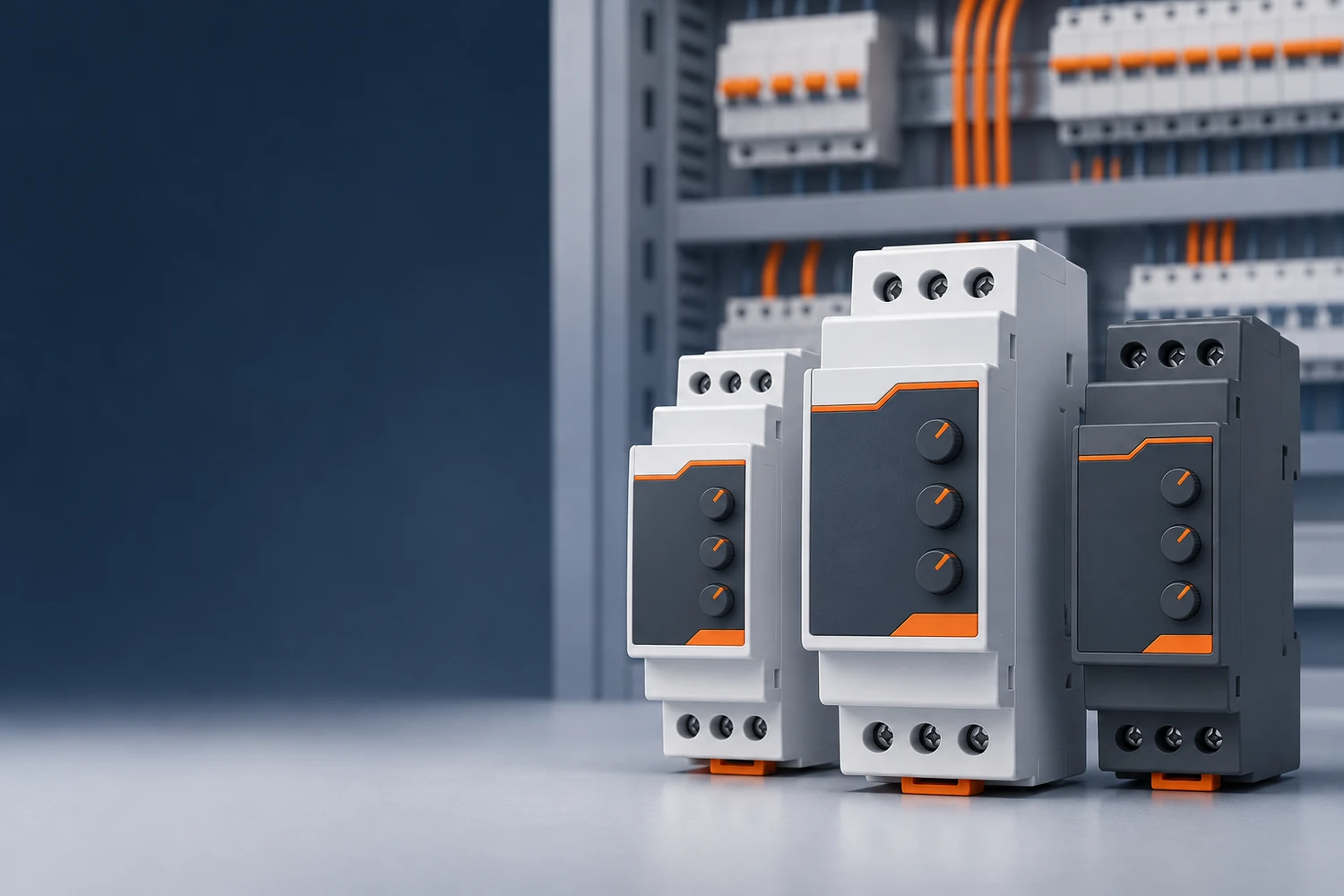
Application concept — illustrative equipment, not an installation drawing.
08 SELECTION WORKFLOW
Record AC or DC, nominal voltage, frequency and network conductors. Confirm the exact measurement point and any available neutral.
List undervoltage, overvoltage, phase loss, sequence and imbalance requirements separately. Avoid ordering a function by category name alone.
Use equipment limits and the engineering specification to define acceptable settings. Do not apply one generic percentage to every installation.
Review startup conditions, short supply dips, fault response and recovery timing. Confirm which timing parameter applies to each monitored function.
Check contact configuration and rated duty against the actual control circuit. Verify whether an interposing device is required.
Review the exact datasheet, dimensions, operating sequence and installation instructions. Agree on documentation and sample acceptance before bulk supply.
09 THRESHOLDS AND TIMING
Time delay and hysteresis solve different problems. A delay can help distinguish a qualifying event from a brief fluctuation where the device supports that behavior. Hysteresis separates the operate and return conditions, reducing repeated switching near a threshold. Neither parameter should be selected without considering the controlled equipment.
Check whether delay is provided at power-up, fault detection, output release or recovery. These terms describe different parts of the sequence. Where a compressor, process or machine requires controlled restart, evaluate the complete control logic rather than relying on a single relay setting.
10 PROTECTION COORDINATION
Detects specified voltage or phase conditions and operates its control output. It does not regulate or stabilize the incoming supply.
Performs the selected switching duty when commanded by the control circuit. Its ratings and coil requirements must match the application.
Overload, short-circuit and surge protection address different events. Select and coordinate the required devices separately; voltage supervision does not replace them.
11 INSTALLATION REVIEW
Have a qualified electrical professional verify the design and install the selected device according to its manufacturer’s instructions and applicable local requirements. Use only the terminal diagram for the exact ordered reference. Similar-looking housings may use different connections or operating principles.
Review enclosure protection, pollution conditions, condensation, ventilation, mounting position and clearance. Confirm conductor sizes, terminal torque and upstream protection from the installation documentation. Do not assume that a relay intended for a protected cabinet is suitable for direct outdoor exposure.
12 DOCUMENTATION
Ask for the monitoring range, auxiliary supply, supported functions, threshold adjustment, accuracy, response sequence and output ratings.
Request dimensional drawings, terminal identification, wiring instructions, mounting details and stated environmental limitations.
Confirm the applicable declarations, certificates or reports for your model and destination. A standard reference alone does not prove third-party certification.
13 EVALUATION
Before approving a sample, agree on the intended supply network, selected settings and expected output states. Ask your qualified test team to verify startup, specified fault response and recovery using a controlled procedure appropriate to the device. Do not create unsafe live faults in an operating installation.
Record the exact reference and settings with the test results. Compare enclosure dimensions, markings, terminal arrangement and documentation with the approved specification. For repeat orders, agree on identification and change notification so a later shipment can be checked against the same acceptance criteria.
14 PROCUREMENT
Include your application, network voltage and frequency, required monitoring functions, threshold preferences, timing requirements and control-output duty. Add panel space constraints, environment, destination country and the documents needed for your project.
For commercial planning, include sample quantity, expected order volume and requested delivery destination. If you need private labeling or packaging, describe those requirements separately. Availability, customization feasibility, minimum order quantities and lead times should be confirmed for the proposed reference.
Send your requirements15 FREQUENTLY ASKED QUESTIONS
No. It supervises specified electrical conditions and operates an output. Voltage regulation or power conditioning requires equipment intended for that function.
No. Voltage supervision and motor overload protection address different conditions. Evaluate both functions and the complete motor protection arrangement.
Do not treat a monitoring relay as a surge protective device. Surge protection requires appropriately selected devices and system coordination.
No. Check the exact model’s functions, calculation method and threshold. Three-phase measurement does not establish every possible phase protection function.
That depends on the selected relay and measurement arrangement. Confirm whether your system and device use three-wire or four-wire measurement.
Base them on the equipment’s permitted operating conditions and engineering specification, within the relay’s documented adjustment limits.
It separates operate and return conditions. Check the model’s definition and value to understand when the output can recover after a fault.
Not necessarily. Power-up, fault and recovery delays may be separate parameters. Read the operating sequence for your chosen device.
Do not assume it can. Compare the output’s documented duty with the control circuit and use coordinated switching equipment where required.
Only if the exact device explicitly supports the required DC measurement and operating supply. Otherwise select a suitable DC monitor.
It can provide an interlock in a properly designed circuit. The complete control arrangement must prevent operation when sequence is unacceptable.
The relay’s output recovery and the machine’s restart behavior are separate issues. Design restart logic for the equipment and application.
Verify the stated environment and enclosure requirements. Cabinet-mounted devices must not be assumed weatherproof or condensation resistant.
Ask for documents covering the exact model, applicable product scope and destination market. Verify issuer and document details where relevant.
Provide supply details, functions, settings, timing, output duty, environment, quantity and destination. Include any labeling and documentation requirements.
16 TECHNICAL REFERENCES
For general background, review Eaton’s voltage monitoring overview and Schneider Electric’s model-specific fault-response explanation. These sources explain category principles; their model ratings and timings are not BDDKG product specifications.
17 RELATED PRODUCT SELECTION
Review the contactor, motor overload device, short-circuit protective device and surge protection arrangement as part of the same panel design. Share the control circuit requirements when requesting support so that voltage supervision can be evaluated alongside the other protection and switching functions.
Discuss panel coordination18 FINAL ENQUIRY
Tell BDDKG what you need to monitor, how the equipment should respond and where it will be installed. Request confirmation of the suitable reference, available functions and supporting documentation before finalizing your order.
Contact BDDKG