A knife switch and a circuit breaker can both open a circuit, but they do not automatically provide the same functions. A plain knife switch is manually operated and has no automatic overcurrent trip. A suitable circuit breaker detects specified overcurrent conditions and interrupts the circuit. Your design may need both devices.
The useful comparison is between the tasks your circuit requires: switching, isolation and protection. Blade shape, handle size and price do not establish those capabilities.
What each device does
A knife switch uses a moving blade and fixed contacts. Depending on its documented design, it may serve as a no-load disconnector, a load-switching device or part of a fuse-combination assembly. These are different capabilities, even when the products look similar.
A circuit breaker combines contacts with a trip mechanism. Its protection depends on the installed trip unit, settings, current rating and interrupting rating. Do not assume that every breaker provides residual-current, arc-fault or every other protective function.
Schneider Electric’s comparison of an ACB and switch-disconnector explains why protection and switching products cannot be treated as interchangeable merely because they share a frame family.
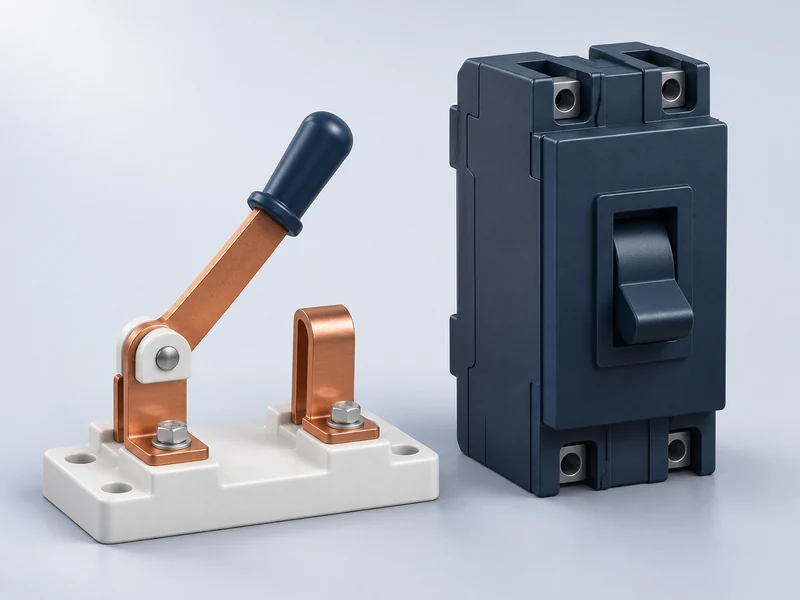
Knife switch vs circuit breaker: practical comparison
| Selection issue | Plain non-fused knife switch | Circuit breaker |
|---|---|---|
| Normal operation | Manual operation within documented duty | Manual operation within documented switching duty |
| Overload or short-circuit response | No automatic trip; separate protection needed | Automatic trip within its specified characteristics |
| Isolation | Only if the device is suitable for isolation | Only if its documented isolation suitability meets the requirement |
| Fault interruption | Not established by blade size or ampere rating | Specified by the applicable interrupting ratings |
| After a protective operation | Inspect the protected equipment and switch as required | Identify and correct the cause; inspect before resetting as required |
| Best procurement question | What can this switch make, carry and break? | What faults can this breaker clear, at what voltage and settings? |
A fused knife switch changes the protection column because its fuses can interrupt specified overcurrents. That is protection provided by the coordinated fuses, not an automatic trip mechanism in the blade.

Does a visible blade gap prove the equipment is safe?
No. A visible opening helps identify the physical state of that switching path, but it does not exclude another source, stored energy or a wiring error. An OFF handle on a breaker is also insufficient by itself to declare equipment safe for work.
For US workplaces, OSHA 1910.333 requires appropriate verification of the deenergized condition by a qualified person, including checking for backfeed. Other markets have their own applicable requirements. Device selection must support the site’s isolation and energy-control procedure.

When should you specify a switch, a breaker or both?
- Specify appropriate circuit protection when an overload or short circuit must be cleared automatically.
- Consider a suitable local isolating device when maintenance needs a secured isolation point.
- Use a load-rated device when normal operation requires opening a connected load.
- Consider a documented fused switch assembly when its protection characteristics and maintenance arrangement suit the design.
- Check whether a suitably rated breaker can meet the required isolation and switching tasks before adding another device.
For example, a machine feeder may already have an upstream protective breaker while requiring a local, lockable isolation point. A correctly selected non-fused switch can serve the second task if the complete design permits it. Conversely, replacing the feeder breaker with a plain blade switch would remove automatic fault protection.

Compare the complete specification, not the purchase price
Ask for the fault level, protection settings or fuse details, operational duty, isolation suitability and installation conditions. Include enclosure and accessory costs, replacement parts, inspection access and the operating procedure. A cheaper component can create a more expensive or incomplete installation when the supporting equipment is omitted.
For project planning, compare the knife switch configurations with the required protection design. The isolator switch vs circuit breaker guide covers the broader functional distinction, while the knife switch overview explains blade configurations.
Frequently asked questions
Can I replace a circuit breaker with a knife switch?
Not as a like-for-like replacement when the breaker supplies required automatic protection. A redesign would need another suitable protective device and verification of switching, isolation and fault coordination.
Does a knife switch protect against short circuits?
A plain non-fused knife switch does not interrupt short circuits automatically. A suitable fuse-combination assembly can provide protection through its specified fuses; its complete coordination conditions still apply.
Can a circuit breaker be used as an isolator?
Some breakers are suitable for isolation. Verify the exact device’s documented suitability, locking provisions and the applicable installation requirements rather than assuming that any OFF handle is sufficient.
Which is safer: a knife switch or a circuit breaker?
Safety depends on matching the device to the task and installation. Automatic fault protection, guarded operation and verified isolation are separate requirements. Neither device name guarantees that all three are satisfied.