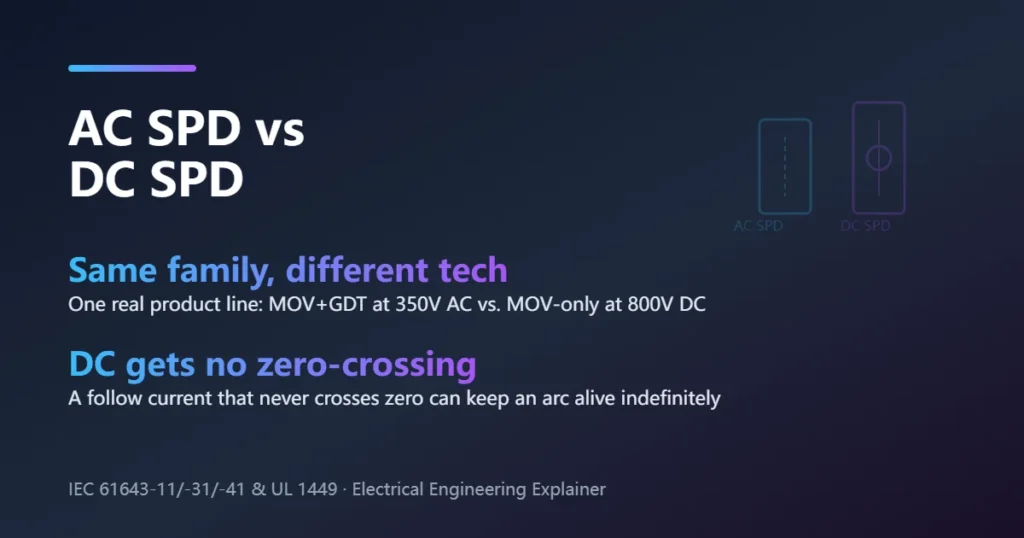
Pull the datasheets for a surge protective device family sold in both AC and DC versions, and the two parts don't just carry different voltage numbers — they can use different internal technology entirely. Schneider Electric's Acti9 iPRD line is a real example: the AC unit combines a metal oxide varistor (MOV) with a gas discharge tube (GDT); the DC/PV sibling in the same product family drops the GDT and runs MOV-only, at more than double the AC unit's voltage rating.
That's not a coincidence of scale. It's the same underlying physics that splits AC and DC fuse ratings — covered in our companion piece on why the same fuse body carries two different ratings — showing up again in a different component. This guide covers what actually changes between an AC-rated and a DC-rated SPD, why an SPD's AC voltage rating tells you nothing about its DC capability, and which standards govern each — including a brand-new one that arrived in 2025 specifically for DC systems that aren't solar.
Key Takeaways
- Same product family, different internal technology. Schneider Electric's Acti9 iPRD (AC, part A9L40501) pairs an MOV with a GDT at a 350V AC continuous operating voltage (Uc); the Acti9 iPRD PV-DC sibling (DC, part A9L40271) is MOV-only at 800V DC.
- AC current crosses zero roughly 100-120 times a second (at 50-60 Hz), which helps a GDT-based SPD stop conducting once a surge passes. DC current never crosses zero, so an unmanaged GDT left conducting on a DC circuit has nothing to help it stop.
- A new IEC standard for general-purpose DC SPDs arrived in May 2025. IEC 61643-41:2025 covers battery storage, EV, telecom, and DC microgrid surge protection up to 1,500 V DC — separate from the existing solar-specific IEC 61643-31.
- UL 1449, the North American SPD standard, was revised again on October 21, 2025, adding a new Type 5 discrete-component category and damp-location requirements.
- The global SPD market was valued at $2.98 billion in 2025 and is projected to reach $3.95 billion by 2030, a 5.8% CAGR.
Quick Comparison
| AC SPD | DC SPD | |
|---|---|---|
| What it has to stop conducting | A transient superimposed on current that crosses zero 100-120 times/sec (50-60 Hz) | A transient superimposed on current with no natural zero-crossing to help |
| Follow-current risk | A GDT stage can rely on the next zero-crossing to self-extinguish after conducting | A GDT with no dedicated DC disconnection design can keep conducting indefinitely once triggered |
| Same family, different tech? | Often pairs an MOV with a GDT stage | The DC/PV sibling in the same family often drops the GDT and runs MOV-only, at a materially different Uc |
| Governing standard | IEC 61643-11:2025 (general AC, ≤1,000V); UL 1449 Ed. 5 | IEC 61643-31:2018 (PV, ≤1,500V DC); IEC 61643-41:2025 (new — general DC, ≤1,500V DC, non-PV); UL 1449 Ed. 5 (also covers PV DC) |
| Typical application | Service panels, Type 1/2/3 locations per NEC 230.67 | PV combiner boxes and inverter DC inputs, battery energy storage, EV DC bus, -48V DC telecom plants |
| Backup overcurrent device | AC-rated breakers and gG fuses | DC/PV-rated fuse or breaker family sized for the DC application |
| Can one replace the other? | No | No |
| Our take | Use only within its listed AC Uc and let-through rating | Spec the DC/PV-specific category — never substitute the AC-rated equivalent |
What Is an AC SPD?
An AC SPD is designed and listed to divert a transient overvoltage on a circuit whose current naturally crosses zero volts every half-cycle — and that zero-crossing helps certain SPD technologies stop conducting once the transient has passed. At 50 Hz that's 100 crossings a second; at 60 Hz, 120. A common design pairs a fast-clamping MOV with a gas discharge tube (GDT), a spark-gap component that can carry very high surge currents; once a GDT ionizes and starts conducting, the next current zero-crossing gives it a real chance to de-ionize and stop.
This is the job covered by IEC 61643-11, the general standard for surge protective devices connected to AC low-voltage power systems up to 1,000 V RMS at 50/60 Hz, and by UL 1449 in North America. Schneider Electric's Acti9 iPRD (part A9L40501) is a documented example: its datasheet lists a 350 V AC maximum continuous operating voltage (Uc) with an MOV-plus-GDT construction, tested to EN 61643-11:2012 / IEC 61643-11:2011, and its listed backup protection is drawn from AC-rated devices — iC60H and NG125 circuit breakers, or gG fuses .
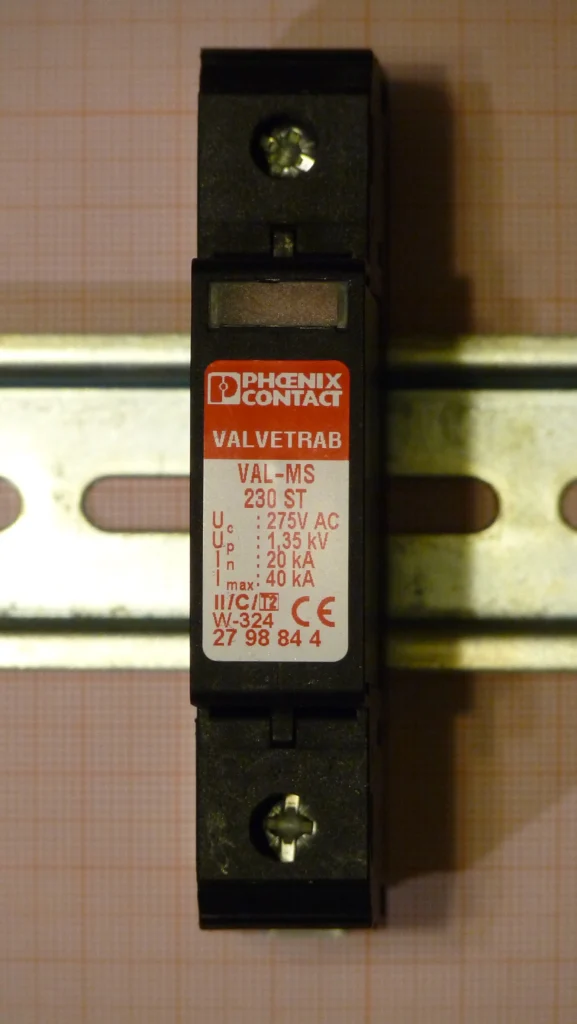
A DIN-rail AC surge arrester with its rating label clearly visible — Uc: 275V AC, Type 2 (II/C/T2). The Uc figure is specific to AC service; it doesn't transfer to a DC circuit.
Verdict: An AC SPD's Uc and follow-current handling assume the current it's protecting gets a natural assist from zero-crossing — a DC circuit never gives it that assist.
What Is a DC SPD?
A DC SPD has to stop conducting with no zero-crossing to help — so DC-rated designs frequently avoid a GDT-only construction, or pair it with a dedicated DC disconnection mechanism, rather than relying on the AC-style assumption that the next half-cycle will finish the job. The Acti9 iPRD PV-DC (part A9L40271) — the DC/PV sibling of the AC unit above, from the same manufacturer and product platform — documents this directly: its datasheet lists an 800 V DC Uc using MOV technology only, no GDT stage, tested to EN 50539-11:2013.
That DC-specific coverage comes from a different standards branch than the AC side. IEC 61643-31 (Edition 1.0, 2018, with a 2022 corrigendum) sets requirements for SPDs protecting photovoltaic installations up to 1,500 V DC — though it explicitly excludes PV systems paired with battery or capacitor energy storage. That gap is exactly what IEC 61643-41 (Edition 1.0, published May 23, 2025) was written to close: a new standard for SPDs on general low-voltage DC systems — battery energy storage, EV charging, telecom -48V DC plants, and DC microgrids — also up to 1,500 V DC, meant to be used alongside the new common-requirements part IEC 61643-01 (published December 20, 2024). In North America, UL 1449 Edition 5 already covers PV applications up to 1,500 V DC within the same standard that governs AC SPDs.
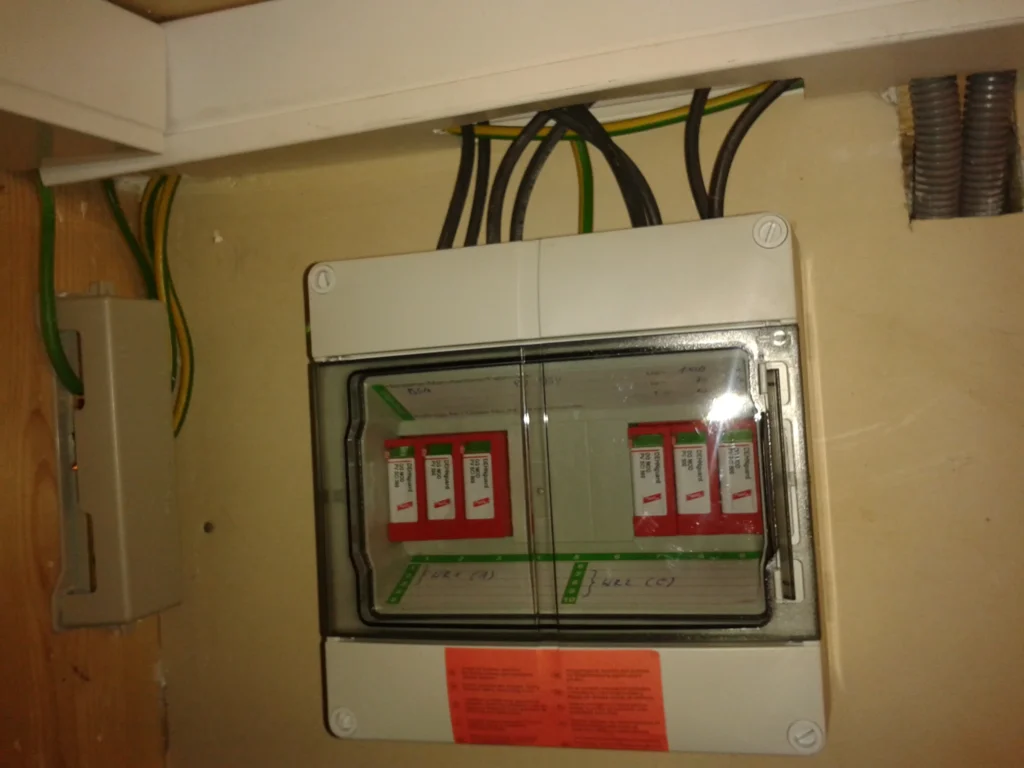
A DC-side surge protection enclosure on a PV installation — DEHNguard PV modules rated for the array's DC voltage, not the inverter's downstream AC output.
Verdict: A DC SPD's job isn't "the same clamping at a higher voltage" — it's a different follow-current problem that the standard and the product design account for, whether through component choice or an added disconnection stage.
The Core Difference: Why DC Follow-Current Is Harder to Stop
The one-line version: AC gets a free assist from physics 100+ times a second, and DC gets none of it. Once a GDT ionizes to carry a surge, it doesn't necessarily stop conducting the instant the transient ends — a small "follow current" from the circuit's own supply can keep flowing through the ionized gas. On an AC circuit, that follow current is already heading toward a zero crossing on its own schedule, giving the GDT a real chance to de-ionize and open. On a DC circuit, there's no schedule to lean on: the follow current can keep flowing indefinitely unless something else — different component technology, or an added disconnection stage — interrupts it. Left unmanaged, that's an overheating and fire risk, not a clean surge-protection event.
MOV-based clamping doesn't have this specific problem, because an MOV's conduction is voltage-triggered rather than dependent on a subsequent current interruption — which is a plausible reason DC-rated SPD designs like the Acti9 iPRD PV-DC lean on MOV-only construction rather than pairing a GDT the way the AC unit does. That said, this is our own reading of the documented component difference between the two Schneider datasheets, not a claim any single source states outright — treat it as informed technical reasoning, not a quoted standard.
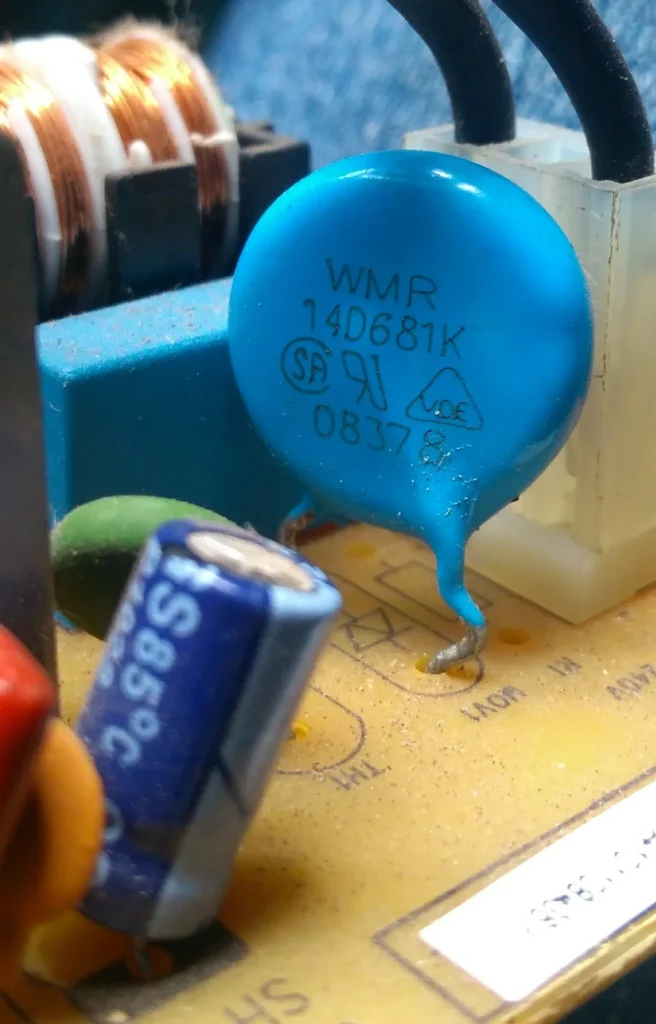
A metal oxide varistor (MOV) — the voltage-triggered clamping component both AC and DC SPD designs rely on. The follow-current problem specifically concerns gas-discharge-tube (spark-gap) stages, not the MOV itself.
A lot of vendor content on this topic repeats a blanket rule — "never use an AC-rated SPD on a DC circuit" — without pointing to a datasheet that shows why. That rule is correct, but the useful version of it is checking the specific product's own Uc and component technology rather than trusting a generic warning. The Acti9 iPRD pair is a case where the manufacturer's own documentation makes the difference concrete: same platform name, different Uc, different internal technology, different governing standard.
Verdict: If you're evaluating an SPD for DC service, check its own DC-specific Uc and construction on its own datasheet — an AC voltage rating on the same or a similarly named product doesn't tell you anything about its DC capability.
Same Family, Two Ratings — In the Manufacturer's Own Numbers
Verdict: When a product family spans AC and DC versions, the DC-rated sibling is a different design, not the AC unit with a bigger number on the label.
The Standards That Govern Each
AC and DC SPDs sit under a fast-moving set of IEC and UL standard parts, and the DC side specifically has been expanding. Internationally, IEC 61643-11 (Ed. 2.0, June 2025) covers general AC low-voltage SPDs up to 1,000 V RMS. On the DC side, IEC 61643-31 (2018, PV-specific, up to 1,500 V DC) has now been joined by IEC 61643-41 (May 2025, general DC — BESS, EV, telecom, microgrids, also up to 1,500 V DC), both meant to be read alongside the new common-requirements part IEC 61643-01 (December 2024).
In North America, UL 1449 plays the consolidated role: Edition 5 covers 50/60 Hz AC circuits up to 1,000 V and PV applications up to 1,500 V DC within a single standard, and its October 21, 2025 revision added a new Type 5 discrete-component surge-suppressor category plus damp-location requirements.20182020202220242026PV DCIEC 61643-31 (2018)AC + PV DCUL 1449 Ed. 5 (2021)GeneralIEC 61643-01(Dec 2024)DC (new)non-PVIEC 61643-41(May 2025)ACIEC 61643-11 Ed. 2(Jun 2025)AC + PV DCUL 1449 revision(Oct 2025)IEC 61643-31, -01, -41, -11 Ed.2 (IEC Webstore); UL 1449 Ed. 5 and its Oct. 2025 revision (ANSI Webstore). Retrieved 2026-09-09.IEC 61643-41, published May 2025, is the first standard written specifically for general-purpose low-voltage DC SPDs — battery storage, EV, telecom, and microgrids — distinct from the solar-only IEC 61643-31.
Verdict: Match the standard to the application, not just the voltage — a DC SPD compliant with IEC 61643-31 is built and tested for PV strings, and a battery-storage or EV DC bus now has its own separate standard to check against instead.
Where DC SPD Demand Is Growing
Surge protection used to be an AC-panel concern almost by default; DC-side demand is now growing fast enough that it pushed regulators to write an entirely new standard in 2025. A few segments are driving that shift:
- Solar PV strings and inverters. Every combiner box and inverter DC input needs surge protection sized for the array's DC voltage, under IEC 61643-31's PV-specific category or the equivalent section of UL 1449 — not a general AC-rated unit.
- Battery energy storage systems (BESS) and EV charging. IEC 61643-41's May 2025 publication exists because this segment needed its own dedicated coverage rather than borrowing scope from the PV-only standard.
- Telecom -48V DC plants. A long-standing but often overlooked DC application — central-office and cell-site power systems have run DC SPDs for decades, independent of the recent PV and BESS growth.
That demand shows up in the broader SPD market. The global surge protective device market — spanning AC and DC segments — was valued at $2.98 billion in 2025 and is projected to reach $3.95 billion by 2030, a 5.8% compound annual growth rate.
Verdict: If you're specifying SPDs for solar, storage, or EV work, expect DC-specific standards to keep getting more detailed — IEC 61643-41 is unlikely to be the last new part added.
How to Choose: A Practical Checklist
Work through these in order rather than assuming an SPD's AC rating tells you anything about its DC capability:
- Identify whether the circuit is genuinely AC or DC. A DC bus fed from a rectified AC source, a battery, or a PV array is still a DC circuit for SPD-selection purposes — the upstream source doesn't matter.
- Pull the SPD's own DC-specific Uc from its datasheet, not the AC unit's number from the same product family. As the Acti9 iPRD example shows, the two versions can differ substantially — and use different internal technology.
- Match the application to its governing standard: IEC 61643-31 (or UL 1449's PV section) for solar strings, IEC 61643-41 for battery storage/EV/telecom/microgrid DC systems, IEC 61643-11 (or UL 1449's general section) for AC circuits.
- Check the backup overcurrent device is rated for the same circuit type. An SPD's backup fuse or breaker needs to be drawn from the AC or DC family appropriate to the circuit — the same AC/DC distinction that governs fuse selection generally.
Frequently Asked Questions
Can I use an AC-rated SPD in a DC circuit?
Not at its AC voltage rating. An AC SPD's Uc and any GDT-based follow-current handling are proven against current that naturally crosses zero and helps the device stop conducting; a DC circuit gives it no such assist. Use a product specifically rated and listed for DC service.
What's actually different about a DC SPD's construction?
It varies by manufacturer and part, but a documented example is Schneider Electric's Acti9 iPRD family: the AC version pairs an MOV with a GDT, while the DC/PV version in the same product line is MOV-only. Check the specific product's own datasheet rather than assuming a fixed rule.
Do solar PV systems need DC-specific SPDs?
Yes. PV strings and inverter DC inputs need SPDs rated and tested under IEC 61643-31 (or the PV section of UL 1449) for the array's actual DC voltage, not a general-purpose AC unit.
What standard covers DC SPDs for battery storage and EV charging?
IEC 61643-41, a First Edition standard published May 23, 2025, covers general low-voltage DC SPDs — including battery energy storage, EV charging, telecom, and DC microgrids — up to 1,500 V DC, separate from the PV-specific IEC 61643-31.
Conclusion
An AC SPD and a DC SPD can share a product family name and still be built to do two genuinely different jobs. AC current's natural zero-crossing gives certain SPD technologies — particularly GDT stages — a real assist in stopping conduction after a surge; DC current gives them none, which is exactly why DC-specific standards keep expanding as their own category rather than a simple voltage relabeling: IEC 61643-31 for solar since 2018, and now IEC 61643-41 for general DC systems as of May 2025.
The practical takeaway: check an SPD's own DC-specific Uc and construction on its own datasheet before specifying it for a DC application, the way the Acti9 iPRD family's two datasheets make concrete — same platform, different technology, different standard.