"Busbar" and "busway" show up in the same conversation so often that people start treating them as two competing products — pick one, install it, move on. They're not competitors. A busbar is a physical thing: a flat, rigid bar of copper or aluminum that carries current. A busway is a complete, enclosed, factory-built product that happens to have busbars inside it. Asking "busbar or busway" is a bit like asking "wire or extension cord" — one is a raw material, the other is an engineered assembly built around it.
This guide untangles what each term actually refers to, which standards govern them (they're different ones, on purpose), and the practical question that actually matters when you're speccing a job: where does bare busbar make sense, and where does a busway system save you money and callbacks.
Key Takeaways
- A busbar is a conductor — a bare or insulated flat bar, rod, or tube of copper or aluminum. It's a component, not a product on its own.
- A busway is a complete enclosed system — factory-assembled busbars inside a grounded metal housing, built to plug together in standardized lengths with tap-off points along the run.
- They're governed by different standards on purpose: internal switchgear busbars fall under IEC 61439-1 (or UL 891 in North America); busway/busbar trunking systems fall under IEC 61439-6 and UL 857.
- NEC Article 100 defines busway as a raceway built around a grounded metal enclosure that houses factory-installed, bare or insulated copper or aluminum conductors — the enclosure is what turns a busbar into a busway.
- The global busbar trunking system market was valued at $3.2 billion in 2025 and is projected to reach $7.4 billion by 2034, a 9.6% CAGR — separate market tracking that reflects how distinct the two categories are.
Quick Comparison
| Busbar | Busway | |
|---|---|---|
| What it is | A bare or insulated conductor: a flat bar, rod, or tube | A complete enclosed system: busbars + grounded metal housing + fittings |
| Governing standard | IEC 61439-1 (assemblies); UL 891 in North America | IEC 61439-6 (busbar trunking systems); UL 857 in North America |
| Where it's used | Inside switchgear, panelboards, and custom enclosures | Building-wide feeders, risers, and branch runs between panels |
| How it's installed | Cut, drilled, and bolted to fit a specific enclosure on site or in a panel shop | Bolted together from standardized, factory-tested sections with plug-in tap-off points |
| Typical run length | Short — sized to the panel or switchgear it lives in | Long — designed to run continuously through a building, often hundreds of feet |
| Our take | Right choice for custom internal connections inside an enclosure | Right choice for distributing power across a facility without pulling conduit and cable |
What Is a Busbar?
A busbar is a rigid conductor — a flat bar, rod, or tube, usually copper or aluminum — used to carry and distribute current inside an electrical enclosure. It's not a product you install as a standalone item; it's a component that gets cut to length, drilled, bent, and bolted into place inside switchgear, a panelboard, or a custom enclosure.
Internal switchgear and panelboard busbars are covered by IEC 61439-1 internationally (the foundational standard for low-voltage switchgear and controlgear assemblies) or UL 891 in North America for switchboards. The busbar itself isn't separately certified — its rating is verified as part of the complete assembly it's installed in, which is why two panels with identical busbar material can carry very different official ratings depending on how the rest of the enclosure is built and tested.
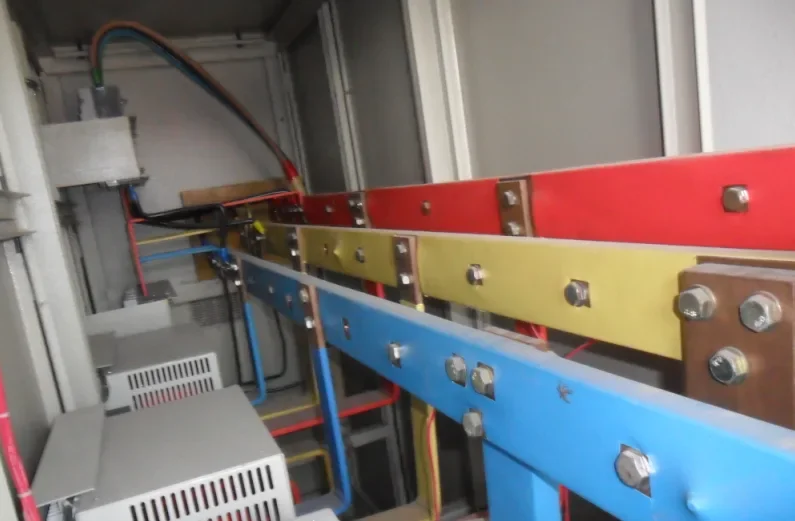
Color-coded copper busbars (red, yellow, blue — standard three-phase color coding) bolted inside an LT panel. Each bar is cut and drilled to fit this specific enclosure; it isn't a separately certified product.
Verdict: A busbar is raw conductor material shaped to fit one specific enclosure — its performance is only as good as the assembly it's bolted into.
What Is a Busway?
A busway is a complete, factory-built power distribution system: busbars sealed inside a grounded metal enclosure, manufactured in standardized sections that bolt together on site. NEC Article 100 defines it plainly as a raceway built around a grounded metal enclosure housing factory-installed conductors — bare or insulated, typically copper or aluminum bars, rods, or tubes.
That enclosure is the entire point. Unlike a busbar cut to fit one panel, a busway section is a tested, listed product designed to connect to identical sections indefinitely — run it straight down a hallway, up a riser shaft, or across a data center ceiling, adding plug-in tap-off units wherever a branch circuit needs to come off the run. Internationally, busway is called a busbar trunking system, governed by IEC 61439-6, which "defines service conditions, construction requirements, technical characteristics and verification requirements" specifically for this product category — separate from the general assembly standard that covers panel busbars. In North America, busway must be listed to UL 857.
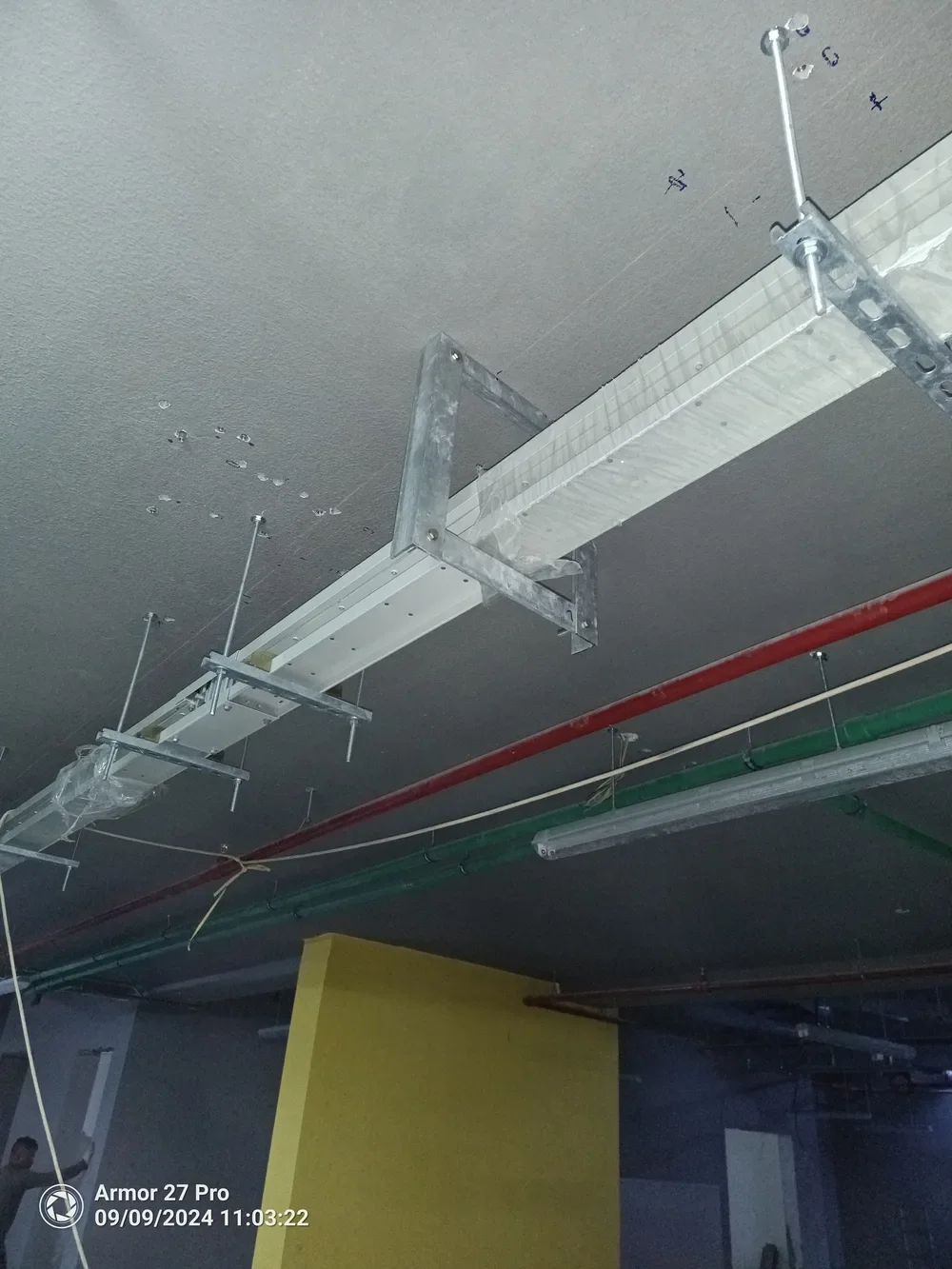
A busway section suspended from ceiling hangers during construction. Unlike a panel's internal busbar, this is a complete, factory-tested product designed to run continuously and accept plug-in tap-offs along its length.
Verdict: A busway is the finished product; the busbars inside it are just one component of a system that's tested and listed as a whole.
The Core Difference: Component vs System
The one-line version: a busbar is what you build with; a busway is what arrives already built. That distinction drives almost everything else — cost, labor, flexibility, and how each one gets specified.
- A busbar is a material. A panel builder buys stock lengths of copper or aluminum bar, then cuts, drills, plates, and bends it to fit whatever enclosure it's going into. The finished result is only as good as the fabrication and the assembly's own certification.
- A busway is a product. A manufacturer designs, builds, and tests complete sections — straight lengths, elbows, tap-off units, end feeds — as a certified system. An installer bolts sections together on site; nobody is fabricating custom conductors in the field.
The busbar-vs-busway question quietly disappears once you notice that busway contains busbars — it's never "busbar or busway" for the same job, because a busway's internal conductors are still, technically, busbars. The real question is whether you need a custom-fabricated internal connection (busbar, on its own) or a pre-engineered distribution run (busway, which already includes busbar as one of its components).
This is also why the two live under different certification paths. A busbar's rating is only meaningful in the context of the specific assembly it's tested inside (IEC 61439-1 / UL 891). A busway section is rated and listed on its own, independent of any specific building it ends up in (IEC 61439-6 / UL 857) — because it has to work identically whether it's installed in a hospital, a data center, or a parking garage.
Verdict: If you're fabricating a custom internal connection for one enclosure, you're specifying busbar. If you're distributing power continuously across a building, you're specifying a busway system.
Can You Use Busbar Instead of a Busway?
For short, one-off internal connections, yes — that's literally what busbar is for. For a long building-wide run, no — that's re-inventing a certified product from scratch, and it usually costs more, not less. Every panel and switchgear assembly already relies on busbar for its internal connections; there's no busway involved at that scale, and there shouldn't be.
The calculation flips once the run gets long or needs to branch. Building a multi-hundred-foot power feeder out of raw busbar means field-fabricating and bolting every joint, individually supporting the bare or custom-enclosed conductor along its entire length, and getting the whole thing inspected and approved as a one-off assembly — with none of the standardized, pre-tested joints a busway ships with. NEC Article 368 covers busway installation specifically because the code recognizes it as a distinct wiring method from ordinary busbar-in-an-enclosure work, with its own support spacing, overcurrent protection, and fitting rules — down to specifics like exactly when a reduced-ampacity section needs its own overcurrent device.
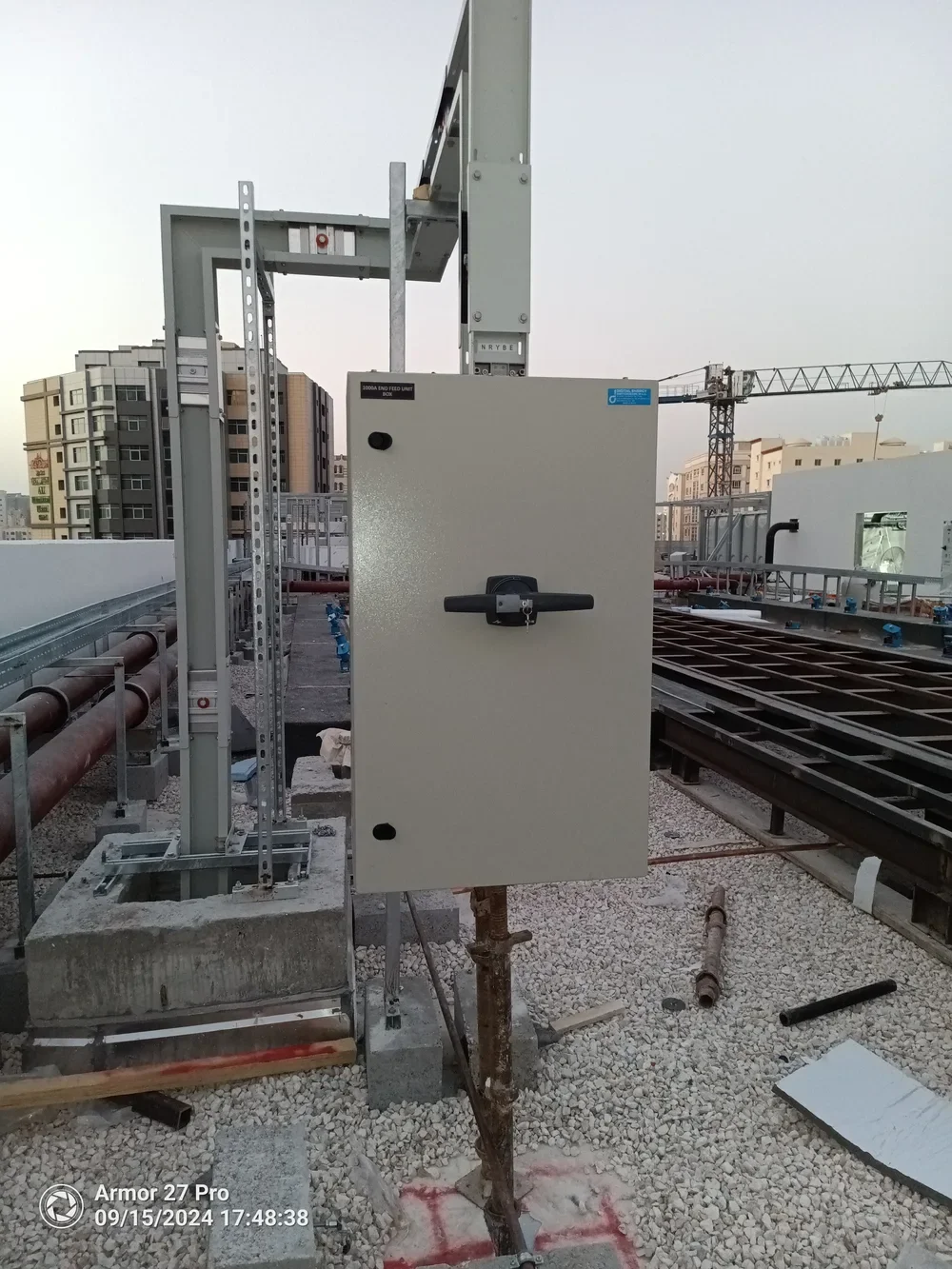
A busway end-feed unit on a rooftop, where the enclosed trunking run (visible on the elevated supports) continues to distribute power across the building — the kind of long, branching run busbar alone isn't practical for.
Verdict: Busbar for the connections inside one box; busway for the run between boxes. Trying to make one do the other's job usually costs more in labor than it saves in material.
Where You'll Find Both Together
A real building's power distribution almost always uses both — busbar inside every panel, and busway (where distances or loads justify it) connecting panels together. A few common patterns:
- Switchgear and panelboards. Every distribution panel, MCC, or switchboard uses internal busbar to tie its breakers, disconnects, and terminals together — this is universal and doesn't involve busway at all.
- High-rise and data center risers. Vertical busway runs are common where a building needs to carry large currents up multiple floors without pulling and terminating individual conductors floor by floor — each floor taps off the riser through a plug-in unit.
- Long horizontal feeders. Busway is frequently chosen over cable-and-conduit for long runs feeding multiple downstream loads (a factory floor, a row of data center racks), specifically because tap-off points can be added or relocated without re-pulling cable.
That distinction shows up in how the industry tracks these products, too. The busbar trunking system (busway) market was valued at roughly $2.9 billion in 2024 and is projected to grow to $3.2 billion in 2025, reaching $7.4 billion by 2034 at a 9.6% CAGR. Panel-internal busbar isn't tracked as its own market at all — it's a raw material input to the switchgear and panelboard markets, not a standalone product category, which itself underlines how different the two really are.
Verdict: The question in a real project is rarely "busbar or busway" — it's "how much of this job is inside one box, and how much is between boxes."
How to Choose: A Practical Checklist
Work through these in order rather than defaulting to whatever your panel shop or distributor stocks most of:
- Is this connection entirely inside one enclosure? If yes, that's busbar — fabricated and bolted to fit that specific panel or switchgear assembly, certified as part of it.
- Does power need to travel a long, continuous distance between enclosures — up a riser, across a floor, along a production line? If yes, that's a busway candidate, not a field-fabricated busbar run.
- Will branch circuits need to tap off at multiple points along the run, now or in a future expansion? If yes, busway's plug-in tap-off units make that trivial; a cable-and-conduit or bare-busbar run doesn't.
- Check the enclosure rating against the installation environment. As a general pattern across manufacturers, plug-in busway (with tap-off openings along its length) commonly tops out around IP54, while feeder busway without those openings can often reach a higher IP65 — but ratings vary by product line, so verify the specific enclosure's rating against the actual installation environment (indoor, exposed, or wet location) before specifying.
Frequently Asked Questions
Is busway the same thing as busbar trunking?
Yes. "Busway" is the North American term (governed by UL 857); "busbar trunking system" is the equivalent term used internationally under IEC 61439-6. They describe the identical product category — enclosed, factory-built busbar systems for power distribution.
Can I use busbar instead of installing a busway?
For a connection entirely inside one panel or switchgear enclosure, yes — that's exactly what busbar is designed for. For a long run between panels or floors, field-fabricating an equivalent out of raw busbar means giving up the standardized joints, support spacing, and independent certification a busway ships with, usually at a labor cost that outweighs any material savings.
Does a busway need overcurrent protection like a busbar-fed panel does?
Yes. NEC Article 368 requires overcurrent protection sized to the busway's ampacity, with a specific exception: in industrial establishments, a reduced-ampacity section of busway doesn't need its own additional overcurrent device if it's no longer than 50 feet (15 meters) and rated at least one-third of the upstream device's rating.
What's the difference between plug-in and feeder busway?
Plug-in busway has openings along its length where tap-off units can be inserted to feed branch circuits without cutting into the run; as a general pattern, that commonly limits it to around an IP54 rating. Feeder busway has no openings along its length — it's meant purely to carry power from one point to another — and can often reach a higher IP65 rating as a result, though exact ratings vary by manufacturer and product line, so check the specific datasheet before specifying.
Need Busbar or Busway Specified for a Job?
Whether you're fabricating custom busbar for a panel build or specifying a busway run for a riser or feeder, matching the right standard, rating, and enclosure to the actual installation avoids a rejected inspection later.
Conclusion
A busbar and a busway aren't two options for the same job — they're two different things that usually show up in the same building. The busbar is the conductor: cut, drilled, and bolted to fit one specific enclosure, its rating meaningful only in the context of that assembly under IEC 61439-1 or UL 891. The busway is the finished, independently certified product: busbars sealed inside a grounded enclosure, built in standardized sections under IEC 61439-6 or UL 857, designed to run continuously and accept tap-offs wherever a branch circuit needs one.
The practical takeaway: don't ask "busbar or busway" — ask whether the job is a custom connection inside one box (busbar) or a distribution run between boxes (busway). Most real installations need both, each doing the job it was actually built for.