DB most commonly stands for Distribution Board — the panel that takes one incoming electrical feed and splits it into multiple protected outgoing circuits. That's the answer on a panel schedule, a single-line diagram, or a site electrician's notes. But unlike most "full form" abbreviations, DB isn't a one-answer question: the same two letters are also the correct unit symbol for the decibel (written dB, not DB) in every electrical, acoustic, and telecom spec sheet, and they're the shell-size code stamped on the D-subminiature connectors better known as DB9 and DB25. All three meanings are genuinely electrical. None of them are the same thing.
This guide covers all three: what a distribution board actually does and how it differs from a plain junction box, why the decibel is correctly written "dB" and not "DB" (and why that capitalization isn't just pedantry), what DB9 and DB25 actually identify on a connector — including a mislabeling that's been repeated so often it's now the industry-standard name for the wrong part — and, briefly, the one well-known non-electrical place "DB" shows up.
Key Takeaways
- DB most often means Distribution Board — an enclosure that splits one incoming feed into multiple breaker- or fuse-protected outgoing circuits, called a panelboard or load center in North America and a consumer unit in UK domestic installations, and "DB box" internationally .
- DB is also the informal way people write dB, the decibel — a logarithmic unit for power and amplitude ratios used throughout electrical, telecom, and acoustic engineering. The technically correct symbol is lowercase-d, uppercase-B: dB, not DB.
- DB9 and DB25 are D-subminiature connector names, where the letter indicates shell size (A=15 pins, B=25, C=37, D=50, E=9) — meaning a genuine "DB" connector has 25 pins, and the ubiquitous 9-pin "DB9" serial connector is, technically, a DE-9.
- These three meanings never overlap in practice — context (a panel schedule vs. a spec sheet vs. a cable pinout) makes it obvious which "DB" is meant, but conflating them in a single explainer is exactly what most short abbreviation glossaries get wrong.
- Outside electrical work, DB is also the NYSE ticker for Deutsche Bank AG, a German multinational bank — unrelated to any electrical meaning.
What Does DB Stand For as a Distribution Board?
A distribution board (DB) takes one incoming power feed and splits it into multiple outgoing circuits, protecting each one individually with its own breaker or fuse. An incoming main switch or main breaker feeds a bus, which in turn feeds a bank of branch breakers — each breaker guarding one downstream circuit, so a fault on one circuit trips only that breaker instead of taking down everything fed from the board.

A real distribution board directory: this laminated diagram, taped inside the panel door of a tower-block DB, shows the incoming three-phase supply split through switches S1–S4, individually metered (KWh) for four apartments, and then further divided into numbered breaker circuits (F1–F9) for each unit's branch loads.
The naming varies by region even though the function doesn't: North America generally calls the same equipment a panelboard, breaker panel, or load center; UK domestic installations call it a consumer unit; and "DB box" is the common informal international shorthand. In the U.S., this equipment is governed by NEC Article 408, "Switchboards, Switchgear, and Panelboards" — a completely different code article from the one covering plain junction boxes, since a DB adds overcurrent protection a junction box never has. A companion post on this site works through that distinction — junction box, distribution box, and terminal box — in much more depth, including exactly which NEC article and IEC/UL standard governs each one and a documented safety case for not mixing them up.
Verdict: if a box splits one feed into several individually protected circuits, "DB" on the label almost always means Distribution Board — this is the dominant, default electrical reading of the abbreviation.
What Does DB Mean as a Unit of Measurement? (dB, the Decibel)
DB is also the informal, often-incorrect way of writing dB — the decibel, a logarithmic unit that expresses the ratio between two values of power or amplitude. It shows up constantly in electrical and telecom specifications: signal-to-noise ratio, amplifier gain, cable attenuation, antenna gain, and audio levels are all conventionally expressed in decibels rather than as raw ratios.
The reason engineers reach for a logarithmic unit instead of a plain ratio is practical: a 100,000:1 power ratio is unwieldy to write and compare, but the same ratio is just 50 dB — and because the scale is logarithmic, gains and losses along a signal chain can be added and subtracted instead of multiplied and divided, which is far easier to do by hand or at a glance on a spec sheet.

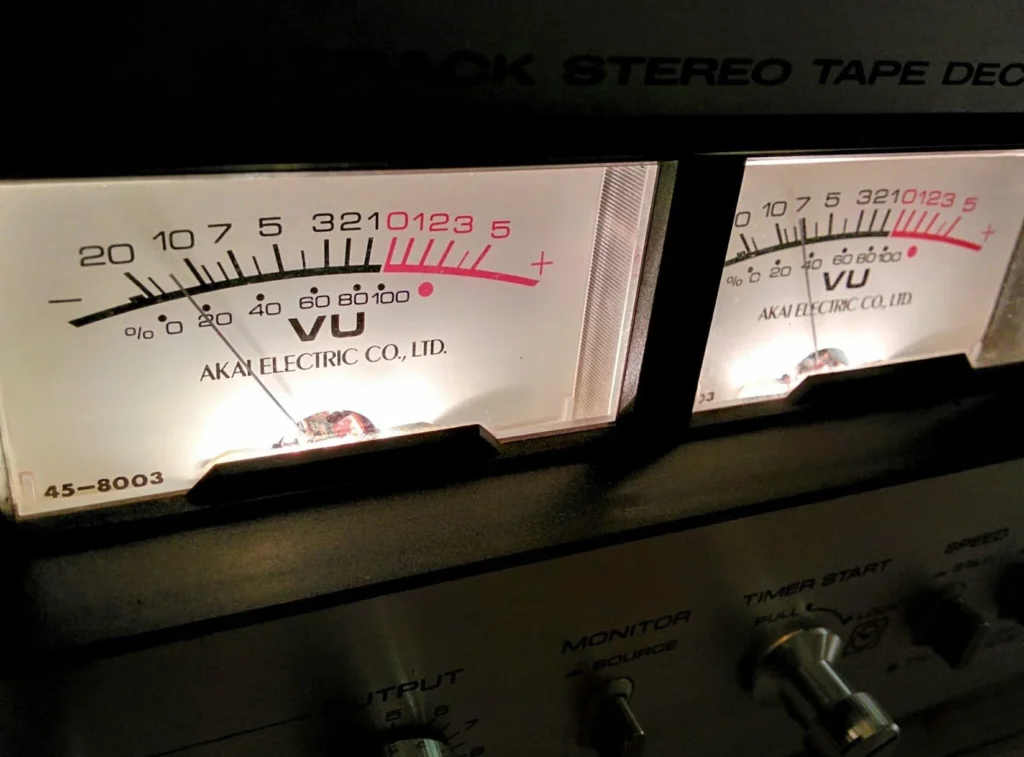
A real analog VU meter, scaled in decibel-referenced steps from -20 to +5 — the kind of physical dial where a "dB" reading is a live, moving measurement, not just a number printed on a spec sheet.
The correct symbol is dB — lowercase d, capital B — not "DB." The lowercase "d" is the SI-style prefix deci- (one-tenth), and the capital "B" stands for the bel, the full unit named after telecommunications pioneer Alexander Graham Bell. A decibel is one-tenth of a bel, which is why the prefix is lowercase while the unit letter derived from a person's name stays capitalized — the same convention that keeps "kHz" lowercase-k and "MW" capital-M. This isn't just a style preference: the letter-symbol convention for the bel, the decibel, and other logarithmic units used in electrical technology is formally standardized by IEC 60027-3, "Letter symbols to be used in electrical technology — Part 3: Logarithmic and related quantities, and their units". Writing "DB" instead of "dB" isn't a capitalization crime with real technical consequences the way, say, confusing mV and MV would be — but it is technically wrong against that standard, and precise documentation (datasheets, test reports, engineering drawings) should use "dB," not "DB." In casual field writing, "DB" for decibel is common shorthand; on anything meant to be technically precise, it isn't correct.
Verdict: if "DB" is followed by a number describing gain, loss, or signal level, it's almost certainly meant to be dB (decibel) — check that the source is actually using correct notation before treating "DB" as intentional here.
What Does DB Mean on a Connector? (DB9, DB25, and the D-Sub Shell Code)
On cabling and connector documentation, "DB" identifies a specific D-subminiature connector shell size — and one of its most common uses, "DB9," is technically a mislabeling of what should be called DE-9. The D-sub series was introduced by Cannon (later ITT Cannon) in 1952, using a lettering system where each shell-size letter corresponds to a specific pin count: A = 15 pins, B = 25 pins, C = 37 pins, D = 50 pins, and E = 9 pins.
A male 9-pin D-sub connector — universally sold and referred to as a "DB9," even though its 9-pin count technically corresponds to the E shell size, making DE-9 the correct name.
By that lettering system, a true "DB" connector is a 25-pin part — which is exactly what early PCs used for their parallel and serial ports. When 9-pin serial ports arrived later, they should have been labeled DE-9, since 9 pins is the E shell size, not B. Instead, according to Wikipedia's account of the naming history, they were "often mislabeled as DB-9 instead of DE-9 due to ignorance of the fact that B represented a much larger shell size" — and the mislabel stuck so completely that "it is now common to see DE-9 connectors sold as 'DB-9' connectors" even today, decades later. The correct name did eventually get formalized: TIA-574 is the actual telecommunications-industry standard that specifies the 9-pin, DE-9 connector for asynchronous serial data interchange between DTE and DCE equipment, replacing the older 25-pin EIA-232-D interface for that role. That's a genuinely useful thing to know if a datasheet or supplier catalog is being pedantic about part numbers: "DB9" and "DE9" almost always describe the identical physical connector in commercial use, but only one of the two names is actually correct by both the original D-sub shell-size convention and the standard that later formalized it.
Verdict: DB25 genuinely is a 25-pin D-sub connector by the original naming rule — but "DB9" is industry-standard usage for a connector that should technically be called DE-9. Both names point to the same hardware; only one matches the original shell-size code.
How to Tell Which "DB" a Document Actually Means
Context makes the three meanings obvious almost every time — the trick is knowing what to look for. Here's the fast way to tell them apart:
| If "DB" appears... | It almost certainly means | What confirms it |
|---|---|---|
| On a panel schedule, single-line diagram, or breaker directory | Distribution Board | Nearby breaker ratings, circuit numbers, or NEC/IEC panel references |
| Followed by a number on a spec sheet, datasheet, or audio/RF measurement | Decibel (should be written dB) | Context words like "gain," "loss," "SNR," "attenuation," or "level" |
| In a connector part number, cable pinout, or port label | A D-sub connector shell size | A trailing pin count (DB9, DB25) and nearby pinout tables |
None of these three usages will plausibly show up in place of another — nobody writes a decibel value on a breaker directory, and nobody labels a connector's shell as a panel. The confusion, when it happens, is almost always at the search-query level (someone typing "DB full form" without specifying which field they're in), not in real documentation.
Does DB Mean Something Non-Electrical?
Yes — outside electrical and electronics work, DB is the New York Stock Exchange ticker symbol for Deutsche Bank Aktiengesellschaft, a major German multinational investment bank with no connection to any of the electrical meanings above. Deutsche Bank has traded its Global Share on the NYSE under "DB" since 2001, alongside its primary listing on the Frankfurt Stock Exchange, with a market capitalization in the tens of billions of dollars as of September 2026. If a search for "DB" landed here from a finance context rather than an electrical drawing or a spec sheet, that's almost certainly the ticker being looked for.
Frequently Asked Questions
What does DB mean on an electrical panel?
DB means "distribution board" — the enclosure that takes one incoming electrical feed and splits it into multiple outgoing circuits, each protected by its own breaker or fuse. It's called a panelboard, breaker panel, or load center in North America and a consumer unit in UK domestic wiring.
Is dB the same as DB?
Not technically. The decibel's correct unit symbol is "dB" — lowercase d, capital B — following the convention that a metric prefix (deci-) stays lowercase while a unit named after a person (the bel, for Alexander Graham Bell) keeps its capital letter. "DB" is common informal shorthand for the same unit but isn't the technically correct notation.
Why is a 9-pin connector called DB9 if B means 25 pins?
Because of a historical naming mistake that stuck. In the D-subminiature system, the shell-size letter B corresponds to 25 pins, and E corresponds to 9 pins — so a true 9-pin connector should be called DE-9. Early PC documentation mislabeled 9-pin serial ports as "DB-9" anyway, and that incorrect name became the near-universal commercial standard, to the point that DE-9 connectors are still sold labeled as "DB9" today.
What's the difference between a distribution board and a junction box?
A distribution board adds overcurrent protection — a breaker or fuse for every outgoing circuit — while a junction box only houses splices with no protective device inside at all. Mixing the two up matters: a junction box was never designed or rated to do a distribution board's job.
Is there one official "DB full form" in electrical engineering?
No single official answer covers every context. Distribution Board is the dominant meaning on panel schedules and wiring diagrams, but dB (decibel) and the DB9/DB25 connector code are both legitimate, unrelated electrical meanings for the same two letters — which one applies depends entirely on what kind of document you're reading.
Related Resources
- Wikipedia, "Distribution board" — regional naming conventions and the general definition this article's first section is built on.
- NEC Article 408, "Switchboards, Switchgear, and Panelboards" — the U.S. code article governing distribution boards (via up.codes, a third-party NEC-text mirror, not NFPA's own site).
- IEC 60027-3:2002, IEC Webstore — the standard governing letter symbols for the bel, decibel, and other logarithmic units in electrical technology.
- TIA-574, GlobalSpec standards listing — the standard that formalized the 9-pin DE-9 connector for serial data interchange, the connector nearly everyone still calls "DB9."
- Wikipedia, "D-subminiature" — the full shell-size lettering system and the documented DB9/DE-9 naming history.