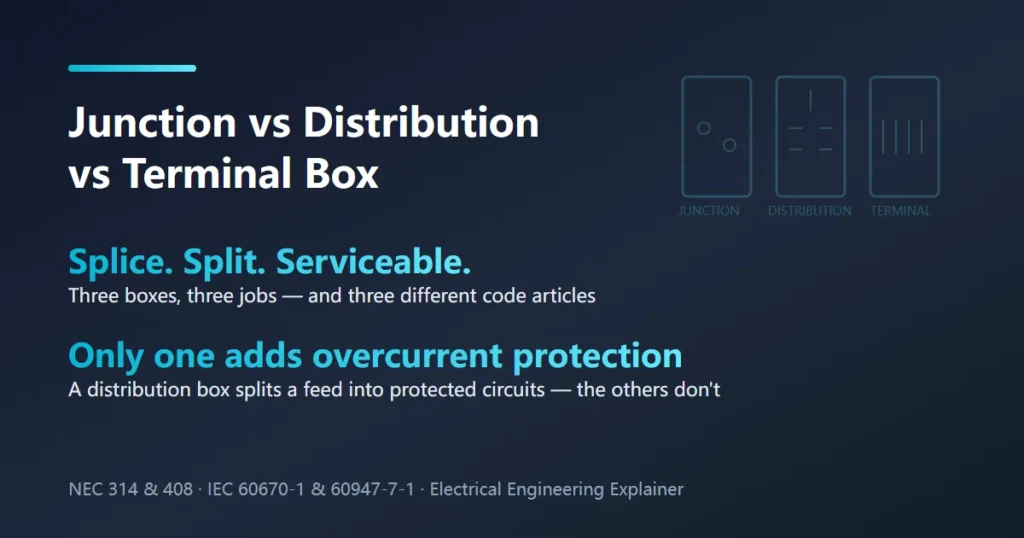
From the outside, a junction box, a distribution box, and a terminal box can look like the same thing: a metal or plastic enclosure with a lid, mounted somewhere along a circuit. Open the lid and that resemblance ends — one contains nothing but spliced wires, one contains a bank of breakers splitting a single feed into a dozen protected circuits, and one contains a row of individual terminals that never touch each other electrically at all. Calling all three "a junction box" in casual trade talk is common; wiring one like it's another is how a panel ends up missing required overcurrent protection, or a marshalling cabinet ends up full of undocumented splices where every terminal should be independently traceable.
This guide sorts out what each box actually does, which standards cover each one (three different tracks, not variations on one), and where a real installation typically uses all three.
Key Takeaways
- A junction box only splices conductors — taps, joins, or extensions mid-circuit, with no overcurrent protection device inside. In the US it falls under NEC Article 314; internationally, the enclosure itself is scoped by IEC 60670-1.
- A distribution box splits one incoming feed into multiple protected outgoing circuits via breakers or fuses — in the US this is a panelboard or switchboard under NEC Article 408, a completely different code article from a junction box.
- A terminal box holds individually serviceable connections, not splices. Each conductor lands on its own dedicated terminal point that can be disconnected without disturbing its neighbors — governed by an entirely separate standards track (UL 1059, IEC 60947-7-1) that has nothing to do with box-enclosure standards.
- Electrical failure or malfunction was a contributing factor in 80% of the estimated 32,620 annual U.S. home fires involving electrical distribution and lighting equipment in 2015–2019 — the documented backdrop for why using the right box, wired the right way, isn't a cosmetic choice.
- Most real installations use all three together: a distribution box protects branch circuits, terminal boxes marshal control and instrumentation wiring, and junction boxes splice lighting or receptacle circuits mid-run.
Quick Comparison
| Junction Box | Distribution Box | Terminal Box | |
|---|---|---|---|
| Primary purpose | Houses splices, taps, or terminations mid-circuit | Splits one incoming feed into multiple protected outgoing circuits | Provides individually serviceable connection points — no splicing |
| Contains overcurrent protection? | No | Yes — breakers or fuses | No |
| Connection method | Permanent splices (wire nuts, crimp connectors, listed splicing devices) | Bus bar or lugs feeding branch breakers | Screw or spring-clamp terminals, each independently landed |
| Governing NEC article (US) | Article 314 | Article 408 | Not a box-enclosure article — terminal blocks are a component standard |
| Governing IEC standard | IEC 60670-1 (boxes/enclosures for electrical accessories) | No single dedicated IEC enclosure standard — built to assembly/switchgear practice | IEC 60947-7-1 (terminal blocks for copper conductors) |
| Governing UL standard | Part of box/enclosure listings (e.g., UL 514A family) | UL 67 (panelboards) | UL 1059 (terminal blocks) |
| Typical application | Lighting/receptacle circuit splices, extending a run | Sub-panels, load centers, "DB boards" | Control-panel marshalling, instrumentation, field-wiring interfaces |
| Our take | Right tool for a mid-run splice — never for protection | Right tool whenever one feed needs to become several protected circuits | Right tool when wires need to stay individually traceable and serviceable |
What Is a Junction Box?
A junction box's entire job is housing a splice — joining, tapping, or extending conductors mid-circuit — with nothing inside that senses current or protects anything. No breaker, no fuse, no trip mechanism. It's a code-required cover over connections that would otherwise be exposed.

A small junction box doing exactly one job: three wire-nut splices join incoming and outgoing conductors. There's no protective device anywhere in this box — the breaker for this circuit lives elsewhere, upstream.
In the US, NEC Article 314 governs junction boxes alongside outlet, device, and pull boxes, conduit bodies, and handhole enclosures — as a companion post on this site covers in more depth, the Code doesn't even treat "junction box" as a separate legal term from "pull box"; the distinction is functional, based on whether the box contains splices. Internationally, the enclosure itself is scoped by IEC 60670-1, which covers boxes and enclosures for electrical accessories rated up to 1,000V AC or 1,500V DC for fixed installations — explicitly excluding things like cable trunking and ceiling roses, which have their own standards.
Verdict: A junction box's only function is a housed splice — if you find a breaker inside one, it's stopped being a junction box and become something else.
What Is a Distribution Box?
A distribution box takes one incoming feed and splits it into multiple protected outgoing circuits — that protection is exactly what separates it from a junction box, not just its size. Inside, an incoming main switch or main breaker feeds a bus or set of terminals, which in turn feeds a bank of individual breakers or fuses, each one protecting its own downstream branch circuit.

A distribution board mid-installation: the main switch at top feeds the neutral/earth terminal blocks and a bank of breakers below. Per the source photo's own documentation, the main switch is rated 100A, feeding a 50A circuit for each stairwell riser, a 25A circuit for house lighting and water heating, and several smaller breakers for individual lighting and utility feeds — every one of those breakers a distinct point of overcurrent protection the incoming feed alone doesn't have.
In the US, this equipment falls under NEC Article 408, "Switchboards, Switchgear, and Panelboards" — a completely different article from the junction-box rules in Article 314, covering construction, conductor arrangement, bonding, and circuit identification for equipment rated up to 1,000V. Internationally, the same function is usually called a distribution board or "DB box," built to general switchgear and assembly practice rather than a single dedicated enclosure standard the way a junction box has in IEC 60670-1. The terminology varies by region; the function — one feed, many protected outputs — doesn't.
Verdict: If a box splits a feed into multiple circuits and each one has its own breaker or fuse, it's a distribution box, not an oversized junction box.
What Is a Terminal Box?
A terminal box doesn't splice anything — every conductor gets its own dedicated terminal, individually serviceable, with no permanent joint to anyone else's wire. Disconnect one terminal and every other connection in the box stays exactly as it was. That's the opposite design goal from a junction box, where a splice is meant to be a stable, generally undisturbed connection for the life of the circuit.

A terminal marshalling strip inside a control panel: color-coded terminal groups (blue, green, yellow) keep circuits visually organized, and the labeled fused terminal block (F2a/F2b/F2c) lets a technician isolate one specific circuit without touching any other wire on the strip.
Terminal blocks are covered by a standards track that has nothing to do with box-enclosure rules. UL 1059 states its own scope directly: it covers "assemblies of wiring terminals and supporting blocks intended to provide for the connection of wiring," rated 1,500V or less — and explicitly excludes field-installed power distribution blocks, which fall under the separate UL 1953 instead. Internationally, IEC 60947-7-1 specifies requirements for terminal blocks with screw-type or screw-less clamping units, covering copper conductors from 0.05 mm² up to 300 mm², rated up to 1,000V AC or 1,500V DC. Neither standard says anything about the box the terminals sit in — that's a separate enclosure question entirely.
Verdict: A terminal box's whole value is that nothing inside it is permanently joined — every connection stays independently traceable and disconnectable.
The Core Difference: Splice, Split, or Serviceable Point
The one-line version: a junction box joins, a distribution box protects and branches, and a terminal box keeps everything separate. They answer three different questions about what should happen to a conductor at a given point in a circuit:
- A junction box asks: "Does this conductor need to be joined to another one here, permanently?"
- A distribution box asks: "Does this single feed need to become several independently protected circuits here?"
- A terminal box asks: "Does this conductor need to land somewhere it can be disconnected and reconnected without disturbing anything else?"
A useful gut check: if you can point to a specific breaker or fuse protecting one specific downstream circuit inside the box, it's a distribution box. If every connection is a permanent splice you'd have to cut apart to undo, it's a junction box. If every connection is a screw or clamp you could loosen and re-land without touching anything else, it's a terminal box. A box that has all three characteristics at once isn't a hybrid — it's usually a distribution box with a terminal strip added for its neutral and earth connections, which is common and fine, as long as each function is still doing its own job.
Verdict: Ask what's supposed to happen to the conductor at that specific point — joined, branched-and-protected, or independently landed — and the box type follows from the answer.
Why Mixing Them Up Is a Documented Safety Issue
Getting box selection or wiring method wrong isn't a paperwork problem — it shows up in fire statistics. US fire departments responded to an estimated average of 32,620 home fires per year involving electrical distribution and lighting equipment between 2015 and 2019, causing an estimated 430 civilian deaths, 1,070 civilian injuries, and $1.3 billion in direct property damage annually. Electrical failure or malfunction was a contributing ignition factor in 80% of these fires — far ahead of any other listed cause.
Worth being precise about what this data does and doesn't show: it covers electrical distribution and lighting equipment broadly — wiring, panelboards, outlets, switches, cords — not junction, distribution, and terminal boxes as a specific isolated category. But within that same dataset, "panelboard, switchboard, or circuit breaker board" is tracked as its own distinct equipment code, and "arc from faulty contact or broken connector, including... loose connections" is explicitly one of the named electrical-failure sub-factors. A loose splice in a junction box, an undersized breaker in a distribution box, or a poorly torqued terminal in a marshalling cabinet are all variations on exactly that failure mode.
Verdict: The stakes for choosing and wiring the correct box aren't theoretical — loose or improper electrical connections are the single largest documented contributing factor in this entire class of home fires.
Where All Three Show Up Together
A single machine control panel is a good example of all three boxes doing distinct jobs at once. Incoming power hits a distribution box — a main disconnect and a bank of breakers splitting the feed into protected circuits for the control transformer, motor starters, and auxiliary loads. Field wiring from sensors, limit switches, and actuators lands on a terminal box or marshalling strip, where each device keeps its own dedicated, labeled terminal a technician can disconnect for troubleshooting without touching anything else. Meanwhile, general lighting or receptacle circuits elsewhere in the building get spliced at ordinary junction boxes wherever a run needs to be joined or extended.
None of the three substitutes for either of the others without losing something the design needs: a junction box has no protection to offer a distribution box's job, a distribution box's bus connections aren't meant for the constant disconnect/reconnect cycle a terminal box is built for, and a terminal box has no splicing capability to offer a junction box's job.
Verdict: A real installation isn't choosing one box type over the others — it's putting each one where its specific function is actually needed.
How to Choose: A Practical Checklist
Work through these in order rather than defaulting to whichever box is already on the truck:
- Does this point need a permanent splice — joining, tapping, or extending a conductor mid-run? That's a junction box, sized and covered per NEC Article 314 (or IEC 60670-1 internationally), with no protective device inside.
- Does this point need to turn one feed into several independently protected circuits? That's a distribution box, built to NEC Article 408 (panelboard/switchboard practice) with breakers or fuses sized to each branch circuit.
- Does this point need individually serviceable, disconnectable connections — for field wiring, instrumentation, or troubleshooting access? That's a terminal box, using terminal blocks listed to UL 1059 or IEC 60947-7-1.
- Check whether a "combination" box is really doing double duty correctly — a distribution box with a terminal strip for its neutral and earth bar is normal; a distribution box being used as if its bus bar were just a big splice point, with no breaker actually protecting a downstream run, is not.
- Verify every connection is torqued and rated for its conductor, regardless of box type — the NFPA data above makes clear that loose or improper connections, not box selection alone, are the leading documented failure mode.
Frequently Asked Questions
Can a junction box have breakers in it?
No — once a box contains breakers or fuses protecting downstream circuits, it's functioning as a distribution box (or panelboard), governed by NEC Article 408 rather than the junction-box rules in Article 314. Adding a breaker to what's labeled a junction box doesn't make it compliant; it means the box needs to meet panelboard requirements instead.
Is a distribution board the same thing as a panelboard?
Functionally, yes. "Distribution board" (or "DB box") is the term used internationally and in many trades; "panelboard" and "switchboard" are the NEC's Article 408 terminology for the same one-feed-to-many-protected-circuits function. The equipment does the same job under different regional names.
Do terminal blocks ever get used for splicing?
Some terminal blocks are specifically listed for splicing applications, but that's a distinct product category from the individually-landed terminal connections used in a typical marshalling or field-wiring terminal box. Whether a given terminal block is suitable for a splice depends entirely on its listing — check the manufacturer's rating before assuming general-purpose terminals can substitute for a proper splicing device.
Why does a terminal box use screw or spring-clamp terminals instead of wire nuts?
Because the design goal is different. A wire-nut splice inside a junction box is meant to be a permanent, undisturbed joint. A terminal block is meant to let a technician remove and reconnect one specific wire — for testing, troubleshooting, or swapping a field device — without disturbing any other connection on the strip.
Need a Factory-Direct Source for All Three?
Whether you're speccing junction boxes for a lighting retrofit, panelboards for a distribution upgrade, or terminal blocks for a control-panel marshalling rebuild, getting the right standard and rating for each box's actual job avoids a callback later.
Conclusion
A junction box, a distribution box, and a terminal box solve three different problems that happen to share a family resemblance from the outside. The junction box's only job is a housed, permanent splice under NEC Article 314 or IEC 60670-1. The distribution box's job is turning one feed into several independently protected circuits under NEC Article 408. The terminal box's job is keeping every connection individually serviceable, under an entirely separate standards track in UL 1059 or IEC 60947-7-1. None of the three standards, and none of the three devices, was written to cover either of the other two jobs.
The practical takeaway: don't ask "which box do I grab" — ask whether this point in the circuit needs a splice, a protected branch, or a serviceable terminal, and the right box follows from the answer. Most real installations need all three, each doing its own job.