A DIN rail is a standardized metal rail — most often a 35mm "top hat" profile — mounted inside an electrical enclosure so that circuit breakers, terminal blocks, relays, and other panel components can snap on and off without individual screws. The rail itself is purely mechanical: it carries no load current, though it's often bonded to earth so grounded components can use it as a chassis ground point. What makes it useful isn't the metal strip — it's the standard behind it, which guarantees that a terminal block made in Germany clips onto a rail made in the US or China with no adjustment.
This guide explains what a DIN rail actually is, where the name comes from, the different rail profiles and sizes you'll run into, what it's made of, how components physically clip on, and how to figure out how much gear fits in a given length.
Key Takeaways
- A DIN rail is a standardized metal rail — governed today by IEC 60715 — used to mechanically mount circuit breakers, terminal blocks, relays, and similar panel components without carrying load current itself.
- The rail concept originated in Germany in 1928, but "DIN" didn't mean Deutsches Institut für Normung until 1975; in 1928 Germany's standards body was called the Deutscher Normenausschuß, a different name entirely.
- The 35mm "top hat" rail (TS35, in 7.5mm or 15mm depth) is the industry workhorse; a 15mm mini rail and a 32mm G-section rail also exist, and none of the three interchange with each other.
- Devices on 35mm rail are sized in whole-number "modules" (1M), but the module width itself isn't universal — commonly 18mm for single-pole breakers, 17.5mm for DIN 43880-style devices — so a 1-meter rail holds roughly 55-57 single-module devices in theory, before end stops and clearance reduce that in practice.
- Standard rail is zinc-plated steel and inexpensive — one direct-seller listing prices a 1-meter TS35/7.5 steel rail at about $3.20 — while stainless and aluminum variants cost more and exist mainly for corrosion resistance or weight-sensitive installs.
What Is a DIN Rail?
A DIN rail is a length of formed metal — typically a symmetrical "top hat" cross-section — screwed or bolted to the back panel of an electrical enclosure, onto which components clip using a standardized spring-loaded foot. Instead of drilling and screwing every relay, terminal block, and breaker individually to the backplate, an installer screws down one rail and then snaps components onto it in seconds, and just as easily pulls them back off for replacement.
The rail carries no current and provides no electrical function of its own — its job is purely mechanical support, holding devices in a fixed, evenly spaced line inside the panel.
Ideal for:
- Industrial control panels and motor control centers, where dozens of relays, breakers, and terminal blocks need a fast, serviceable mounting method
- Building automation and low-voltage control enclosures, where compact devices need a dense, organized layout
- Any installation where components will be swapped, added, or removed over the equipment's life
Not ideal for:
- Extremely high-current bus connections, where the rail's mechanical-only design isn't a substitute for a rated busbar
- One-off, single-component installs where a direct screw mount is simpler than buying and cutting a length of rail

A standard top-hat DIN rail, unmounted. The slotted holes let it be screwed to a backplate at whatever spacing the installer needs, and the raised hat shape is what components' spring clips grip onto.
Where Does the Name "DIN Rail" Come From?
"DIN" refers to Germany's national standards body, and the rail concept itself dates to 1928 — but the body wasn't actually called by that name until nearly 50 years later. Germany's standards organization was founded in 1917 as the Normenausschuß der deutschen Industrie (NADI), renamed Deutscher Normenausschuß (DNA) in 1926, and only became Deutsches Institut für Normung (DIN) in 1975, when it was also formally recognized by the German government as the national standards body. The mounting-rail concept that "DIN rail" now refers to was developed in Germany in 1928 and elaborated into the standards used today during the 1950s.
Put those two facts together and there's a small historical wrinkle worth knowing: when the mounting-rail concept was first standardized in the late 1920s, the organization behind it wasn't named "DIN" at all — it was the Deutscher Normenausschuß. The rail's now-familiar "DIN 46277" designation reflects the name DIN adopted decades later in 1975, not the name in use when the underlying engineering practice began. It's a reminder that a standard's document number tells you when it was catalogued, not necessarily when the idea behind it originated.
A related, often-repeated myth is worth clearing up too: "DIN" is sometimes expanded as "Deutsche Industrienorm," a holdover from the organization's early practice of publishing standards under a "DI-Norm" label — but that isn't the actual meaning of the modern acronym, which is Deutsches Institut für Normung. Some trade histories additionally credit the German utility RWE with the earliest practical rail designs in 1928, though that specific attribution isn't confirmed by the standards body's own documented history and should be treated as a secondary-source detail rather than an established fact.
As European industry expanded in the postwar decades, the German DIN 46277 specification was adopted continent-wide as EN 50022, and the international electrotechnical standards body folded the same dimensions into IEC 60715, first published in 1981 and updated with an amendment in 1995. The current second edition, IEC 60715:2017, cancels and replaces both of those and remains the governing international document today.
From DIN 46277 to IEC 60715: A Standard's Timeline
1917 NADI founded1926 Renamed DeutscherNormenausschuß1928 Rail concept +DIN 462771950s-60s Adopted as EN 500221975 Body renamedDIN1981 / 2017 IEC 60715 issued,then revised
The rail concept (green) predates the "DIN" name itself (purple) by 47 years. Source: Wikipedia summaries of DIN rail and Deutsches Institut für Normung; IEC 60715:2017 publication record.
Source: Wikipedia (DIN rail; Deutsches Institut für Normung) and the IEC 60715:2017 publication listing, retrieved 2026-08-30.
What Are the Standard DIN Rail Types and Sizes?
There are three DIN rail families in common use, and they are not interchangeable with each other despite superficially similar names. IEC 60715 covers "top hat," "C," and "G" section rails, but in practice the vast majority of installations use one of three profiles:
| Type | Width × Depth | European Standard | Also Called | Typical Use |
|---|---|---|---|---|
| TS35 / TH35 (top hat) | 35mm × 7.5mm (standard) or 35mm × 15mm (deep) | EN 50022 | NS35; McMaster's "DIN 3" | The industry workhorse — breakers, terminal blocks, relays, PLCs, contactors |
| TS15 / TH15 (mini top hat) | 15mm × 5.5mm | EN 50045 | McMaster's "DIN 2" | Compact junction boxes, building-automation controllers, miniature relay modules |
| G-section | 32mm × 15mm | EN 50035 | G32; McMaster's "DIN 1" | Heavier-duty or higher-power components |
The two TS35 depth variants share the same slot geometry — a 15 × 6.2mm opening on a 25mm hole pitch, per one distributor's published dimension chart, single-sourced and worth confirming against a specific manufacturer's datasheet before using it for a precision fit — which is why the same terminal block or breaker clips onto either the shallow 7.5mm rail or the deeper 15mm rail without modification; the deeper version simply gives more clearance behind the rail for grounding conductors or bulkier wiring. TS15, by contrast, uses a smaller 4.2mm mounting-hole pattern on a 20mm pitch and a device foot sized for the 15mm-wide rail — a TS35 device will not seat on it, and a TS15 terminal block will not grip a TS35 rail correctly.
DIN Rail Cross-Sections at a Glance
TS35 × 7.5 35mm wide, 7.5mm deep Most common
TS35 × 15 35mm wide, 15mm deep Same slots, deeper
TS15 15mm wide, 5.5mm deep Not TS35-compatibleG32 32mm wide, 15mm deep Heavy-duty gear
TS35 × 7.5 and TS35 × 15 share the same 15 × 6.2mm slot on a 25mm hole pitch, so devices interchange between them. TS15 and G32 use different foot geometries and are not interchangeable with TS35 or with each other. Source: IEC 60715:2017; manufacturer and distributor dimension listings, retrieved 2026-08-30. Shapes simplified for clarity.Source: IEC 60715:2017, the Rastro DIN rail dimension chart, and McMaster-Carr's steel DIN rail catalog, retrieved 2026-08-30.
McMaster-Carr's own catalog illustrates how differently the same three profiles get labeled depending on who's selling them: it groups TS35 (both depths) under "DIN 3," TS15 under "DIN 2," and G32 under "DIN 1" — a naming scheme that has nothing to do with the EN/IEC "TS"/"G" designations, which is a common source of confusion when cross-referencing a distributor catalog against a manufacturer's datasheet.
What Is DIN Rail Made Of?
Standard DIN rail is cold-rolled carbon steel with a zinc-plated or chromated finish, chosen because it's strong, inexpensive, and corrosion-resistant enough for a typical indoor panel. A representative direct-seller listing for a 1-meter TS35/7.5 rail — RoHS-compliant, zinc-plated steel, built to EN 60715/EN 50022 — prices a 10-pack at $31.95, or about $3.20 per rail. That's a single illustrative data point rather than a market average, but it establishes that basic zinc-plated steel rail is a low-cost commodity item.
Two other materials show up where plain zinc-plated steel isn't a good fit:
- Stainless steel — used where the panel is exposed to moisture, washdown, or corrosive process environments (food and beverage, pharmaceutical, marine, and outdoor enclosures), since it resists the corrosion that will eventually attack a zinc coating once it's scratched or worn through.
- Aluminum — used where weight matters (aerospace, portable equipment, large racks with many rail runs) or where a non-ferrous, non-magnetic rail is specifically required.
Both stainless and aluminum DIN rail cost more than standard zinc-plated steel, but reliable, directly comparable per-meter pricing across manufacturers wasn't consistent enough across the listings checked for this guide to state a specific multiplier with confidence — treat "costs more" as the safe, verified takeaway rather than a precise percentage.
How Do Components Clip Onto a DIN Rail?
Every DIN-rail-mount device has a spring-loaded foot on its back: a fixed tab hooks over the rail's top lip, and a spring-loaded tab snaps under the bottom lip, so the device locks on without any tools. To remove it, you lift the device slightly to compress the spring tab, pivot the top of the device off the rail, and then lower it free — no screwdriver needed on either end of the process. For the fit to work correctly, the width of the device's mounting foot has to match the rail width to a tight tolerance — one terminal-block manufacturer's installation guide quotes 35mm ±0.2mm for TS35 hardware, a single-sourced figure but a plausible and tight one, consistent with how snugly a correctly fitted clip actually grips the rail — which is exactly why the standardized dimensions matter as much as the standardized shape.
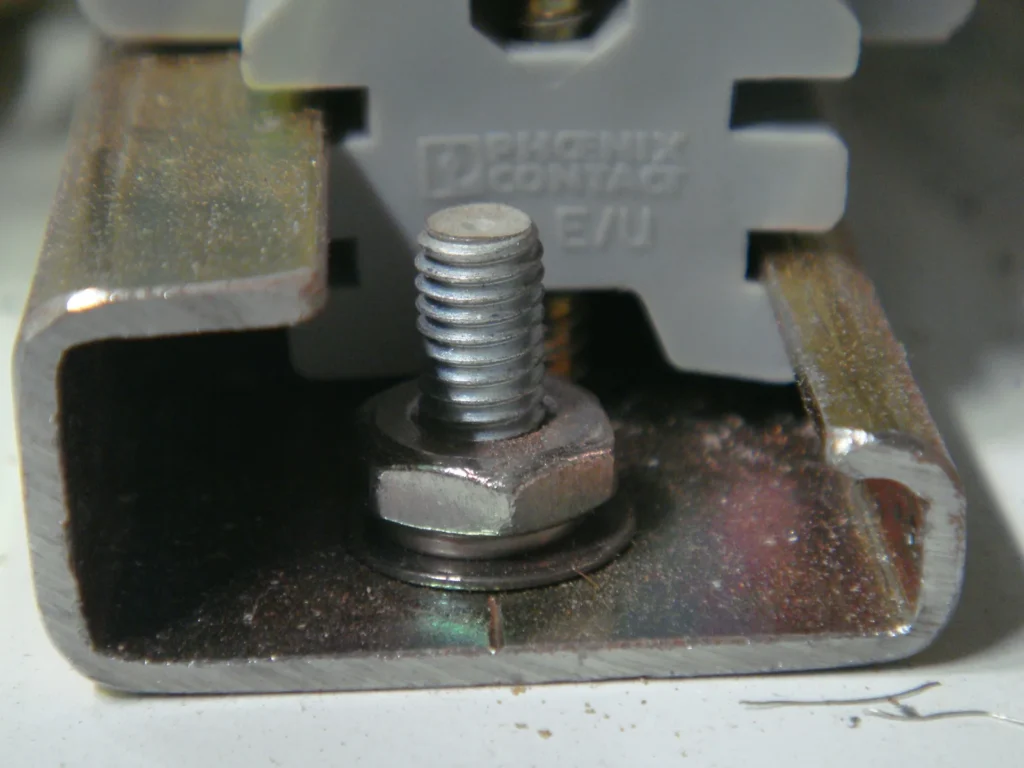
A grounding terminal block bolted directly through a top-hat DIN rail. Because standard rail is conductive zinc-plated steel, it can double as a chassis grounding point for components designed to bond to it — this is a mechanical/grounding connection, not a current-carrying one for the panel's main circuits.
That same spring-clip mechanism is what makes DIN rail practical for panels that get modified over their service life: a technician can add, swap, or relocate a relay or terminal block in the field in seconds, without re-drilling the backplate or hunting for the right screw.
How Many Devices Fit on a DIN Rail?
Devices built for 35mm top-hat rail are sized in whole-number "modules" (abbreviated M), but the width of one module isn't fully universal — a single-pole miniature circuit breaker is commonly built to an 18mm module, while general modular installation devices under the older German DIN 43880 housing standard (timers, impulse relays, some terminal-style devices) use a 17.5mm module instead. Both conventions are real and both are in active use; a 4-module device is simply four of whichever base unit its own product line is built around — 72mm on the 18mm system, 70mm on the 17.5mm system. Rather than assume one number, check the specific device's datasheet, which will state its width directly in millimeters.
Worked calculation: Because both module widths are genuinely in use, the honest answer to "how many devices fit on a 1-meter rail" is a range, not a single number. At an 18mm module, 1,000 ÷ 18 ≈ 55.5, so a full-length 1-meter rail holds roughly 55 single-module devices; at a 17.5mm module, 1,000 ÷ 17.5 ≈ 57.1, or roughly 57. Either way, treat the result as a theoretical ceiling, not a guaranteed fit count — end stops, an odd-width device or two, and wiring clearance at both ends of the rail all reduce the real-world number below the raw division.
Two Module-Width Conventions on 35mm Rail
IEC 60898 MCB (18mm) 1M 18mm2M 36mm4M 72mm (e.g. RCCB)
DIN 43880 general (17.5mm) 1M 17.5mm4M 70mm1,000mm rail ÷ module width ≈ 55 devices (18mm) or ≈ 57 devices (17.5mm) Both are theoretical maximums — check the specific device's datasheet for its actual width
Source: DIN 43880 standard record (GlobalSpec) and manufacturer/distributor module-width listings, retrieved 2026-08-30.Source: DIN 43880 standard record and manufacturer/distributor module-width listings (Omega Engineering, OMCH), retrieved 2026-08-30. Both module-count figures are original calculations for this guide.
What Do You Mount on a DIN Rail?
Just about every small-to-midsize component in a modern control panel is built with a DIN-rail foot: circuit breakers, residual-current devices, terminal blocks, relays, contactors, PLCs, and DIN-rail-mount power supplies are all designed around the same standardized clip. The photo below is a representative lineup — gray, blue, and green/yellow (grounding) terminal blocks, a miniature circuit breaker, a residual-current device with a test button, a small interface relay module, and a contactor — all sharing the same rail-mount foot despite coming from different manufacturers.
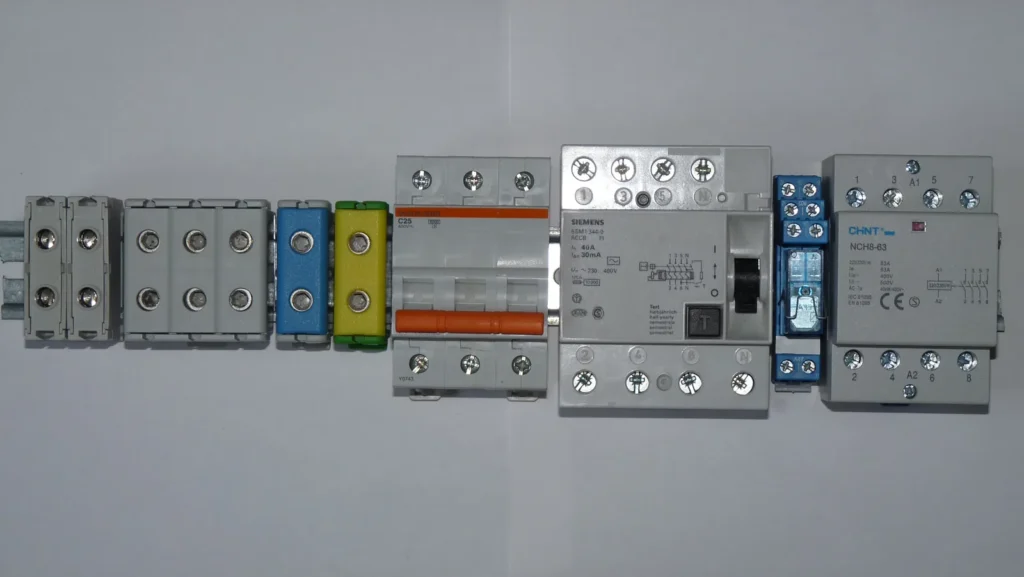
A typical mix of DIN-rail components, left to right: gray screw-terminal blocks, a blue terminal block, a green/yellow grounding terminal block, an MCB, an RCCB with its half-yearly test button, a blue interface relay module, and a contactor — all built around the same standardized rail-mount foot.
That interchangeability is the entire point of the standard: a panel builder can mix breakers, terminal blocks, and control relays from several different manufacturers on the same length of rail and know every one of them will physically fit, because every one of them was designed against the same IEC 60715 dimensions.
What Should You Check Before Buying DIN Rail?
Match the profile, depth, and material to the job — getting any one of those wrong is the most common reason a rail purchase doesn't work out.
- Confirm the profile your devices need. Check the datasheet or mounting-foot spec of the components going on the rail — TS35, TS15, and G32 are not interchangeable, and buying the wrong one means a return.
- Choose 7.5mm or 15mm depth for TS35. The shallow 7.5mm depth covers most general panel work; step up to 15mm when you need more rear clearance for grounding conductors or a bulkier wiring run behind the components.
- Pick the right material for the environment. Standard zinc-plated steel is fine for a dry indoor panel; move to stainless steel for washdown or corrosive environments, or aluminum where weight or non-magnetic properties matter.
- Plan module width before you buy length. Add up the actual widths (in mm) listed on each device's own datasheet — don't assume a single "1M" constant, since MCBs typically use an 18mm module while some DIN 43880-style devices use 17.5mm — plus room for end stops and future additions, before cutting or ordering a specific rail length.
- Buy slotted rail unless you have a specific reason not to. Slotted (perforated) rail lets you reposition the mounting screws anywhere along its length; unslotted rail is cheaper per unit but only comes with holes at fixed positions, which limits where you can anchor it to the backplate.
Frequently Asked Questions
What does "DIN" stand for in DIN rail?
DIN stands for Deutsches Institut für Normung, Germany's national standards body — but that name was only adopted in 1975. When the rail concept was first developed in 1928, the organization was called the Deutscher Normenausschuß. A common myth that DIN stands for "Deutsche Industrienorm" is incorrect; that phrasing is a holdover from an early publication label, not the actual meaning of the acronym.
What size is standard DIN rail?
The most common size is 35mm wide, known as TS35 or top-hat rail, available in two depths: 7.5mm (standard) and 15mm (deep, for extra rear clearance). Both depths share the same slot geometry, so devices fit either one. A separate 15mm-wide mini rail (TS15) and a 32mm G-section rail also exist for compact or heavy-duty applications, but neither interchanges with TS35 or with each other.
Is all DIN rail the same, or do brands differ?
The dimensions are standardized under IEC 60715, so a TS35 rail from any manufacturer accepts a TS35-footed device from any other manufacturer. What differs between brands and listings is material (zinc-plated steel, stainless steel, or aluminum), whether the rail is slotted or unslotted, and length — the mounting profile itself doesn't vary if it's genuinely built to the standard.
Can DIN rail carry electrical current?
No. A DIN rail is a mechanical mounting component, not a current-carrying busbar — the components clipped onto it carry current through their own terminals and wiring, not through the rail. The one common exception is grounding: because standard rail is conductive zinc-plated steel, components with a grounding foot can bond to it as a chassis ground point, which is a mechanical/grounding connection rather than a load-current path.
How many devices can I fit on a 1-meter DIN rail?
It depends on which module width your specific devices use. Single-pole miniature circuit breakers are commonly built to an 18mm module, which gives a theoretical maximum of about 55 single-module devices on a 1,000mm rail (1,000 ÷ 18); some DIN 43880-style general modular devices use a 17.5mm module instead, giving roughly 57. Check the width printed on the device's own datasheet rather than assuming one universal number, and expect real installs to fit somewhat fewer than either theoretical maximum once you account for end stops and wiring clearance at both ends of the rail.
Looking for related electrical components? Browse bddkg's full product range.