A spider box is a portable power distribution unit that takes a single high-amperage electrical feed — typically from a generator or a building's electrical panel — and splits it into several lower-amperage, individually protected outlets. Instead of running one overloaded extension cord to every tool on a job site, crews plug into a spider box positioned close to the work, each output leg backed by its own breaker and ground-fault protection.
The name comes from how it looks in use: several cables radiating outward from a central box, like a spider's legs. This guide covers how a spider box works, what the OSHA and NEC rules actually require, and why the term means something slightly different depending on which industry you're in.
Key Takeaways
- A spider box converts one high-amp feed (commonly 50A or 200A) into multiple lower-amp, individually breakered outlets — typically 15A/20A GFCI duplex receptacles plus one or two 30A locking outlets.
- On U.S. construction sites, every 120-volt, 15- and 20-amp receptacle not part of a building's permanent wiring must have GFCI protection or be covered by a documented Assured Equipment Grounding Conductor Program (AEGCP) — this is a federal requirement, not just good practice.
- "Spider box" means something different by industry: in construction it's usually a single-phase, GFCI-duplex-outlet box; in film, TV, and event production it's more often a 3-phase, camlock-connector splitter feeding lighting and stage equipment.
- Temporary wiring for construction has no fixed day limit under the National Electrical Code — it's permitted for the duration of the project, not a flat 90 days (that 90-day cap applies specifically to holiday and carnival-style lighting, a common point of confusion).
What Is a Spider Box?
A spider box is a rugged, typically weather-resistant enclosure that accepts one large electrical feed and distributes it through several smaller, separately protected circuits. It sits between the power source — a generator, a temporary service panel, or a building's electrical system — and the tools, lights, or equipment that need power at a distance from that source.
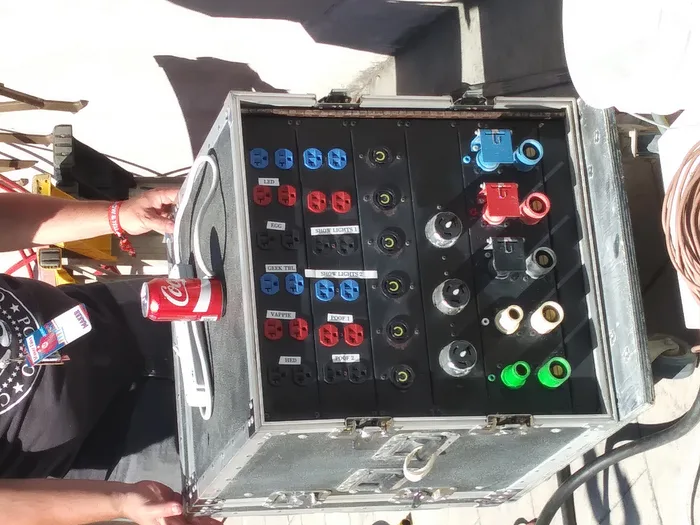
Unlike a simple power strip, a spider box is built for outdoor, job-site duty: a rugged enclosure (often rubber or metal), circuit breakers for each output leg, and ground-fault circuit interrupter (GFCI) protection built in rather than relying on GFCI-equipped tools or cords. Some models add a raised or elevated base to keep connections off wet ground.
Ideal for:
- Construction and renovation sites where multiple trades need power spread across a large area
- Outdoor events, film and TV production, and temporary installations where running permanent wiring isn't practical
- Any situation where a single generator or panel feed needs to safely serve several tools or fixtures at once
Not ideal for:
- Permanent power distribution — a spider box is explicitly a temporary-use device under NEC Article 590, not a substitute for proper panel wiring
- Loads that exceed the box's rated input or any individual output leg's breaker rating
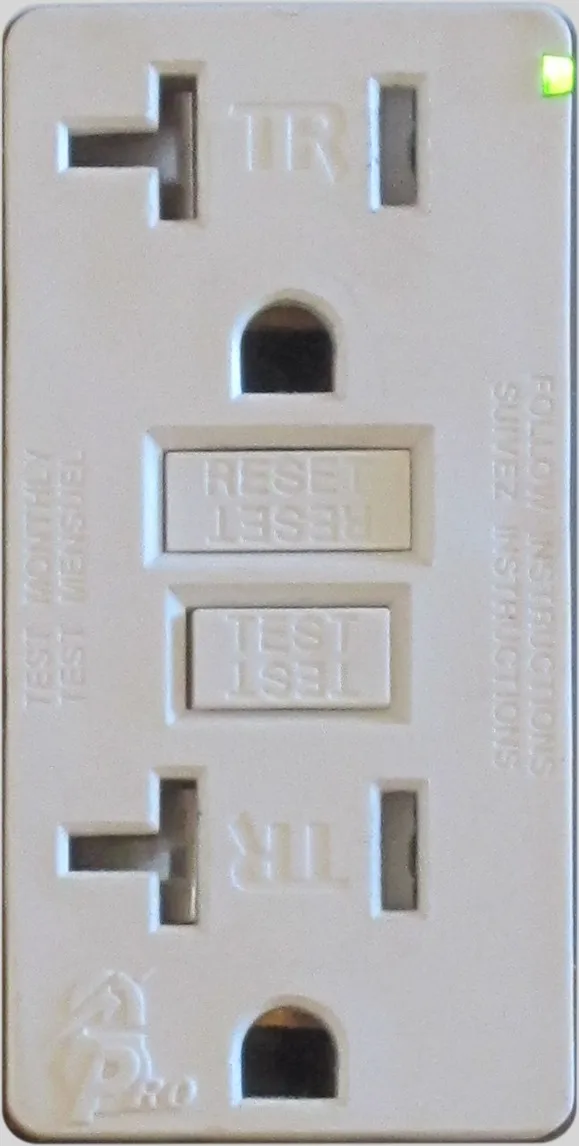
A GFCI receptacle — the same ground-fault protection built into a spider box's individual output legs, required by OSHA on most construction-site circuits.
How Does a Spider Box Work?
A spider box works by taking one high-amperage input and routing it through a bank of circuit breakers — each protecting one output receptacle or "leg" — so a single feed can safely power several tools or fixtures at once without any one circuit being overloaded.
The typical input is a 50-amp or 200-amp, 125/250-volt single-phase feed brought in through a locking inlet connector, sourced from a portable generator or a temporary electrical panel. Inside the box, that feed passes through thermal-magnetic circuit breakers and GFCI protection before being split across multiple output receptacles — commonly several 15-amp or 20-amp GFCI duplex outlets for hand tools, plus one or two higher-amperage locking outlets (such as NEMA L5-30) for heavier equipment.
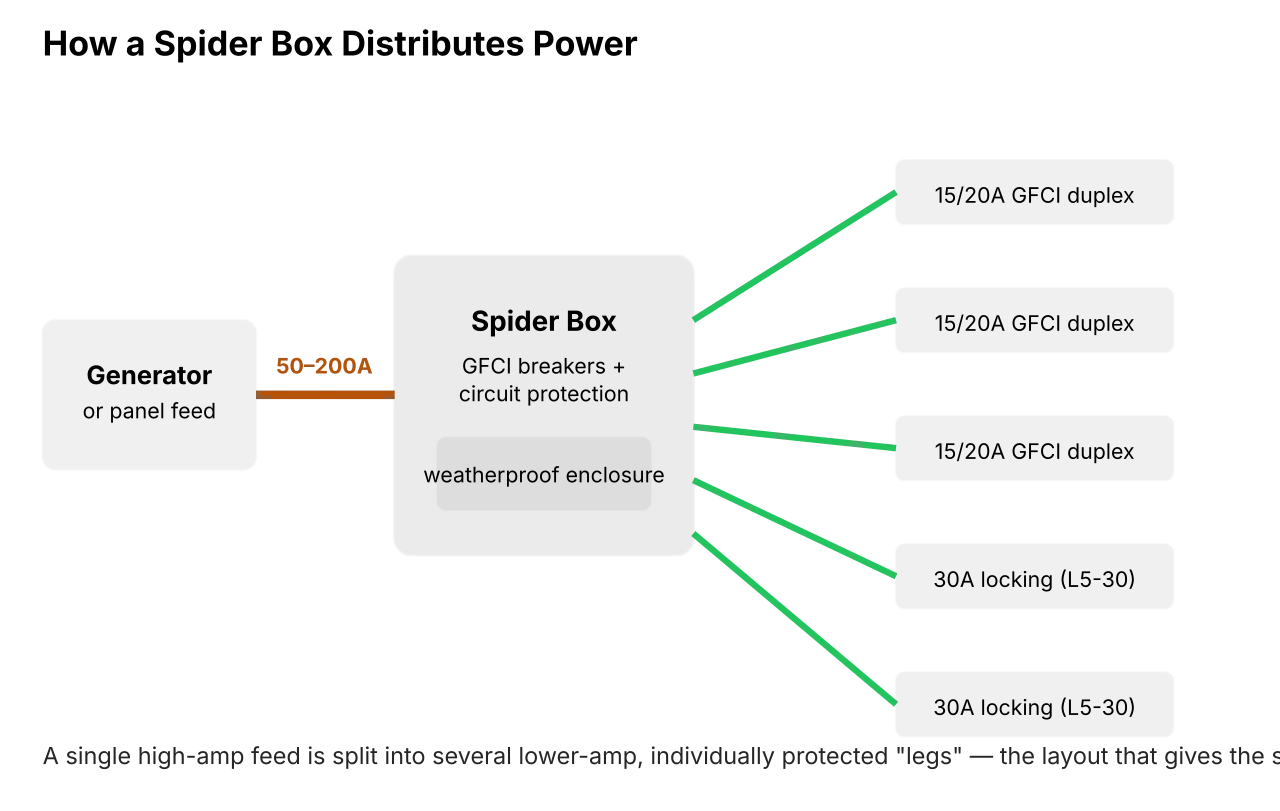
Configuration and receptacle counts vary by model and manufacturer; based on typical spec sheets (2026).
The GFCI protection is the part that actually matters most for worker safety, not just the convenience of multiple outlets. A spider box with built-in GFCI on every leg means every tool plugged into it is protected without depending on each individual cord or tool having its own GFCI — which is exactly the gap OSHA's construction standard is written to close.
A camlock-style AC power distribution unit — this rack-mounted example is used in touring and theatrical power distribution, illustrating the same camlock connectors found on heavy-duty, high-amperage spider boxes.
For heavier loads — often above 100–150 amps — spider boxes and similar distribution equipment switch from locking twist connectors to camlock (cam-type) connectors, where each conductor (each phase, neutral, and ground) is a separate, single-pole cable that locks into the box with a quarter-turn twist. This style is common on 3-phase distribution used in film and event production, covered in more detail below.
What Are the OSHA and NEC Requirements?
By law, a construction-site spider box (or any temporary power source feeding 120-volt, 15- and 20-amp receptacles) must provide ground-fault protection — this isn't optional equipment, it's a federal requirement.
OSHA's construction standard, 29 CFR 1926.404(b)(1), requires employers to use one of two approaches for these receptacles:
- GFCI protection — "All 120-volt, single-phase, 15- and 20-ampere receptacle outlets on construction sites, which are not a part of the permanent wiring of the building or structure and which are in use by employees, shall have approved ground-fault circuit interrupters for personnel protection".
- An Assured Equipment Grounding Conductor Program (AEGCP) — under 29 CFR 1926.404(b)(1)(iii), a documented, jobsite-specific program covering inspection and testing of cord sets, receptacles, and cord-and-plug equipment, administered by a designated competent person, as an alternative to GFCI protection.
Most contractors choose GFCI-equipped spider boxes specifically because they satisfy this requirement automatically, without the ongoing administrative burden of running a formal AEGCP.
On the wiring-code side, the National Electrical Code's Article 590 governs temporary installations. A common misconception is that temporary wiring is capped at 90 days — that limit actually applies only to temporary installations for "holiday decorative lighting, carnivals, and similar purposes" under NEC 590.3. For construction, remodeling, maintenance, or demolition work, temporary wiring (including a spider box setup) is permitted for the duration of that work, and must be removed once the work is complete.
GFCI testing: Whichever protection method is used, GFCI devices should be tested regularly — monthly testing is a common industry-recommended interval — using the built-in test button to confirm the device still trips correctly.
Construction vs. Film/Production Spider Boxes
Here's where the terminology gets genuinely confusing: "spider box" describes two meaningfully different pieces of equipment, depending on which industry you're talking to.
| Feature | Construction-Site Spider Box | Film/Production Spider Box |
|---|---|---|
| Typical input | 50A or 200A, single-phase, locking inlet | Often 100A+ per phase, 3-phase, camlock connectors |
| Typical outputs | Multiple 15A/20A GFCI duplex, plus 30A locking | Multiple single-phase "legs" split off a 3-phase feed, often to camlock or Bates connectors |
| Primary protection | GFCI on every duplex outlet (OSHA-mandated) | Circuit breakers per leg; GFCI use varies by local code and application |
| Typical load | Hand tools, lighting, small equipment | Studio/set lighting, grip equipment, staging |
| Related terms | — | Often distinguished from a simpler "lunch box" splitter, which typically lacks built-in breakers |
Both versions do the same basic job — one feed in, several protected outputs out — but the connector types, phase configuration, and typical amperage differ enough that equipment from one industry usually isn't a direct substitute for the other. If you're renting or specifying a spider box, confirm the input connector type, voltage, phase count, and output receptacle types against what your generator or panel and your tools actually need.
When Do You Need a Spider Box?
A spider box makes sense any time you need to power several tools or fixtures from one source, at a distance from that source, without running permanent wiring. That covers most active construction sites, temporary event setups, and any location where a generator is the primary power source.
You probably need one if:
- More than one or two tools need power in an area without existing outlets
- The power source (generator or panel) is far enough from the work that running individual cords for every tool isn't practical
- You need to document GFCI compliance rather than run an AEGCP program
You probably don't need one if:
- You're powering a single tool close to an existing, properly protected outlet — a GFCI-protected extension cord may be sufficient
- The installation is meant to be permanent — that calls for proper panel wiring, not temporary distribution equipment
Frequently Asked Questions
What's the difference between a spider box and a lunch box?
Both are portable power splitters, but a spider box typically includes its own circuit breakers and GFCI protection for each output, while a "lunch box" is often a simpler splitter without built-in overcurrent protection, relying on the source panel's breakers instead. The terms are sometimes used loosely, so always check a specific unit's actual features rather than assuming based on the name alone.
Does a spider box need to be GFCI protected?
For 120-volt, 15- and 20-amp receptacles used on U.S. construction sites, yes — OSHA 1926.404(b)(1) requires either GFCI protection or a documented Assured Equipment Grounding Conductor Program. Higher-amperage locking outlets and equipment used outside standard construction-site rules may fall under different requirements, so check the applicable code for your specific application.
Can I rent a spider box instead of buying one?
Yes — spider boxes are commonly available through equipment rental companies, electrical supply houses, and event/production power vendors, since most job sites only need one temporarily. Renting is especially common for short-duration projects or one-off events.
How many amps does a spider box handle?
It depends entirely on the model. Common construction-oriented units accept a 50-amp input, while heavier-duty units (including some film/production models) handle 200 amps or more. Always match the spider box's rated input to your generator or panel's actual output, and confirm each output leg's breaker rating against the equipment you're plugging in.
Is a spider box the same as a temporary power pole?
No. A temporary power pole (sometimes called a "temp pole") is typically a metered, permitted service connection point — often required by a utility for new construction before permanent service is installed — while a spider box is a portable distribution device fed from an existing source like a generator or an already-established panel. They're often used together: a temp pole provides the source, and a spider box distributes it around the site.
Related: Spider boxes are built around the same sealed-enclosure principles as bddkg's waterproof junction boxes.