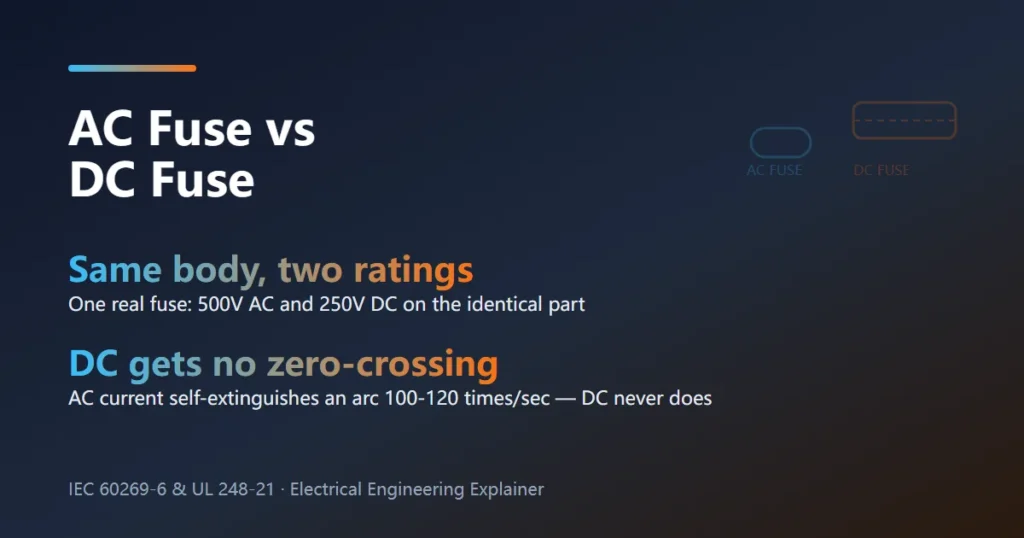
Pull the datasheet for a common industrial NH-style fuse and you'll often see two voltage numbers on the same physical part: one for AC, a lower one for DC. That's not a printing error, and it's not a marketing gimmick — a fuse that melts open at the exact same current has to do a much harder job when the circuit is DC, because the current on the other side of that gap behaves completely differently.
This guide covers what actually changes between an AC-rated and a DC-rated fuse, why a fuse's AC voltage rating tells you almost nothing about its DC capability, and which standards govern each — including a genuinely new one that just arrived for battery systems.
Key Takeaways
- AC current crosses zero volts roughly 100-120 times per second (at 50-60 Hz), and that natural zero-crossing helps an arc self-extinguish. DC current never crosses zero, so a DC fuse has to force the arc out entirely on its own.
- The same physical fuse body often carries two different voltage ratings. Mersen's NH000 gG fuse-link, for example, is listed at 500 V AC but only 250 V DC on the identical part.
- A new UL standard for battery and BESS fuses arrived in October 2025. UL 248-21 covers low-voltage fuses for protecting batteries and battery systems rated up to 2,000 V DC.
- Solar PV strings have their own DC fuse category. IEC 60269-6 sets supplementary requirements for gPV-class fuse-links protecting PV strings and arrays up to 1,500 V DC — separate from the general IEC 60269-1 low-voltage fuse standard.
- The global electric fuse market (AC and DC combined) was valued at $4.00 billion in 2025 and is projected to reach $5.07 billion by 2030, a 4.9% CAGR, with the report explicitly segmenting by AC and DC fuse type.
Quick Comparison
| AC Fuse | DC Fuse | |
|---|---|---|
| What it has to interrupt | Current that crosses zero volts twice per cycle (100-120 times/sec at 50-60 Hz) | Continuous current with no natural zero-crossing to help extinguish an arc |
| Same body, different rating? | Often carries the higher of the two voltage ratings on a dual-listed body | Often carries a lower voltage rating on the identical physical part |
| Governing standard | IEC 60269-1 (general low-voltage fuses); UL 248-1 | IEC 60269-6 (gPV/solar, up to 1,500 V DC); UL 248-21 (battery/BESS, up to 2,000 V DC — new Oct. 2025) |
| Typical application | Domestic/commercial branch circuits, motor circuits | Solar PV strings, EV battery packs, battery energy storage, -48 V DC telecom plants |
| Can one replace the other? | No — an AC-rated fuse is neither tested nor listed to interrupt a fault at its AC voltage rating when the circuit is DC | No — an undersized or wrong-category DC fuse risks sustained arcing after the element melts |
| Our take | Use it only within its listed AC voltage and interrupting rating | Spec the DC-specific category (gPV, UL 248-21, etc.) — never substitute the AC-rated equivalent |
What Is an AC Fuse?
An AC fuse is designed and listed to interrupt a fault current that naturally crosses zero volts every half-cycle — and that zero-crossing does a lot of the interruption work for it. At 50 Hz, that's 100 crossings a second; at 60 Hz, 120. Each time the current passes through zero, the arc that forms as the fuse element melts loses its ionized path and has a real chance to go out on its own, rather than the fuse having to force it out.
This is the standard job covered by IEC 60269-1, the general low-voltage fuse standard (2024 edition), and by UL 248-1 in North America. Most familiar fuses — ceramic cartridge fuses in a UK consumer unit, glass automotive fuses, blade-type fuses in a car's fuse box — are built and rated against this AC (or low-voltage general) baseline.
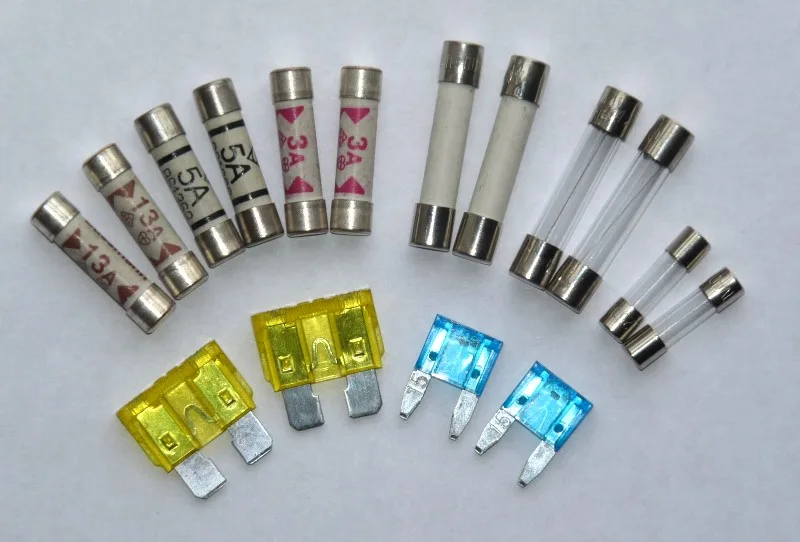
A typical mix of AC and low-voltage general-purpose fuses — ceramic cartridge, glass, and blade types — all built around the same zero-crossing assumption.
Verdict: An AC fuse's voltage and interrupting rating assume the current it's clearing gets a natural assist from zero-crossing — a DC circuit never gives it that assist.
What Is a DC Fuse?
A DC fuse has to fully extinguish an arc with no zero-crossing to help — so it's built with a longer internal arc path and packed with arc-quenching filler to pull that off at the same current rating. Once a DC fuse element melts and an arc forms, that arc will keep drawing energy from the circuit indefinitely unless the fuse's own construction cools and stretches it out until it can no longer sustain itself.
That's exactly the additional requirement layered on by IEC 60269-6, which sets supplementary rules for gPV-class fuse-links protecting photovoltaic strings and arrays up to 1,500 V DC. On the North American side, the relevant DC-specific coverage was just refreshed: UL 248-21, a new First Edition standard published October 1, 2025, covers low-voltage fuses specifically for protecting batteries and battery systems rated up to 2,000 V DC — a direct response to how fast EV and battery-storage DC protection has grown as its own category.

The same NH knife-blade fuse body style used across this class of fuse — shown here disassembled, in an AC-rated configuration — is also the physical format many dual AC/DC-rated fuse-links share.
Verdict: A DC fuse's job isn't "the same interruption at a lower voltage" — it's a harder interruption problem that the standard accounts for with more arc path and more quenching material.
The Core Difference: Why DC Arc Interruption Is Harder
The one-line version: AC gets a free assist from physics 100+ times a second, and DC gets none of it. When a fuse element melts under fault current, it doesn't instantly stop conducting — a plasma arc bridges the gap for a short time afterward. On an AC circuit, that arc is fighting a current that's already heading toward zero on its own schedule; the fuse's job is mostly to keep the arc from re-striking once it does cross. On a DC circuit, the current has no schedule to lean on. The arc will keep going until the fuse itself increases the arc's resistance enough — by stretching its path and cooling it — to choke it out entirely.
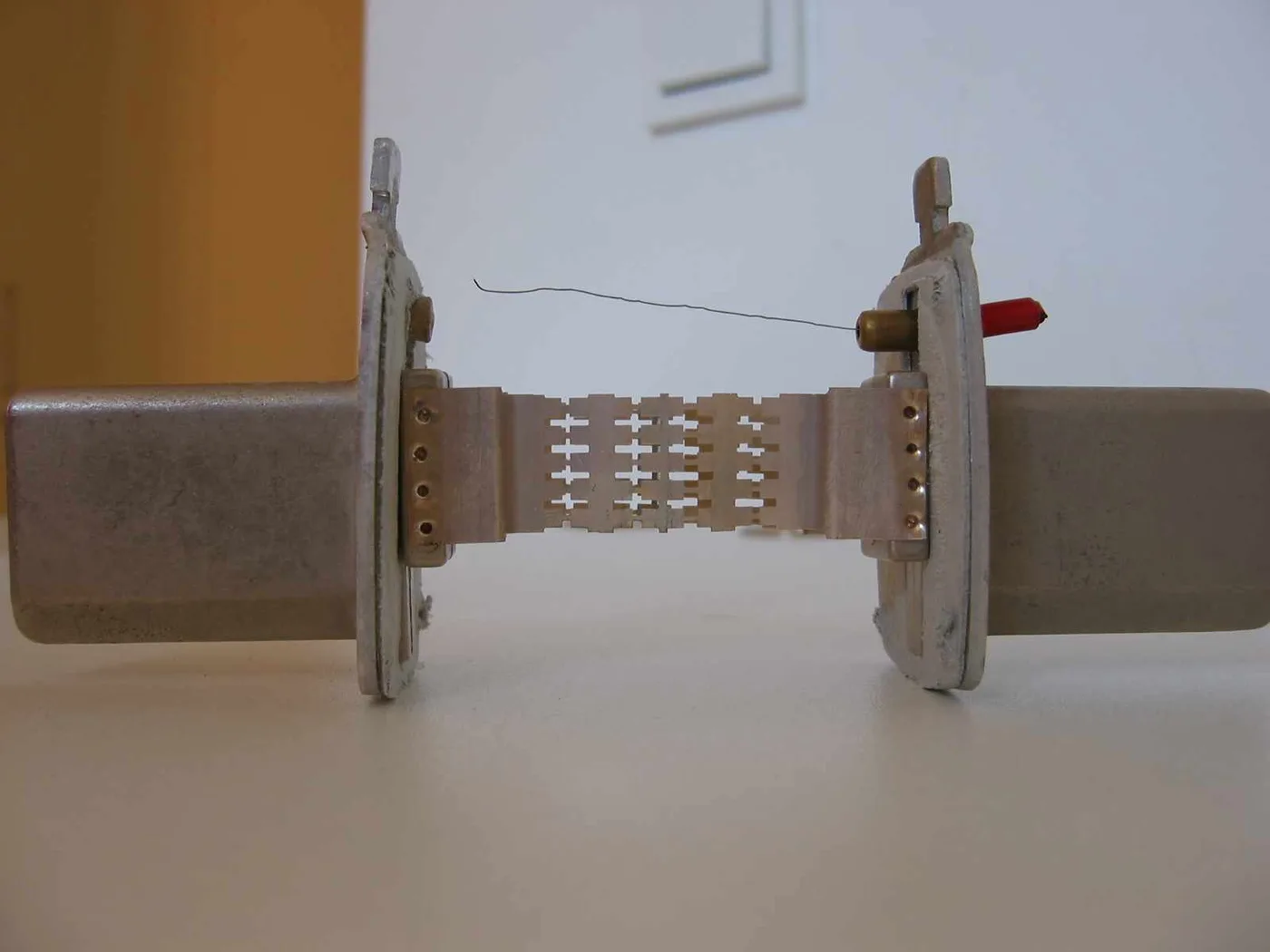
The perforated fusible element inside a fuse — the narrow points are where the element is designed to melt first. A DC-rated fuse needs a longer version of this path, surrounded by more quenching filler, to fully interrupt an arc with no zero-crossing to help.
A lot of vendor content on this topic repeats specific figures — arc temperatures in the tens of thousands of degrees Celsius, or "DC fuses need 50-60% of the AC voltage rating" as a fixed rule — without citing a source for either number, and we couldn't independently verify them against a standard, a datasheet, or a named test. What we could verify is more useful anyway: a real manufacturer datasheet showing the actual derating on a specific part. That's a better anchor than an unsourced rule of thumb, because the real derating varies by fuse design, not by a fixed percentage.
Verdict: If you're evaluating a fuse for a DC application, check its own DC-specific rating on its own datasheet — don't apply a generic AC-to-DC conversion rule that isn't traceable to a standard.
Can You Use an AC Fuse on a DC Circuit?
No — not at its AC voltage rating, and treating the two ratings as interchangeable is exactly the mistake DC-specific fuse categories exist to prevent. A fuse that's only tested and listed for AC interruption hasn't been proven to clear a DC arc at that same voltage. If it can't fully interrupt the arc, the result isn't a blown fuse doing its job — it's a sustained arc across an open gap, which is a heat and fire risk that keeps building until something else clears the circuit or the arc burns itself out unpredictably.
The clearest evidence of this isn't a warning label — it's how manufacturers themselves rate a single part. Mersen's NH000 gG fuse-link carries a 500 V AC rating with a 120 kA AC breaking capacity on its datasheet — and a separate 250 V DC rating on the exact same physical fuse. Same fuse, same catalog number, two different jobs it's actually certified to do.
Verdict: Check the DC rating on the datasheet, not the AC rating — the same part number can legitimately carry both, and only one of them applies to your circuit.
The Standards That Govern Each
AC and DC fuses aren't split by a single rulebook — they're split across two standard families that have each grown DC-specific branches as demand for battery and solar protection increased. Internationally, IEC 60269 is the low-voltage fuse family: Part 1 sets general requirements, and Part 6 (IEC 60269-6:2010) layers on supplementary DC-specific requirements for gPV-class solar fuse-links up to 1,500 V DC.
In North America, UL 248 plays the same role. UL 248-1 sets general requirements; UL 248-14 covers supplemental fuses where a DC rating is optional at the manufacturer's discretion; and — most notably — UL 248-21 is a genuinely new addition, published October 1, 2025, specifically for low-voltage fuses protecting batteries and battery systems up to 2,000 V DC. Preferred DC interrupting ratings under the UL 248 series run 10,000 / 20,000 / 50,000 / 100,000 / 150,000 / 200,000 A, giving specifiers a standardized scale to match against a battery system's available fault current.
Verdict: Match the standard to the application, not just the voltage — a fuse can be fully IEC 60269-1 compliant and still be the wrong part for a 1,500V DC solar string, because that job belongs to 60269-6.
Where DC Fuse Demand Is Growing
DC fuse protection used to be a niche corner of the fuse market; it's now one of the fastest-growing reasons the whole market is expanding. A few segments are driving that shift:
- Solar PV strings. Every string in a combiner box needs overcurrent protection sized for its own DC fault current, under IEC 60269-6's gPV category or an equivalent UL-recognized DC fuse — a plain AC fuse dropped into a string position isn't a compliant substitute.
- EV batteries and battery energy storage (BESS). UL 248-21's October 2025 publication exists because this segment needed its own dedicated standard rather than borrowing coverage from general-purpose fuse categories.
- Telecom -48V DC plants. A long-standing but often overlooked DC application — central-office and cell-site power systems have run on -48V DC for decades, with their own DC-rated fuse and fuse-panel conventions.
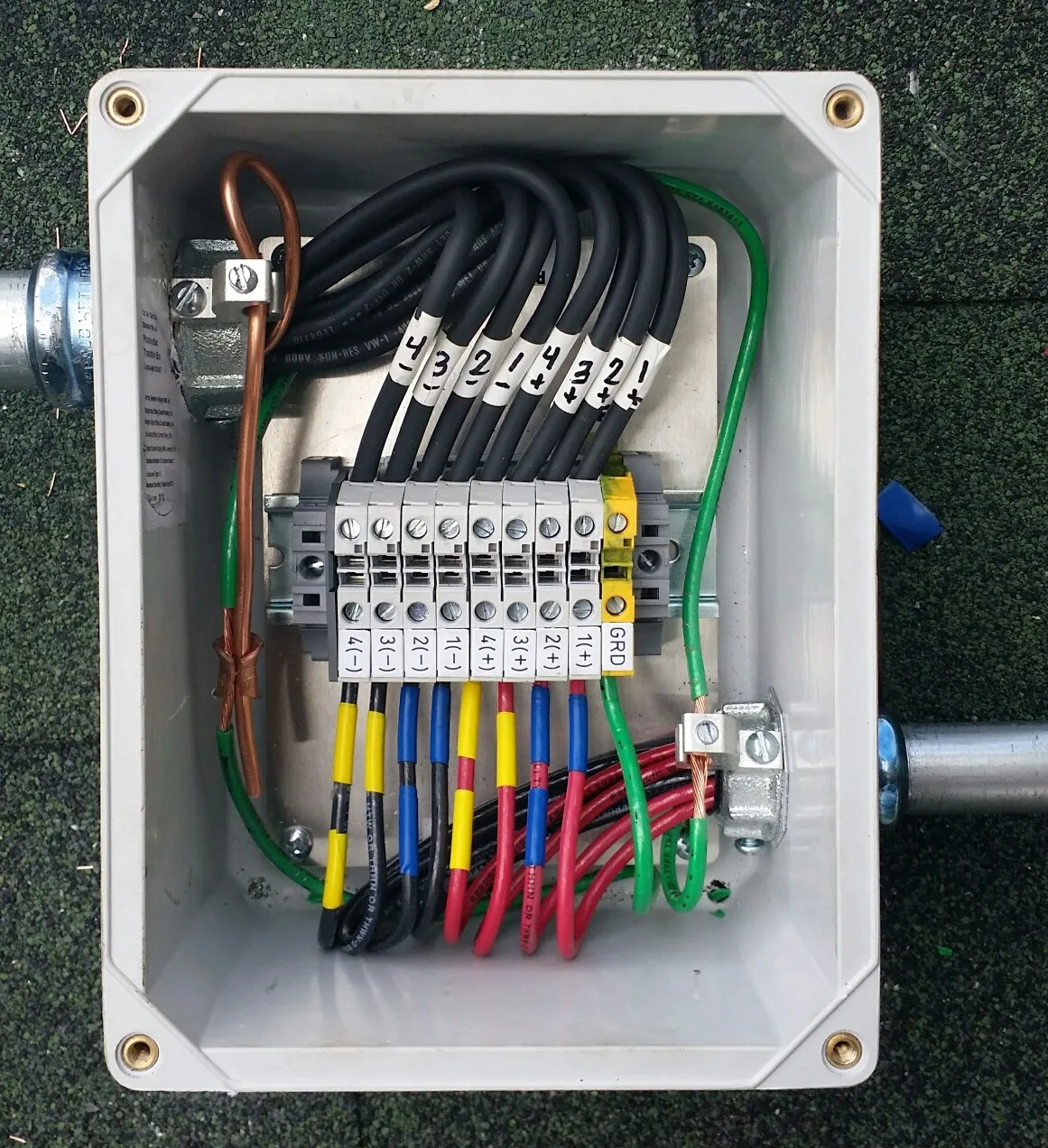
Inside a PV string combiner box: each labeled string position is where a gPV-rated DC fuse gets specified — this particular box shows the string terminal wiring, the location those fuses protect.
That growth shows up in the numbers tracked for the fuse market as a whole. The global electric fuse market — AC and DC combined — was valued at $4.00 billion in 2025 and is projected to reach $5.07 billion by 2030, a 4.9% CAGR, with the underlying report explicitly segmenting the market by AC versus DC fuse type even though it doesn't break out a DC-only dollar figure in its public summary.
Verdict: If you're specifying fuses for solar, EV, or storage work, expect the DC-specific standards to keep getting more detailed, not less — UL 248-21 is unlikely to be the last new part added.
How to Choose: A Practical Checklist
Work through these in order rather than assuming a fuse's AC rating tells you anything about its DC capability:
- Identify whether the circuit is genuinely AC or DC. This sounds obvious, but a DC bus fed from a rectified AC source, a battery, or a PV array is still a DC circuit for fuse-selection purposes — the upstream source doesn't matter.
- Pull the fuse's own DC-specific rating from its datasheet, not a generic conversion percentage. As the Mersen NH000 example shows, the real number is manufacturer- and design-specific.
- Match the application to its DC standard: gPV (IEC 60269-6) for solar strings, UL 248-21 for battery/BESS protection, or the relevant supplemental UL 248 part for other DC applications.
- Verify the fuse's DC interrupting rating against your system's actual available fault current — not the catalog default — using the standardized UL 248 DC interrupting-rating scale (10 kA through 200 kA) as your reference points.
Frequently Asked Questions
Can I use an AC-rated fuse in a DC circuit?
Not at its AC voltage rating. An AC fuse's rating and interrupting capacity are proven against a current that naturally crosses zero volts and helps extinguish the arc; a DC circuit gives it no such assist. If the fuse can't fully interrupt the arc, the result is sustained arcing, not a clean trip.
What's actually different about a DC fuse's construction?
A DC fuse is built to interrupt an arc with no zero-crossing to help, which generally means a longer internal arc path and more arc-quenching filler around the fusible element than an equivalent AC-only fuse needs. The exact difference varies by manufacturer and part — check the datasheet rather than applying a fixed rule of thumb.
Do solar PV systems need DC-specific fuses?
Yes. PV strings need fuses rated and listed under IEC 60269-6's gPV category (or an equivalent UL-recognized DC fuse) for the string's actual DC voltage and fault current, not a general-purpose AC fuse.
What standard covers battery and BESS DC fuses in North America?
UL 248-21, a First Edition standard published October 1, 2025, specifically covers low-voltage fuses for protecting batteries and battery systems rated up to 2,000 V DC.
Need a Factory-Direct Source for Both?
Whether you're speccing gPV-rated DC fuses for a solar string, UL 248-21 battery protection, or standard AC branch-circuit fuses, matching the standard, the voltage rating, and the DC interrupting capacity to the actual application avoids a field failure later.
Conclusion
An AC fuse and a DC fuse can be built into the same physical body and still be certified for two genuinely different jobs. AC current's natural zero-crossing gives a fuse a real assist in extinguishing an arc; DC current gives it none, which is exactly why DC-specific standards — IEC 60269-6 for solar, and now UL 248-21 for batteries as of October 2025 — exist as their own categories rather than a simple voltage derating.
The practical takeaway: check a fuse's own DC-specific rating on its own datasheet before specifying it for a DC application, and don't apply a generic AC-to-DC conversion rule that isn't traceable to the fuse's actual documentation — as the Mersen NH000 example shows, the real numbers are specific to the part, not a fixed ratio.