"Isn't a GFCI breaker basically the same as an AFCI?" is one of the most common questions homeowners ask an electrician mid-panel-upgrade, and the honest answer is no — they're built to catch two completely different failures, using two different detection methods, under two different UL standards. A GFCI can't detect a dangerous arc, and an AFCI can't detect current leaking through a person standing in a wet bathroom. That's not a design gap; it's the entire point of having both device types instead of one.
This guide compares AFCI and GFCI protection across the dimensions that actually decide where each one goes: what each device detects and how, which NEC sections require them and in which rooms, how often each one nuisance-trips in the field according to current survey data, what a dual-function breaker gets you, and what each option costs in 2026. It closes with a room-by-room decision framework and the exact NEC and UL citations you'll want on hand for a permit, an inspection, or a licensing exam.
Key Takeaways
- AFCI and GFCI protection are governed by two separate UL safety standards testing entirely different failure modes: UL 1699 for arc-fault circuit interrupters (fire prevention) and UL 943 for ground-fault circuit interrupters (shock prevention) — one is not a substitute for the other.
- NEC §210.12 drives AFCI requirements (bedrooms, living/family/dining rooms, kitchens, laundry areas, hallways, and similar dwelling spaces); NEC §210.8 drives GFCI requirements (bathrooms, kitchens, garages, outdoors, laundry areas, unfinished basements). Kitchens, laundry areas, and unfinished basements are the overlap zones where the 2023 NEC requires both.
- ESFI's 2024 AFCI/GFCI Performance Survey of California electrical contractors found only 56% of service calls had the correct protection device installed, and that standard (non-AFCI, non-GFCI) breakers still caused 28% of surveyed breaker trips — more than AFCI (23%), fuses (18%), GFCI (17%), or dual-function devices (14%) individually.
- A frequently cited CPSC estimate — now over two decades old — put GFCI protection's electrocution-prevention potential at roughly 47% of home electrocutions; treat it as a long-standing industry benchmark rather than a current statistic.
- A single listed dual-function (Combination Type) AFCI/GFCI breaker satisfies both NEC requirements in one device, at a price between a standalone breaker and two stacked protective devices.
Quick Comparison
| Category | AFCI (Arc-Fault Circuit Interrupter) | GFCI (Ground-Fault Circuit Interrupter) |
|---|---|---|
| Best For | Preventing electrical fires from dangerous arcing | Preventing electric shock and electrocution |
| What It Detects | Abnormal arc waveform signatures (parallel and series arcing) | Current imbalance between hot and neutral (current leaking to ground) |
| Typical Trip Threshold | No fixed current threshold — pattern/waveform-based analysis | ~5mA ground-fault current (Class A, per UL 943), typically within 1/40 second |
| Governing UL Standard | UL 1699 | UL 943 |
| Primary NEC Driver | §210.12 | §210.8 |
| Common Required Locations | Bedrooms, living/family/dining rooms, kitchens, laundry areas, hallways, closets | Bathrooms, kitchens, garages, outdoors, laundry areas, unfinished basements |
| Overlap Locations (Both Required) | Kitchens, laundry areas, unfinished basements | Kitchens, laundry areas, unfinished basements |
| Typical Breaker Cost (2025-2026) | ~$40-45 | ~$35-45 (GFCI receptacle alone: ~$15-25) |
| Nuisance-Trip Share (ESFI 2024 survey) | 23% of surveyed service-call trips | 17% of surveyed service-call trips |
| Can Satisfy Both in One Device? | Wins with a dual-function breaker | Wins with the same dual-function breaker |
| Our Verdict | Wins for fire prevention | Wins for shock prevention |
What's the Actual Difference Between an AFCI and a GFCI?
The core difference isn't degree — it's category: an AFCI watches for a fire-starting condition, and a GFCI watches for a shock-starting condition, and the electronics inside each one are built around detecting a completely different electrical signature. An AFCI uses microprocessor-based waveform analysis to distinguish a dangerous arcing fault (a loose connection, a nicked cord, a nail through a cable) from the benign arcs that show up constantly in normal households — a motor brush sparking, a switch operating, a vacuum cleaner starting up. Getting that distinction right is the entire engineering challenge behind UL 1699, the standard that governs AFCI listing.
A GFCI, by contrast, doesn't analyze waveforms at all — it continuously compares the current going out on the hot conductor against the current coming back on the neutral. Any material imbalance means current is escaping somewhere it shouldn't, most dangerously through a person's body to ground. A Class A GFCI trips at roughly 5 milliamps of imbalance, fast enough — within about 1/40 of a second — to interrupt the shock before it becomes lethal, per UL 943, the ground-fault circuit interrupter standard.
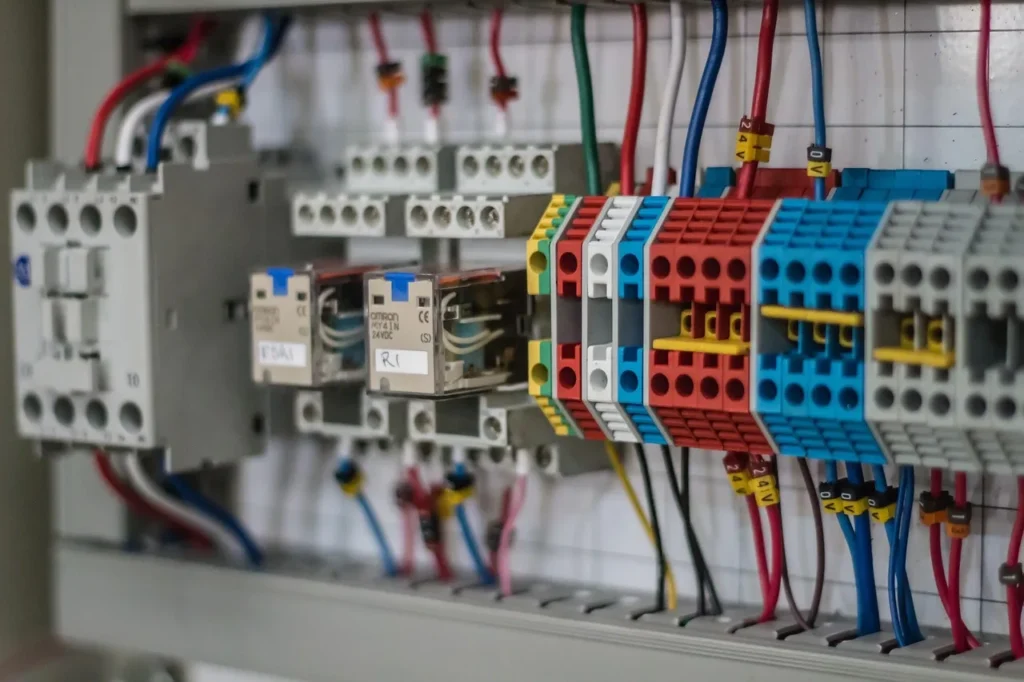
Wiring a receptacle correctly matters as much as choosing the right protection type — a GFCI device wired backward, for instance, can fail to protect the outlet it's meant to cover.
The mistake that trips up even experienced homeowners isn't confusing the acronyms — it's assuming that because a circuit already has one type of protection, it's automatically covered against the other hazard too. A bedroom on an AFCI breaker still has zero ground-fault protection. A bathroom outlet on a GFCI receptacle still has zero arc-fault protection. Neither device does the other's job, which is exactly why the 2023 NEC requires both in several rooms rather than picking one as a universal upgrade.
Which One Actually Prevents House Fires?
AFCI protection is built specifically around arcing faults, which the electrical safety community identifies as a leading cause of home electrical fires — and arcing faults are a failure mode standard breakers are not designed to catch at all. A standard thermal-magnetic breaker trips on sustained overcurrent or a short circuit; it has no mechanism for recognizing the erratic, lower-current signature of a loose wire nut arcing intermittently inside a wall for months before it ignites insulation or framing. That gap is precisely why AFCI protection exists as its own device category rather than an upgraded standard breaker.
Electrical Safety Foundation International attributes tens of thousands of home fires per year in the United States to arcing-related electrical faults, with hundreds of associated deaths, over a thousand injuries, and hundreds of millions of dollars in property damage annually. AFCI protection doesn't eliminate every ignition source in a home's wiring, but it directly targets the specific failure mode — arcing inside the branch circuit — that a disproportionate share of those fires trace back to.
On service calls, the arcing faults that actually justify an AFCI trip are rarely dramatic. They tend to show up as a breaker that trips once every few weeks with no obvious cause, on a circuit feeding an older extension cord, a loose backstab connection, or a staple driven slightly too deep through a cable during a remodel years earlier. AFCI protection is designed to catch exactly that slow-building, easy-to-miss condition before it becomes a fire — not a dramatic short that a standard breaker would already catch.
Which One Actually Prevents Electric Shock and Electrocution?
GFCI protection exists because a fatal shock can happen at a current level far too small to trip any standard or AFCI breaker — the device fills a gap that has nothing to do with overcurrent or arcing at all. A person's body can conduct a lethal current well under the amperage that trips a 15A or 20A breaker; a GFCI's ~5mA threshold is calibrated specifically around the point where current becomes dangerous to a human, not the point where it damages wiring or triggers a fire.
The industry's standard-bearer estimate on GFCI effectiveness traces back to a CPSC analysis published in 2003 (examining 1999 data), which put GFCI protection's electrocution-prevention potential at roughly 47% of home electrocutions, averaging about 92 deaths a year in the study period. That figure — along with an older, frequently re-cited UL estimate putting GFCI effectiveness in an 81%-95% range (a figure that circulates widely in industry and manufacturer literature, but that this article was unable to trace to a specific, still-accessible UL publication) — is worth treating as a long-standing industry benchmark rather than a current, independently verified statistic; no comparably rigorous, more recent CPSC or UL re-study was found during research for this article. What hasn't changed since then is the underlying physics: current escaping to ground through a person is exactly the condition GFCI protection is built to interrupt, regardless of how old the specific percentage estimate is.
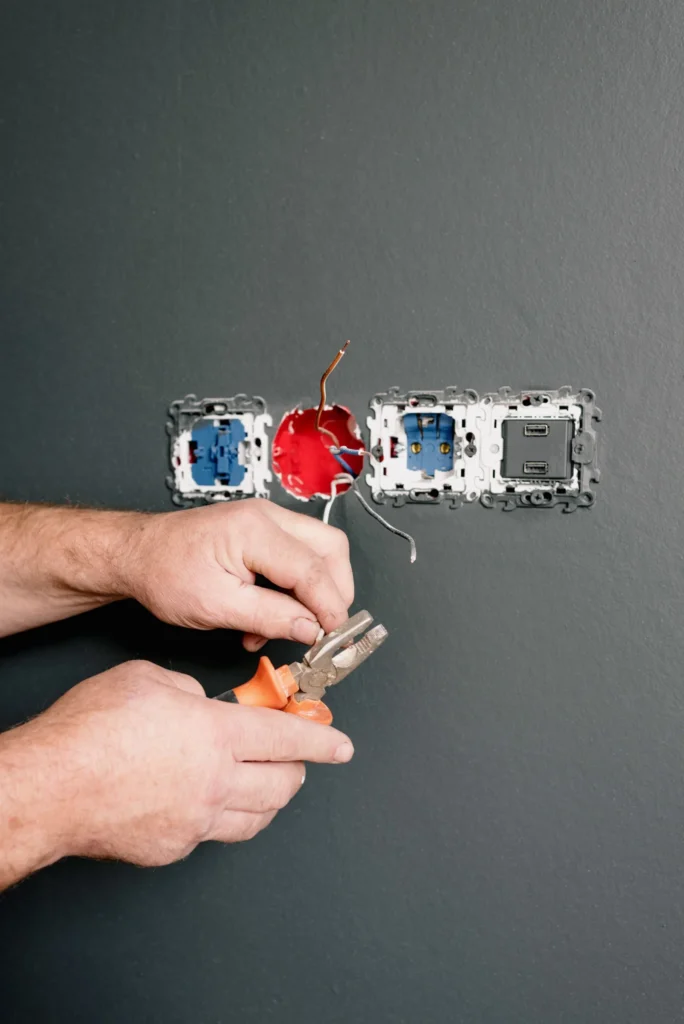
An open panel showing branch-circuit wiring — the physical difference between an AFCI and a GFCI breaker often comes down to a small "SPACE" or "TEST" marking and a coiled white pigtail wire, easy to miss during a quick visual check.
Where Does the NEC Actually Require Each One?
Neither device is a blanket "install everywhere" requirement — the 2023 NEC assigns AFCI and GFCI to specific rooms based on the hazard each one addresses, and three rooms require both. NEC §210.12(B) requires AFCI protection on 120V, single-phase, 15A/20A branch circuits supplying outlets and devices in kitchens, family rooms, dining rooms, living rooms, parlors, libraries, dens, bedrooms, sunrooms, recreation rooms, closets, hallways, laundry areas, and similar rooms, including finished basements.
NEC §210.8 takes a different, hazard-specific approach, requiring GFCI protection for 125V-250V receptacles in bathrooms, kitchens (as of the 2023 NEC, this now covers all kitchen receptacles, not just countertop outlets — including refrigerator, microwave, dishwasher, and disposal circuits), garages, accessory buildings, boathouses, outdoors, crawl spaces, unfinished basements, and laundry areas.

A clearly labeled panel schedule is the fastest way to confirm which circuits already carry AFCI, GFCI, or dual-function protection before starting any panel work.
Jurisdictions are gradually rolling out the 2026 NEC over 2026-2028, and secondary sources describe several changes on the horizon for both sections — including a split between garage and accessory-building GFCI rules under §210.8(A), a higher ampere threshold for outdoor-outlet GFCI protection under §210.8(F), and new flexibility for installing a listed Outlet Branch-Circuit AFCI at the first receptacle of an existing circuit under §210.12(E). None of this is confirmed against a primary NFPA 70 copy in this article, and adoption timelines vary by state and municipality — check with your local authority having jurisdiction before assuming any 2026 change already applies to your project.
What About Places That Need Both?
Kitchens, laundry areas, and unfinished basements aren't an edge case — the 2023 NEC requires full AFCI and GFCI protection on the same circuit in all three, and the practical solution is a single listed dual-function breaker rather than two stacked devices. Historically, meeting both requirements meant an AFCI breaker at the panel feeding a GFCI receptacle downstream, which works but adds an extra device, an extra point of failure, and an extra thing to troubleshoot when either protection type trips.
A Combination Type AFCI/GFCI breaker — commonly called a dual-function breaker — integrates both detection circuits into one device at the panel, satisfying §210.12 and §210.8 simultaneously without a separate downstream GFCI receptacle. It costs more than either standalone breaker, but less than the combined cost and labor of installing two separate devices, and it gives an inspector or future electrician one clearly labeled device to check instead of two.
The tell for a dual-function breaker in an unfamiliar panel isn't just its label — it's usually a slightly deeper housing than a standard single-function breaker, to fit both detection circuits, plus the same coiled white pigtail neutral wire a standalone GFCI breaker uses. If a panel schedule says "AFCI/GFCI Combo" or "Dual Function" for a kitchen or laundry circuit, that single breaker is doing the job of what used to take two devices.
Which One Trips More Often — and Why?
AFCI breakers trip more often in the field than GFCI breakers do, and the most current survey data available shows standard breakers still causing more trips than either. ESFI's 2024 AFCI and GFCI Performance Survey polled California electrical contractors and found that, across surveyed service calls involving a tripped breaker or fuse, standard (non-AFCI, non-GFCI) breakers accounted for 28% of trips, AFCI breakers 23%, fuses 18%, GFCI breakers 17%, and dual-function AFCI/GFCI breakers 14%.
The same survey found 93.9% of contractors had personally encountered AFCI nuisance-tripping problems on residential systems — a figure that lines up with AFCI's long-standing reputation among electricians as the more trip-prone device, since waveform-based arc detection has historically had a harder time distinguishing benign arcs (vacuum motors, dimmer switches, some LED drivers) from genuinely dangerous ones than a straightforward current-imbalance measurement does for GFCI. Dual-function breakers, notably, trip least often of any category in this survey (14%) — some evidence that combined-detection electronics in current-generation devices may be tuned more conservatively than older standalone AFCI designs, though this survey alone isn't enough to confirm that as a general trend.
How Much Does Each Type of Breaker Actually Cost?
Dual-function breakers cost the most per device, but they replace what would otherwise be two separate protective devices — so the real comparison is per-circuit cost, not per-breaker cost. A standard single-pole breaker typically runs $8-15. A standalone GFCI breaker runs roughly $35-45 (a GFCI receptacle alone, without breaker-level protection, is cheaper at about $15-25). A standalone AFCI breaker runs about $40-45. A dual-function AFCI/GFCI breaker runs anywhere from about $45 up to $100 or more depending on brand, amperage, and pole configuration.
Run the math per circuit, not per device: a kitchen circuit needing both protections costs roughly $75-90 as an AFCI breaker plus a separate GFCI receptacle (plus the extra labor of wiring and troubleshooting two devices), versus $45-100+ for one dual-function breaker that does both jobs and gives you one less connection point to fail. For new panel work in a room that needs both protections, the dual-function breaker is usually the more sensible spec even before accounting for the labor savings.
AFCI vs GFCI: Who Needs What, Where
Match the device to the room's actual hazard, not to a general "more protection is always better" instinct — the code already tells you which hazard applies where.
Bedrooms, living rooms, hallways, and similar finished living spaces: AFCI only. These rooms don't carry the wet-location or appliance-grounding risks that drive GFCI requirements, but they do carry the extension-cord-and-old-lamp-cord arcing risk AFCI is built for.
Bathrooms, garages, and outdoor circuits: GFCI only. These are shock-risk locations — water, damp concrete, and grounded metal equipment nearby — where arc-fault protection isn't the code's priority.
Kitchens, laundry areas, and unfinished basements: Both, ideally via one dual-function breaker rather than an AFCI breaker feeding a separate GFCI receptacle downstream.
Anyone doing a panel upgrade or new circuit install: Check the current NEC edition your jurisdiction has actually adopted before assuming a 2026 NEC change already applies — adoption isn't simultaneous nationwide, and neither device substitutes for the other regardless of which edition is in force.
Frequently Asked Questions
Do I need both AFCI and GFCI protection in my house?
In most of the home, no — bedrooms and living areas typically need AFCI only, while bathrooms, garages, and outdoor circuits typically need GFCI only. The exceptions are kitchens, laundry areas, and unfinished basements, where the 2023 NEC requires both types of protection on the same circuit.
Can one breaker provide both AFCI and GFCI protection?
Yes. A listed dual-function (Combination Type) AFCI/GFCI breaker integrates both detection circuits into a single device at the panel, satisfying NEC §210.12 and §210.8 simultaneously without needing a separate downstream GFCI receptacle.
Why does my AFCI breaker keep tripping for no obvious reason?
Nuisance tripping is a well-documented AFCI issue — ESFI's 2024 survey found 93.9% of surveyed contractors had encountered it. Common triggers include certain LED drivers, dimmer switches, vacuum motors, and long extension-cord runs whose electrical signatures can resemble a dangerous arc closely enough to trip conservative detection electronics. If tripping is frequent, have an electrician verify it's a nuisance trip and not an actual wiring fault before assuming the breaker is simply oversensitive.
Is GFCI or AFCI required for kitchen outlets?
Both, under the 2023 NEC. Kitchen receptacles need GFCI protection (as of 2023, this covers all kitchen receptacles, not just countertop outlets), and kitchen branch circuits also need AFCI protection under §210.12(B) — making the kitchen one of the clearest examples of why a dual-function breaker exists.
Is a dual-function AFCI/GFCI breaker worth the extra cost?
For any circuit where the NEC requires both protections — kitchens, laundry areas, unfinished basements — yes, in most cases. It typically costs less than the combined price of a standalone AFCI breaker plus a separate GFCI receptacle, adds no extra downstream device to troubleshoot, and per the 2024 ESFI survey data, tripped least often of any device category surveyed.