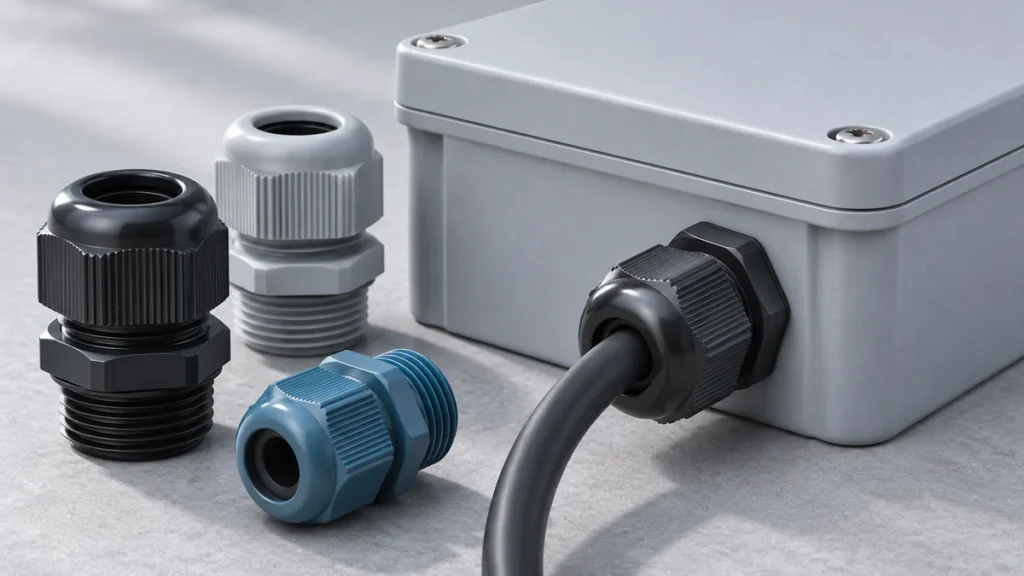
Choose cable glands by checking two separate interfaces: the seal around the cable and the connection to the enclosure. Measure the cable's actual outside diameter, confirm its construction and jacket shape, then match the gland's sealing range, entry thread, wall requirements and documented environmental performance.
Buying “an M20 waterproof gland” is not a complete specification. M20 identifies a thread size; different M20 glands can have different cable ranges, thread lengths, materials and installation requirements.
Measure the Cable Outside Diameter First
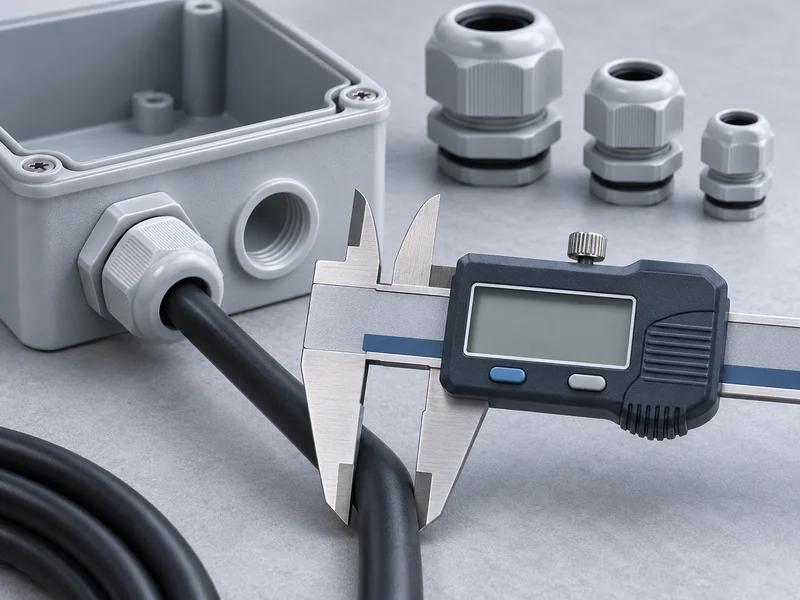
Measure the intact outer jacket at the place that will pass through the seal. Use the cable manufacturer's dimensional data and, when appropriate, a physical measurement to account for the actual product supplied.
Do not select by conductor cross-section alone. Two cables with the same conductor area can have different outer diameters because of core count, insulation, shielding, armour and jacket thickness.
For an illustrative example, a 7 mm round cable falls outside a gland documented for 10–14 mm cable. A seal with a permitted 5–9 mm range is a candidate, but thread fit, cable construction, rating and installation still need checking. These ranges are examples rather than specifications for a BDDKG product.
The CMP gland-size reference shows entry threads and cable dimensions as separate selection fields.
BDDKG Cable-Diameter Options: A Worked Sizing Table
The BDDKG M686-2 product page lists M16 cable options of 3.5–7.0 mm and 7–10 mm, and M20 options of 5–9 mm and 9–12 mm. These are catalogue options checked on 14 November 2026. Confirm the actual insert, entry thread/pitch and supplied configuration before ordering.
| Measured round-cable OD | Candidate from the listed options | Selection result |
|---|---|---|
| 3.0 mm | None | Below the smallest listed range; request a different documented entry system |
| 6.0 mm | M16 3.5–7.0 or M20 5–9 | Both include the diameter; the enclosure interface decides which is usable |
| 8.0 mm | M16 7–10 or M20 5–9 | Choose the option that matches the actual port and supplied seal |
| 10.5 mm | M20 9–12 | The smaller M20 option does not cover this cable |
| 12.5 mm | None | Above the largest listed range; do not force the cable through |
For example, an 8.2 mm cable belongs within the listed M20 5–9 mm option, not the 9–12 mm option. Tightening the larger insert harder is not a substitute for choosing the correct seal. These checks concern diameter only: flatness, jacket material, cable retention and environmental compatibility still need assessment.
The listing does not establish one universal M20 thread pitch or supply an installation torque. Obtain the matching drawing and instructions; a gland that fits the cable can still be wrong for the enclosure wall. Keep conductor area separate: the listing's 0.5–4.0 mm² wire-section field describes a different selection variable from cable OD.
Once the insert and wall interface are confirmed, follow the junction-box installation checks. For an existing wet enclosure, the leak diagnosis guide distinguishes a cable-seal fault from a wall-seal fault or condensation.
Check Cable Construction and Shape
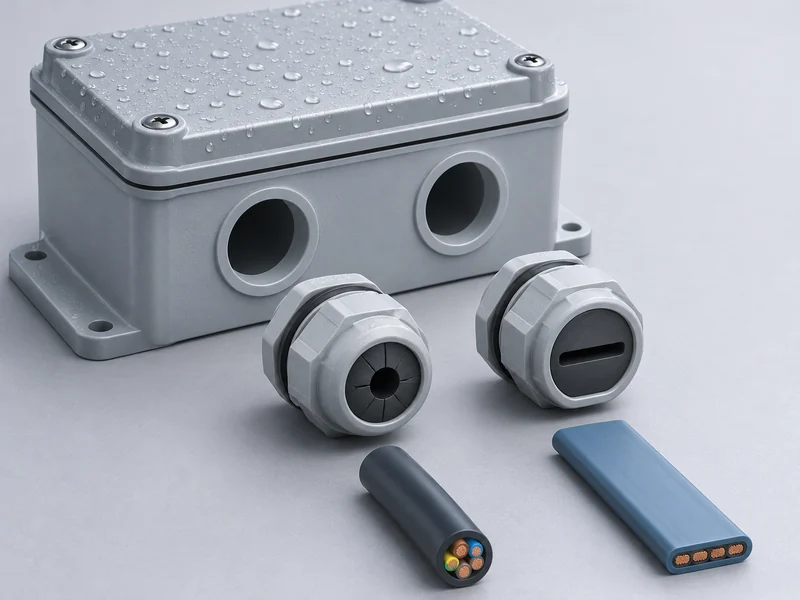
A smooth round unarmoured cable is a different selection problem from an armoured cable, braided cable, flat lighting cable or cable with an assembled connector.
- Round unarmoured cable: check outer-jacket sealing and retention compatibility.
- Armoured cable: assess armour termination and bonding requirements as well as outer-jacket sealing.
- Flat or irregular cable: use a seal designed for that shape.
- Several cables: use a documented multi-hole sealing system with the correct inserts and closures.
- Preterminated cable: assess a split gland or entry system rather than forcing the plug through a seal intended only for the cable.
Do not cut a standard sealing insert to make an improvised split gland. Do not assume a generic polymer compression gland provides an armour termination.
Match the Enclosure Thread and Wall
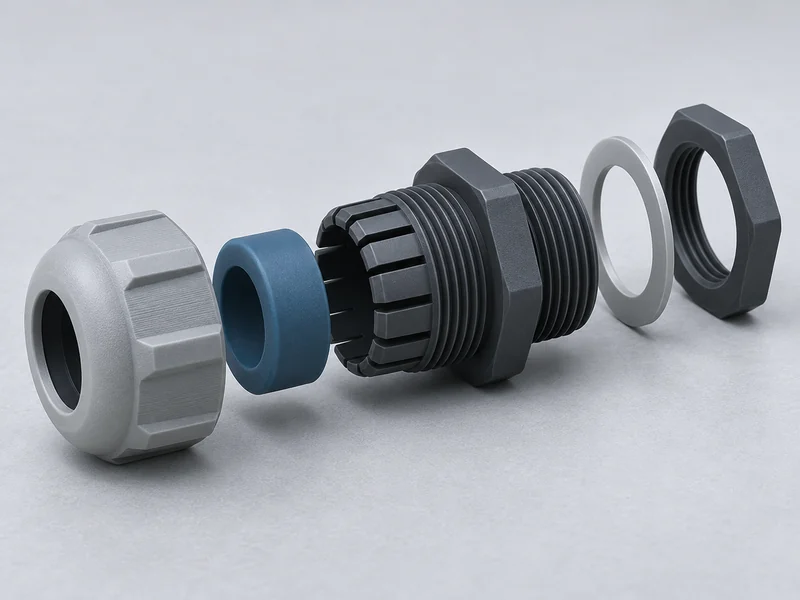
Identify the actual entry thread system, nominal size and pitch. Metric, PG and NPT threads should not be treated as interchangeable because they appear similar. Use an approved adaptor if the design calls for one, and include its sealing requirements in the assessment.
Check whether the enclosure has a threaded entry or a clearance hole. Then verify wall thickness, usable thread length, internal locknut access and the specified enclosure-side sealing method. A gland can clamp the cable correctly while leaking at its connection to the box.
The CMP selection checklist includes cable dimensions, enclosure entry details and wall thickness. Use the equivalent data for the actual gland being purchased.
Distinguish the Two Sealing Points
| Interface | What must match | Typical mistake |
|---|---|---|
| Cable to gland | Cable diameter, shape, jacket and sealing insert | Choosing by conductor size or tightening onto exposed cores |
| Gland to enclosure | Thread or hole, wall thickness and specified seal | Assuming the locknut alone seals the wall |
| Spare insert positions | Approved plugs or closures | Leaving an unused multi-hole opening unsealed |
| Adaptor to enclosure or gland | Compatible fittings and documented sealing procedure | Treating an adaptor as having no effect on the assembly |
A shroud can have a protective role in a particular system, but it should not be assumed to replace the sealing washer, O-ring or entry-thread treatment specified by the manufacturer.
Choose Materials for the Whole Environment
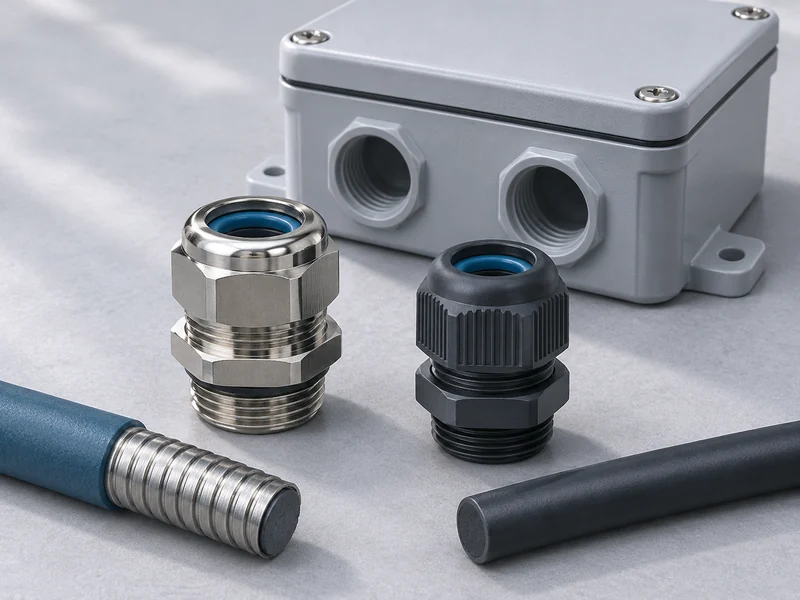
Review sunlight, temperature, salt, oils and cleaning chemicals. The gland body and sealing elastomer may have different compatibility limits. Check both, plus any locknut, washer or bonding accessory.
A metal gland may need a defined bonding arrangement. A polymer gland may be appropriate for a particular environment but cannot be assumed suitable solely because it avoids metal corrosion. Refer to the exact product's material and approval information.
For a hazardous location, use the specifically required certified cable-entry system and competent design process. An ordinary IP68 claim is not an explosion-protection approval.
Match the Protection of the Complete Assembly
The gland's rating applies to its documented installation conditions. It does not establish the rating of an enclosure assembled with incompatible holes, missing seals or an unsuitable cable.
Similarly, an IP68 gland does not upgrade an IP65 box. If both jet cleaning and immersion are expected, request evidence covering both exposures for the proposed assembly. Our IP rating comparison explains why the water test categories differ.
Never use “waterproof” as the only acceptance criterion. Ask for drawings, installation instructions, cable ranges and the applicable rating or approval documents.
Write a Gland Specification You Can Actually Order
Include cable manufacturer and type, outer diameter range, cable shape, armour details, entry thread and pitch, wall thickness, environmental limits, required protection and accessory requirements. Add quantity and whether replacement seals or plugs are needed.
For example: “Round unarmoured cable, actual OD 7.0 mm; enclosure entry M20 × 1.5; wall details on attached drawing; exposed outdoor mounting; gland and entry seal to maintain the documented enclosure protection.” The supplier still needs to confirm an exact product and permitted assembly.
Check the enclosure configuration in the BDDKG waterproof junction box range and submit your cable and entry details. For the surrounding selection process, use our complete junction box guide.
Frequently Asked Questions
How do I know what size cable gland I need?
Measure the cable's outer jacket and choose a compatible gland whose documented sealing range includes it. Then verify cable construction, entry thread, wall fit, materials and required performance.
What cable size fits an M20 gland?
There is no universal range. For example, the BDDKG listing gives M20 options of 5–9 mm and 9–12 mm. An 8.2 mm round cable is within the first option, not the second. Confirm the actual seal, cable compatibility and enclosure interface before ordering.
Are cable glands waterproof?
Some have documented ingress protection when installed with the specified cable, seals and enclosure interface. The product label does not compensate for a cable outside the clamping range or an incorrectly prepared entry.
Can I put two cables through one gland?
Only if it is designed for a multi-cable arrangement and the inserts match both cables. A normal single-hole seal is not automatically suitable for two separate cable jackets.
Do cable glands need a sealing washer?
Follow the gland and enclosure instructions. The required wall seal may be a washer, O-ring or another specified arrangement. A retaining locknut is not a universal substitute.
Can a normal cable gland be used on armoured cable?
Do not assume it can. Where armour termination, mechanical retention or bonding is required, select a gland documented for that cable construction and installation.