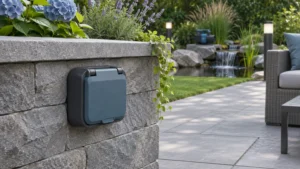
Waterproof junction boxes protect electrical connections from water and dust under specified conditions. To choose one, you need to match its documented protection to the installation environment, then check its material, usable wiring space, cable entries and terminals. An IP rating alone does not tell you whether a box can withstand sunlight, salt, burial or every type of water exposure.
For outdoor lighting, pumps, CCTV and industrial wiring, the important question is how the complete installed assembly will perform. A damaged lid gasket or an incorrectly sized cable gland can compromise an otherwise suitable enclosure.
This guide explains what to check before you buy, how installation affects sealing, and when you need a solution specifically designed for immersion or underground use.
Follow the instructions for your exact model and applicable local electrical rules; mains-voltage work should be performed by a qualified person.
What Is a Waterproof Junction Box?
A waterproof junction box is an enclosure that houses electrical splices, branches or terminations while limiting water and dust ingress to a stated protection level. Depending on the design, it may be supplied empty or with terminals already fitted.
You will find compact inline housings for joining two cables, branching housings with several cable entries, and larger rectangular boxes that accommodate terminal blocks or other connection components.
The enclosure does not replace the circuit's protective devices. If you are deciding between different box types, read our comparison of junction boxes, distribution boxes and terminal boxes.
How Does a Waterproof Junction Box Keep Water Out?

Most serviceable designs rely on several sealing points working together:
- Lid seal: a gasket or O-ring seals the joint between the lid and enclosure.
- Cable entries: compatible glands or entry membranes seal around the cable jacket.
- Unused entries: suitable blanking plugs close openings that are not being used.
- Mounting points: the specified fixing method prevents fasteners from creating unintended water paths.
A gland must match the cable's outside diameter and shape, as well as the enclosure entry. The thread designation alone does not establish which cable diameter it can seal.
Installing an IP68 gland on an IP65 box does not turn the assembly into an IP68 enclosure. Solera makes this same distinction in its sealed-box selection guidance. Check the enclosure manufacturer's permitted combinations of entries, seals and accessories.
Which IP Rating Do You Need?
IP ratings describe protection against access, solid objects and water under the IEC 60529 framework. In the common ratings below, the first digit, 6, indicates dust-tight protection. The second digit identifies the water test category.
| Rating | Water protection category | What you should check |
|---|---|---|
| IP65 | Water jets | Whether the documented rating and outdoor suitability match rain, spray and the actual location |
| IP66 | Powerful water jets | Jet exposure, cleaning method and any restrictions on temperature or pressure |
| IP67 | Temporary immersion under standardized conditions | Whether the installation can exceed the specified immersion conditions |
| IP68 | Immersion under specified conditions beyond the IPX7 test | The manufacturer's stated depth, duration and installation requirements |
The categories above follow the KEYENCE enclosure-rating reference. For a fuller comparison, see IP65 vs IP66 vs IP67 vs IP68.
Do not read IP68 as unlimited underwater service. Ask for the actual test conditions. An immersion rating also does not automatically establish resistance to every water-jet exposure; look for documented ratings covering both conditions when both matter.
IP ratings do not independently establish UV resistance, chemical compatibility or corrosion resistance. NEMA Type designations address a different set of requirements, so do not substitute an IP-only claim for a specified NEMA Type. Ericson's enclosure-rating guidance explains this limitation.
How to Choose the Right Waterproof Junction Box
Start With the Installation Environment
Describe what the box will actually experience: sheltered outdoor exposure, direct rain, hose cleaning, occasional flooding or sustained immersion. Then add sunlight, ambient temperature, chemical exposure and impact risk.
A wall-mounted lighting connection and a pump connection in a flood-prone pit need different evaluations, even if both are described as outdoor installations.
Check the Material and Its Documented Performance
You may encounter ABS, polycarbonate, other engineering plastics, aluminium and stainless-steel enclosures. Material names are a starting point: grades, additives, coatings and construction affect performance.
For an exposed location, ask for documented outdoor and UV suitability. In coastal or chemical environments, include the glands, fasteners and seals in your corrosion and compatibility review. If you use a metal enclosure, confirm the required earthing or bonding arrangement.
Our plastic vs metal junction box comparison explains the broader selection considerations.
Choose the Cable Entry Configuration

| Configuration | Typical purpose | Selection question |
|---|---|---|
| 2-way inline | Join or extend a cable run | Can both cables enter without excessive bending or tension? |
| 3-way branch | Split a run toward another load | Do the entry directions suit the routing? |
| 4-way or multi-entry | Bring several cable runs into one enclosure | Is there enough entry spacing and internal connection room? |
| Larger rectangular box | Accommodate more complex terminations | Can you access and maintain every connection? |
Cable entries and terminal poles are different specifications. A three-entry box does not necessarily contain a three-pole terminal block. Confirm the number of cables, conductors per cable and required connection arrangement separately.
Check Usable Space and Electrical Ratings
External dimensions do not tell you how much wiring space is available after terminals, glands and mounting features are installed.
Check the terminal's permitted conductor type, cross-section, strip length, voltage, current and tightening requirements. Also allow room for cable bend radii, safe separation and future inspection. An empty enclosure's rating does not establish the current capacity of a completed assembly.
For installations governed by US rules, enclosure selection also needs the applicable box-fill or conductor-bending assessment. Our pull box vs junction box guide introduces those different sizing considerations.
Installation Basics: Protect the Complete Assembly

Use the instructions for the specific box, glands and terminals. Before opening or wiring a mains-voltage circuit, isolate it and have a qualified person verify that it is de-energized.
During installation:
- Inspect the enclosure, gasket and entry seals for damage or contamination.
- Use designated mounting points and approved entry locations.
- Fit glands within their specified cable-clamping range, sealing against the outer cable jacket.
- Support cables so their weight and movement do not load the terminals or seals.
- Close every unused opening with a compatible sealing accessory.
- Keep conductors clear of the gasket and close the lid evenly to the specified torque.
Where permitted by the product instructions, downward-facing entries and suitable drip loops can reduce water running toward an entry. They support the sealing system; they do not replace it.
Do not add arbitrary holes or apply sealant over a poor fit. Modifications can change the enclosure's protection and may invalidate its documented configuration. Complete the electrical verification required for the installation before energizing it.
Common Applications and What Changes Between Them
For outdoor LED and landscape lighting, consider branching layout, cable diameter, exposure to irrigation and whether the enclosure sits above areas where water collects.
For CCTV and network connections, allow space for assembled plugs, couplers and cable bends. A compact power-cable joint may not accommodate an RJ45 connector. See our guide to waterproofing RJ45 connectors for connection-specific options.
For pumps and irrigation, establish whether the connection can become submerged, for how long and at what depth. Specify the full connection system against those conditions.
For industrial or coastal installations, review washing practices, vibration, temperature, chemicals, salt exposure and mounting hardware in addition to the ingress rating.
Can You Bury a Waterproof Junction Box?
Only choose burial when the exact connection system is documented for that application and the installation complies with local requirements. An IP68 marking alone does not establish direct-burial suitability.
Underground connections may face standing water, soil pressure, chemicals and mechanical damage. Access and inspection requirements also matter. Some applications call for a purpose-designed encapsulated joint rather than an ordinary gasketed box.
HENSEL distinguishes its general junction boxes from systems intended for underwater and in-ground applications. Treat that distinction as a reason to check the exact product specification before burying a connection.
Why Can Water Appear Inside a Waterproof Box?

Water inside a box may come from an external leak or from moisture condensing inside it. Sealing humid air into an enclosure does not remove that moisture.
| Finding | Possible cause | What to investigate |
|---|---|---|
| Moisture near an entry | Incorrect gland fit, loose accessory or water travelling along the cable route | Cable diameter, gland assembly, cable condition and routing |
| Moisture along the lid joint | Dirty, displaced or damaged gasket; uneven lid closure | Gasket seating, enclosure damage and specified tightening procedure |
| Droplets after temperature changes | Condensation from trapped moisture | Installation humidity and the manufacturer's condensation-control options |
| Water after a pit floods | Exposure beyond the product's documented conditions | Immersion specification and suitability of the complete joint system |
These are investigation starting points, not diagnoses. Isolate the circuit before inspection. Depending on the application, a manufacturer may offer a compatible pressure-equalization vent, drainage system or encapsulation solution. HENSEL describes different approaches in its condensation guidance. Do not drill a drain hole into a sealed enclosure without checking how that affects its permitted use.
Frequently Asked Questions
Are junction boxes waterproof?
Some are designed and rated for water exposure; others are intended for dry indoor locations. Check the exact model's ingress rating, permitted environment and installation instructions. A closed lid by itself does not establish waterproof performance.
What IP rating should an outdoor junction box have?
Choose it against the expected exposure. Water jets, temporary immersion and sustained immersion are different conditions. Also check outdoor material suitability, cable entries and mounting requirements; there is no single IP rating that covers every outdoor location.
Can an IP65 junction box be used underwater?
An IP65 rating does not establish immersion protection. Use a connection system documented for the required immersion conditions. Adding silicone or an IP68 gland does not establish an immersion rating for an IP65 assembly.
Is IP68 better than IP67 for a junction box?
IP68 addresses immersion under specified conditions beyond the IPX7 test, but you still need the actual depth and duration. It is useful when your exposure requires those conditions; it does not automatically establish suitability for burial, salt water or hose cleaning.
Can a waterproof junction box be buried underground?
Only when the specific system is suitable for burial and local installation requirements are met. Check mechanical protection, soil conditions, immersion exposure and access requirements. Do not use IP68 as a substitute for direct-burial documentation.
How do you stop condensation in an outdoor junction box?
First distinguish condensation from leakage. Reduce trapped installation moisture and use a manufacturer-approved solution appropriate to the exposure, which may include venting or encapsulation. Any accessory must remain compatible with the required enclosure protection.
Do you need to put silicone around a waterproof junction box?
Use sealant only where the manufacturer specifies a compatible product and procedure. Correctly assembled gaskets, glands and blanking accessories should provide the intended sealing. Added silicone is not a reliable correction for damaged seals or mismatched entries.
Before You Order
Prepare the installation location, water exposure, cable outside diameters, conductor sizes, entry count, terminal arrangement and required documentation. This gives your supplier enough information to assess a suitable configuration.
Explore BDDKG waterproof junction boxes, or send your project requirements to confirm the available model, entry options and supporting technical documents before ordering.