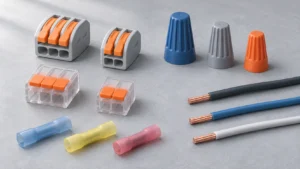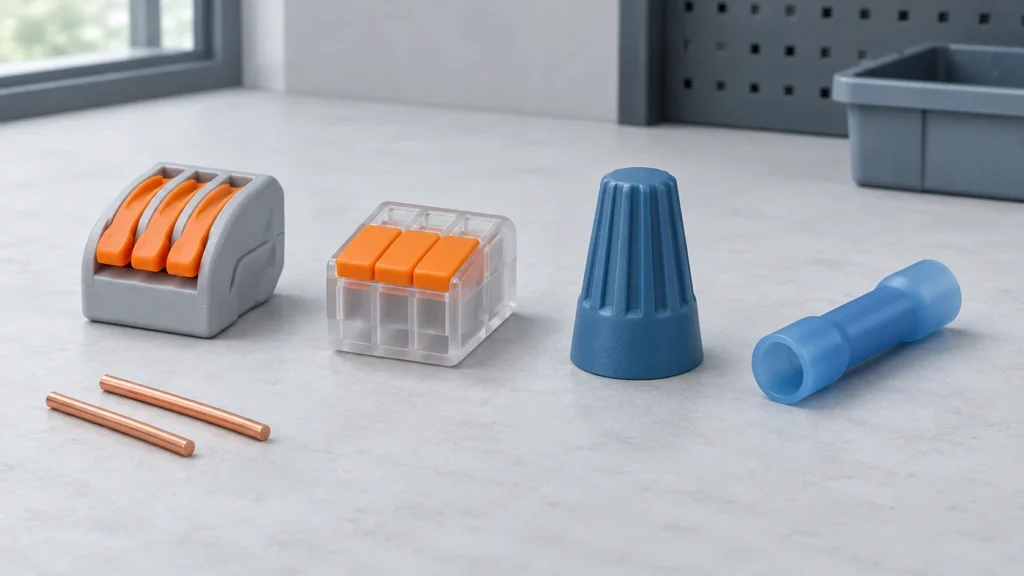
The main wire splice connector types are lever-operated spring connectors, direct push-in connectors, twist-on connectors, crimp splices and specialized sealed splice systems. Choose by the connection you need to make and the conductors involved. The easiest connector to operate is useful only when its exact specifications fit your application.
Your first decision is whether you need an inline extension, several conductors joined at one electrical node, or a branching connection. After that, compare conductor compatibility, service access, environment and installation tools. This article explains those distinctions; qualified personnel must assess and carry out electrical work under local requirements.
Separate Connection Layout From Clamping Method
Inline, branch and multiport describe the layout of a connection. Lever, twist-on and crimp describe how the conductor is retained. Waterproof describes a claimed environmental capability under stated conditions. These labels answer different questions and can overlap.

For example, an inline connector can use a lever mechanism or a crimp barrel. A sealed system may protect a conventional connector inside a compatible gel enclosure. Buying an item simply because its name contains quick splice or waterproof leaves important questions unanswered.
For definitions and the wider decision sequence, start with the complete wire splice connector guide.
Lever-Operated Spring Connectors
A lever opens a spring clamping point so that the conductor can be inserted or removed using the prescribed method. This is convenient where you expect inspection, changes or connections between compatible conductor constructions. A transparent housing, where provided, can assist visual inspection without replacing the required checks.
Do not treat the lever as proof that every flexible conductor fits. Wire size, strand construction, preparation and temperature limits remain model-specific. Some devices also combine direct insertion for certain conductor types with lever operation for others.
IDEAL's lever connector instructions distinguish procedures by conductor construction and connector model. That is a useful reminder to compare the actual instructions rather than adopting a single universal lever-connector procedure.
Direct Push-In Connectors
Direct push-in designs accept eligible conductors into spring contacts without a separate lever-opening step. They can suit repetitive assembly where the conductor construction and preparation are consistent. Their compact form may also help where the permitted enclosure space is limited.

The main selection trap is assuming that every stranded or flexible wire can be pushed into every spring connector. Manufacturers offer different contact technologies and permitted conductor ranges. WAGO's installation tips discuss PUSH WIRE products for solid conductors; this does not establish the limitations of every push-in product on the market.
Check how the selected connector releases the conductor and whether reuse is permitted. Do not pull, twist or probe a contact based on instructions for another series. For a closer operating comparison, see lever vs push-in vs twist-on connectors.
Twist-On Wire Connectors
Twist-on connectors grip a permitted combination of prepared conductors using an internal connecting element. They are familiar in many building-wiring applications, but their suitability depends on the exact combination and installation instructions, not simply the cap color.
Your purchasing check should identify how many conductors of each size and construction will share the connection. A specification giving one minimum and maximum wire size may not describe every allowed mixture. Use the manufacturer's combination chart and preparation method.
These connectors are relevant when an approved combination, sufficient working space and installer familiarity support the choice. They are less convenient where you repeatedly need to identify or remove one conductor from a group. Do not turn this preference into a blanket claim that twist-on connections are unsafe or that another mechanism is always more reliable.
Crimp and Butt Splices
A crimp splice forms a connection by permanently deforming a barrel around the intended conductors. A butt splice commonly joins wires entering from opposite ends. Other crimp layouts serve different joining needs. The resulting joint depends on the specified connector, wire preparation, tool, die and crimp process working together.

Crimp splices can be appropriate for harness assembly or a compact permanent extension where the selected product is approved for the conditions. They normally require cutting out and replacing the joint rather than reopening a spring clamp when a change is needed.
TE Connectivity's PLASTI-GRIP selection guide provides wire-size and tooling information for specific splices. The important selection lesson is that a connector and tool form a specified process; general-purpose pliers are not a substitute for a documented crimp system.
Sealed and Environmentally Protected Splice Systems
Sealing may use a purpose-designed housing, gel, resin or a specified heat-shrink assembly. The system must address the places where moisture can reach the joint, including the cable interfaces. An insulated barrel or plastic cap alone does not establish wet-location suitability.
For example, TE's DuraSeal D-406-0002 product page identifies a particular sealable butt splice. Its properties belong to that product and its permitted application, not every heat-shrink splice with a similar appearance.
If your joint will face rain, condensation, flooding or burial, use the outdoor splice connector guide. For detachable sealed interfaces rather than conductor splices, the existing waterproof connector types article covers the broader category.
Match the Type to Your Maintenance Need
| Your connection need | Candidate approach | Condition that decides suitability |
|---|---|---|
| Reopen an individual conductor during service | Lever-operated connector | Approved wire construction, preparation and enclosure |
| Repeat consistent solid-wire assembly | Suitable direct push-in connector | Exact model's accepted conductor and release instructions |
| Join an approved group of conductors | Suitable twist-on connector | Manufacturer's wire combination chart |
| Make a compact permanent inline joint | Butt crimp splice | Correct conductor, barrel, tool and die system |
| Protect a joint in a wet environment | Documented sealed splice system | Complete assembly and exposure suitability |
A Useful Example: One Cable Extension, Different Priorities
Suppose you must extend a disconnected equipment lead. If future changes and inspection are important, a compatible releasable connector inside a suitable accessible enclosure may be the better candidate. If the approved equipment repair process calls for a crimped harness splice, the designated barrel and tool process may control the decision instead.

Neither candidate is selected by appearance alone. Confirm equipment instructions, conductor compatibility, mechanical support and the applicable environment before choosing. If the extension changes cable routing, flexing or strain, evaluate those effects too.
Your shortlist should therefore include:
- The intended electrical layout and number of separate nodes.
- Every conductor's material, construction and size.
- The required enclosure, cable support and access.
- Whether the joint should reopen or be replaced during service.
- The exact installation process and verification requirements.
Use the wire splice connector selection guide to turn this shortlist into a specification.
Frequently Asked Questions
What is the difference between a butt splice and a wire connector?
A butt splice is one type of wire connector, usually arranged for an inline joint with conductors entering from opposite ends. Wire connector is the broader category, including spring, twist-on and other joining methods.
Are all push-in connectors suitable for stranded wire?
No. Check the specific model and conductor construction. Solid, rigid stranded and fine-stranded wire can have different acceptance rules, even within one manufacturer's range.
Are lever connectors reusable?
Releasable models may permit reconnection under their instructions. Inspect their condition and the conductor before reuse. Reopenability does not establish suitability after overheating, contamination or mechanical damage.
Does heat-shrink tubing make any splice waterproof?
No. A suitable sealed splice is a documented assembly with compatible components and an installation process. Adding unspecified tubing to an arbitrary joint does not prove suitability for rain, immersion or burial.
Technical sources reviewed 18 November 2026.