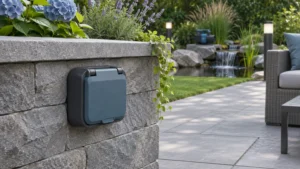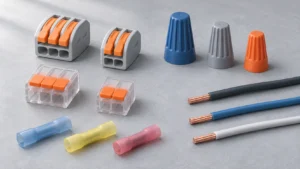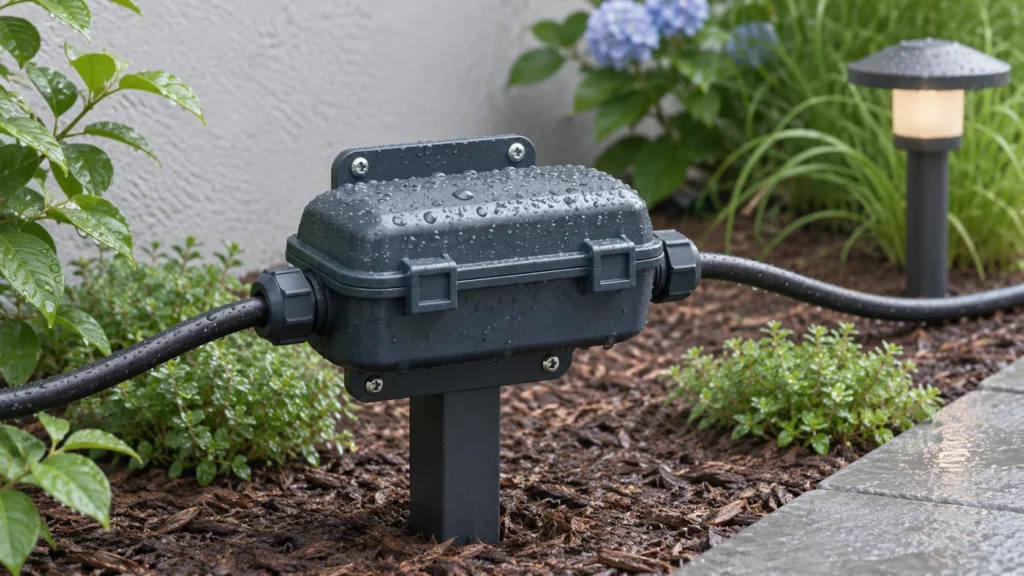
Choose an outdoor wire splice system by checking two separate things: whether the connector accepts your conductors and whether the complete assembly is suitable for its exposure. A strong electrical splice is not automatically moisture-resistant. An IP marking also does not, by itself, establish suitability for direct burial, sunlight, every chemical or every installation voltage.
Your choice should start with the actual location: a sheltered light fitting, an exposed garden junction, a damp chamber and a buried cable joint present different conditions. For mains circuits, have a qualified electrician assess the connection, enclosure and circuit protection together.
Define the Exposure Before Choosing a Product
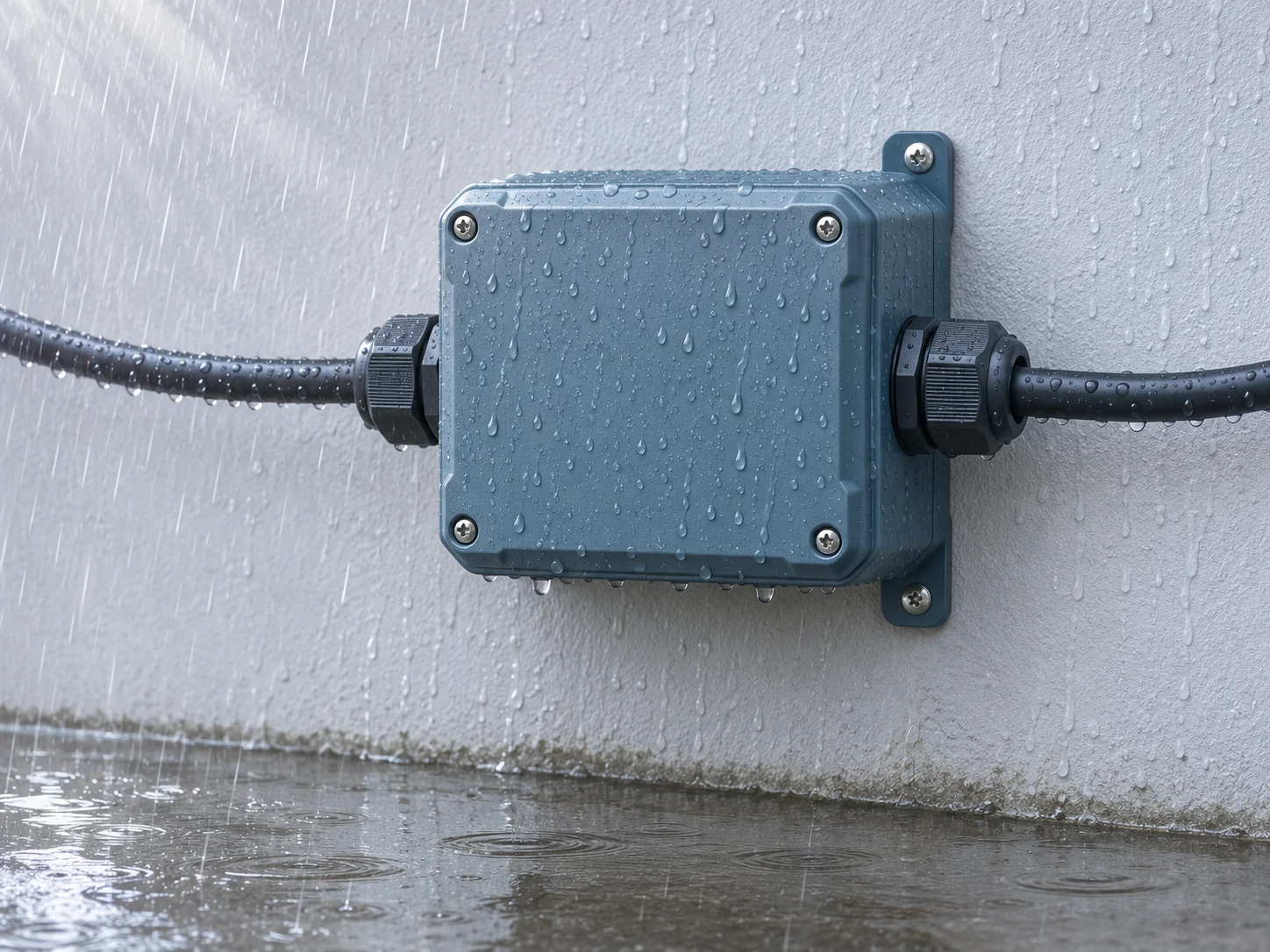
Describe what can reach the joint during normal use and foreseeable maintenance. Rainfall is only one source of moisture. Condensation can form inside an enclosure, water can track through a cable route, and a nominally dry chamber can flood. A connector mounted above ground may still be exposed to jets during cleaning.
Record the temperature range, sunlight, vibration and mechanical damage risk as well. A seal that fits at installation can be disturbed by cable movement or an incompatible cable jacket. Chemical resistance needs checking wherever fertilizers, oils, cleaning liquids or salt exposure are relevant.
| Installation situation | Evidence to request | Assumption to avoid |
|---|---|---|
| Sheltered exterior fitting | Permitted location and condensation provisions | A roof makes all connections dry |
| Exposed wall or garden equipment | Complete sealing arrangement and weather suitability | An insulated connector is waterproof |
| Chamber liable to flooding | Specified water exposure conditions and cable system suitability | A chamber always stays drained |
| Direct contact with soil | Explicit direct-burial suitability and installation instructions | An IP rating grants burial permission |
| Washdown area | Suitable jet exposure, materials and cleaning compatibility | Immersion performance covers every jet condition |
This description is more useful to a supplier than requesting the highest IP number without explaining the duty. It also helps identify whether the splice needs relocation rather than a different connector.
Match the Electrical Connection Independently
Check the connector's conductor material, size range, construction and permitted combinations. Identify solid, rigid stranded and flexible conductors accurately. For a sealed inline device, also verify the number of electrically independent paths rather than treating cable-entry count as pole count.
Your wire cross-section and the cable's outside diameter perform different jobs in selection. The first affects the electrical termination; the second often determines the seal fit. Two cables with the same conductor area may have different jacket diameters. A gland selected only from an AWG value can therefore be unsuitable.
The wire splice connector selection guide covers electrical matching. For outdoor use, retain that selection and then verify the environmental assembly around it. Neither layer compensates for a mismatch in the other.
Compare Complete Sealing Systems
Outdoor splices may use a connector inside a sealed enclosure, a matched gel-filled protective system, an approved resin joint or a sealed crimp arrangement. These are different assemblies with different installation and servicing requirements. A bag of ordinary connectors plus an unrelated sealant is not equivalent to a documented system.
For example, WAGO publishes a defined Gelbox-and-connector system for moisture protection. Its GB guidance distinguishes SELV applications from low-voltage applications such as 230 V, where an additional junction box is required. This is a model-family example, not a general exemption for every gel-filled splice. Check the exact regional product documentation. WAGO Gelbox guidance.
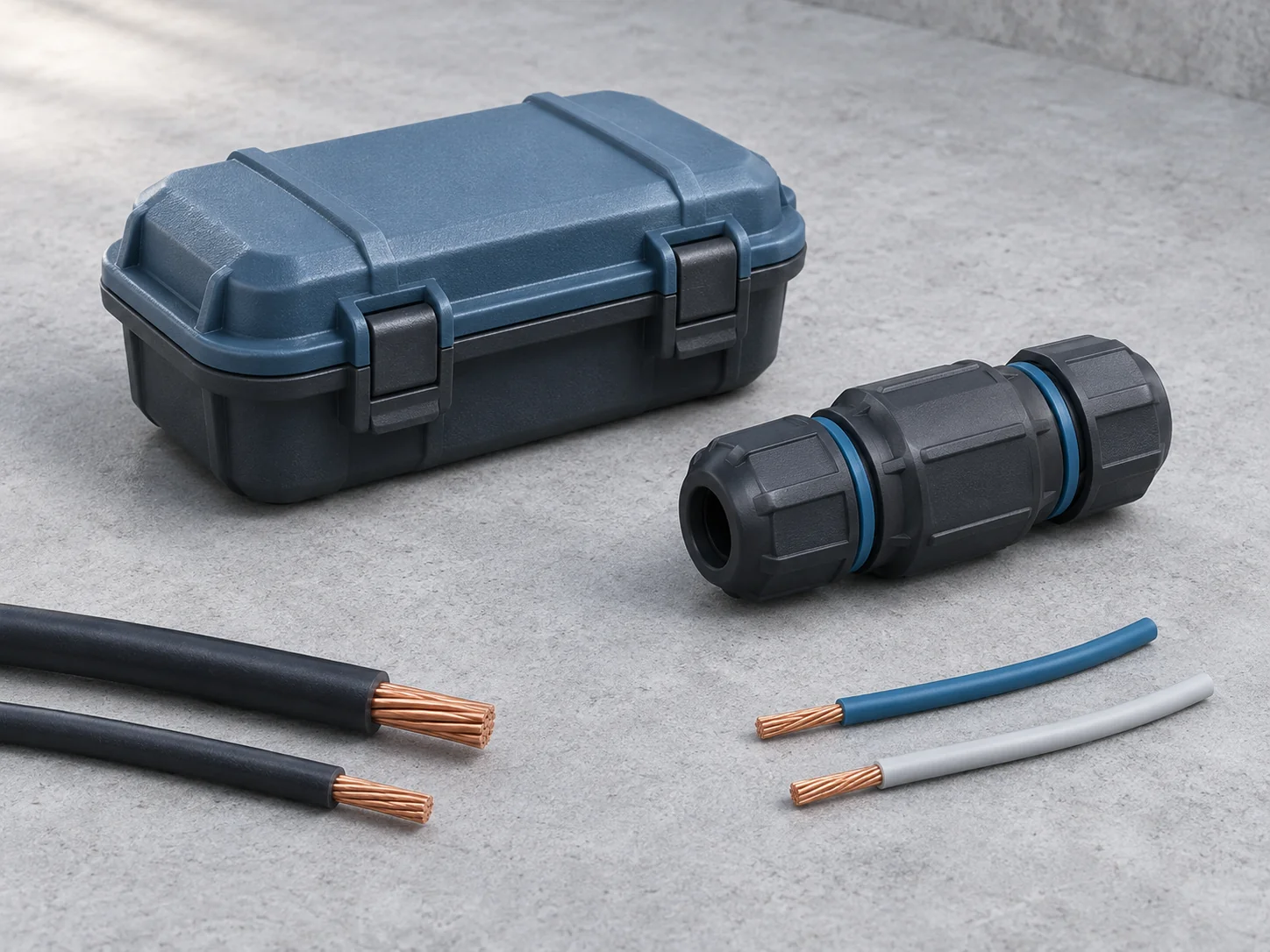
Ask whether seals are replaceable, whether the system may be reopened and which components must be renewed afterward. Re-accessible does not necessarily mean reusable. WAGO's cited guidance, for example, requires new Gelboxes and connectors when rewiring to maintain the stated protection.
Read the Rating With Its Conditions
An ingress-protection rating describes specified water or solid-object protection tests. It does not answer every environmental or electrical question. The manufacturer's documentation should identify the relevant assembly, cable sizes, permitted orientation, closure process and exposure conditions.
Do not substitute an immersion rating for confirmed suitability against a different exposure such as high-pressure cleaning. Similarly, a water-protection claim does not establish UV resistance, impact resistance or compatibility with the soil and chemicals at your site. If these characteristics are essential and undocumented, request evidence or choose another assembly.
Avoid turning the product name into a permission statement. Waterproof is commonly used as a category description; the useful specification is what the exact assembled system is documented to withstand. Keep that distinction when comparing quotations and product listings.
Verify Every Cable Entry and Mechanical Interface
The cable jacket must fit the sealing component in both size and shape. Flat cable, multiple separate wires and round jacketed cable may require different interfaces. Unused openings need the specified closures. Mixing seal inserts or gland parts from unrelated systems may prevent the intended compression.
Cable support matters because pulling and bending loads can disturb the seal or reach the electrical contact. Provide restraint as the system requires, and route the cable so routine servicing does not load the splice. Do not tighten an entry fitting by guesswork when the manufacturer specifies an assembly method or torque.
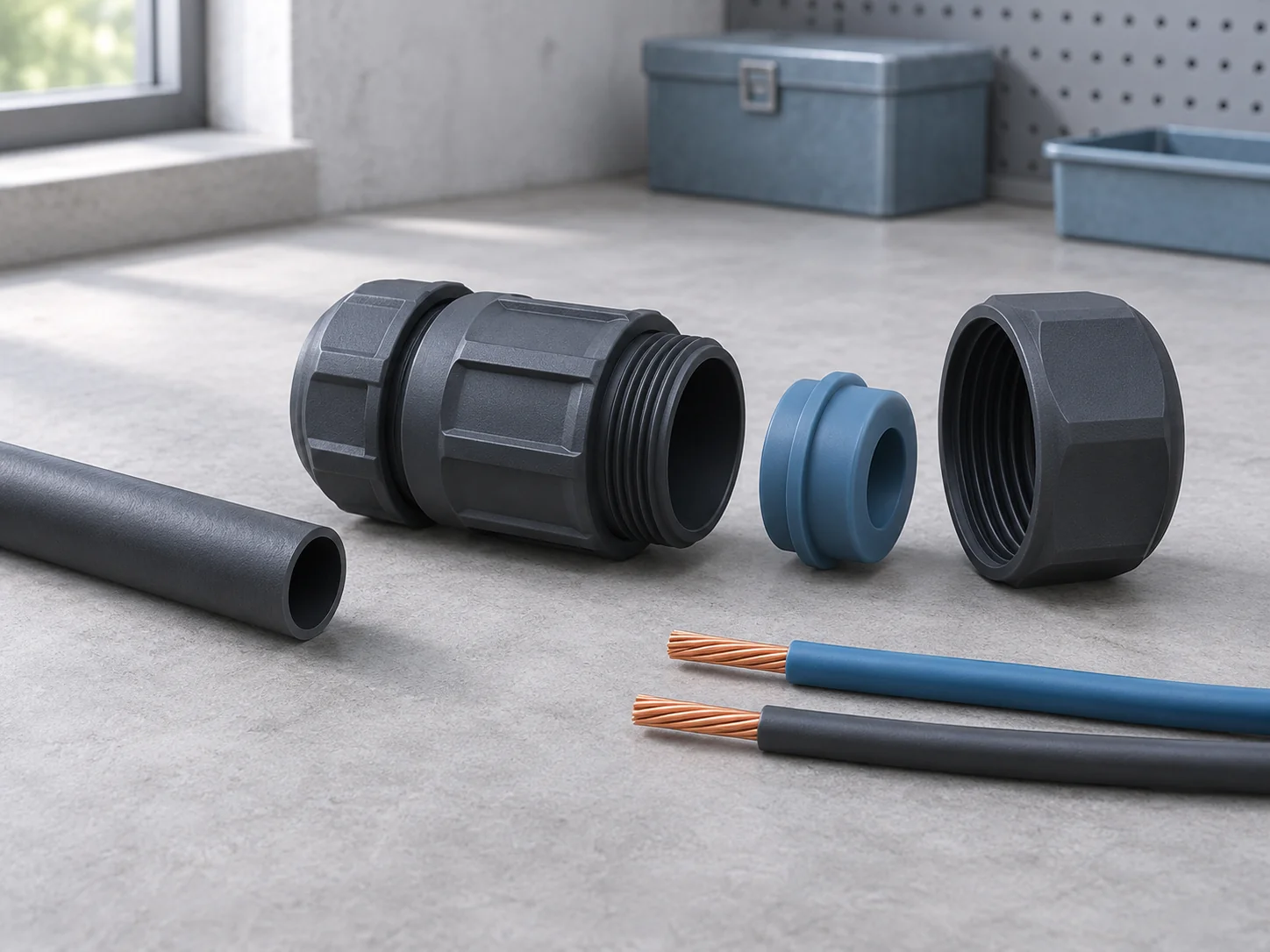
Qualified installers should inspect sealing surfaces for debris, trapped insulation, cracks or distortion before closure. An extra layer of silicone cannot establish that an incompatible or damaged assembly now meets its intended performance. Restore the documented system instead of disguising the defect.
Work Through a Bounded Selection Example
Suppose your project joins a fixed outdoor lighting cable to a flexible luminaire lead inside an above-ground enclosure. The location experiences rain and temperature cycling but is not intended to flood. This is a hypothetical selection exercise, not a recommendation for a particular BDDKG model.
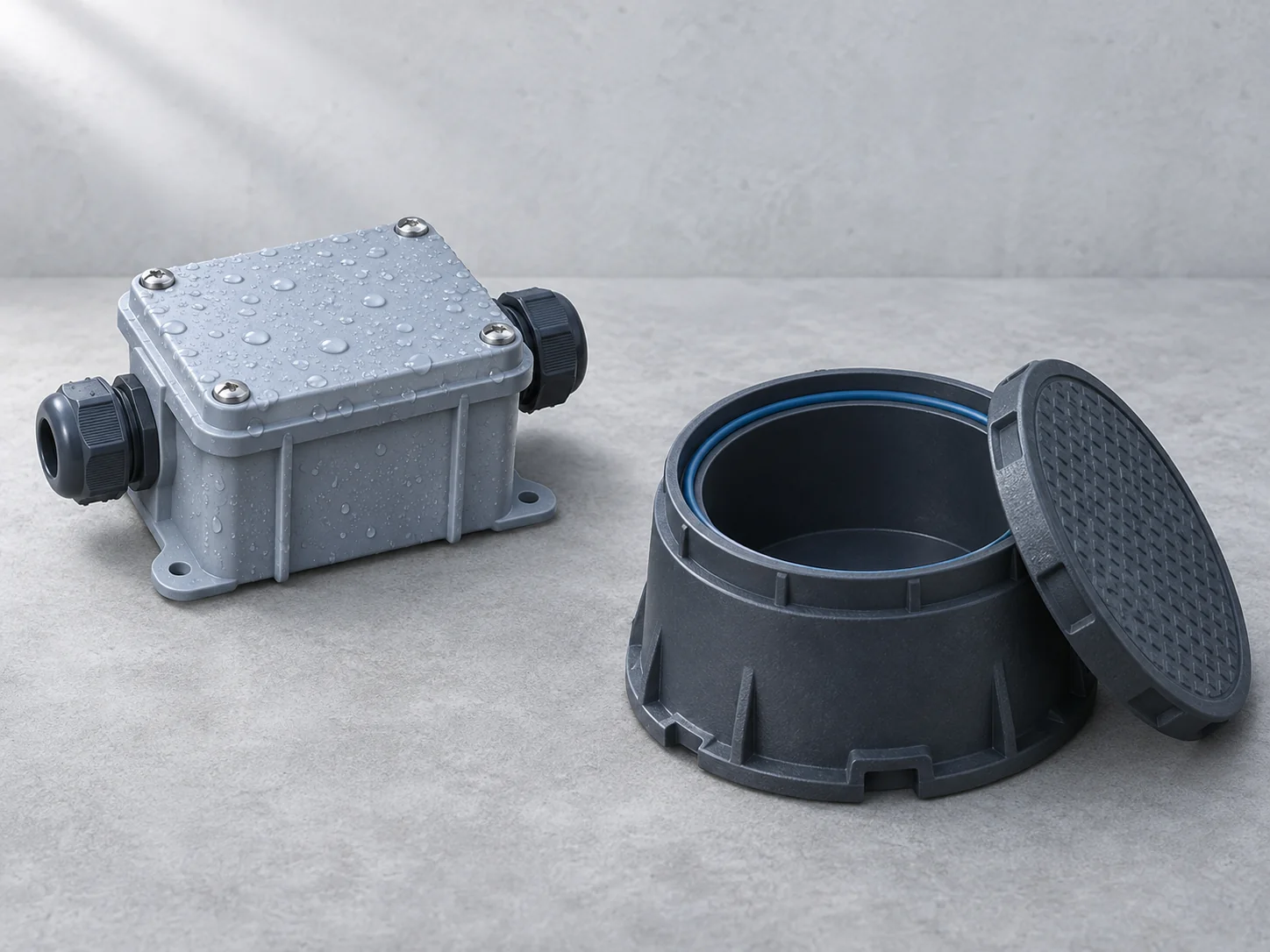
First, identify both conductor constructions and choose a connector that accepts them. Second, check cable-jacket dimensions against the enclosure entries. Third, verify the enclosure's weather suitability and any manufacturer-approved moisture protection at the connection point. Finally, confirm circuit protection, installation rules and verification with the electrician.
If the same connection is moved into a chamber that regularly fills with water, the previous selection is no longer established. Reassess the entire system for that exposure; do not assume that adding gel or raising one cable entry solves the change in duty.
Prepare a Useful Supplier Enquiry
Your enquiry should include:
- Country, installation voltage and circuit purpose.
- Conductor material, construction, size and quantity.
- Cable-jacket dimensions and shape for every entry.
- Rain, jets, flooding, soil contact, temperature and chemical exposure.
- Need for future access and component replacement.
- Required product documents and installation records.
Use the junction-box requirements article to establish the enclosure question early. After selection, use the installation overview to check preparation, inspection and qualified-person verification.
Frequently Asked Questions
Can ordinary lever connectors be used outdoors?
Only within a complete arrangement documented as suitable for the location and electrical application. A standard insulated lever connector alone is not evidence of rain, flood or UV protection.
Does a waterproof connector need a junction box?
Sometimes it does. Electrical insulation, mechanical protection and local installation requirements still apply. The cited WAGO example expressly distinguishes its SELV use from 230 V use requiring an additional enclosure.
Can I bury a waterproof wire splice connector?
Do not infer burial suitability from the word waterproof or an IP marking. Require explicit documentation for the complete joint, cable and burial application, together with compliance with local installation requirements.
Can a gel-filled splice be reopened and reused?
Follow the specific system instructions. Reopening to access a connection does not mean the gel case and connectors can be reused. Some systems require both to be replaced after opening or rewiring.
Technical sources checked 18 November 2026.