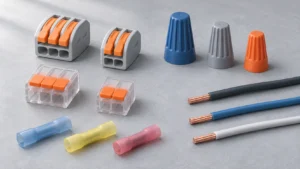
For ordinary fixed mains wiring, plan to place wire splice connectors inside a suitable enclosure. That enclosure may be a junction box or an equipment wiring compartment designed for the connection. An insulated connector housing alone does not establish that a splice can be left exposed or concealed in a wall.
Exceptions depend on a documented product system, the wiring method and the rules adopted in your location. A purpose-designed cable joint or a specifically permitted extra-low-voltage assembly can differ from a loose connector joining mains conductors. Have a qualified electrician establish which arrangement applies before the work is installed or covered.
Separate the Connector's Job From the Enclosure's Job
The connector grips and electrically joins conductors within its specified limits. Its housing provides the insulation intended for that component. The surrounding enclosure can provide additional protection for the wiring arrangement, cable entries, mechanical stresses and environment.
These functions overlap but are not interchangeable. A compact connector may protect its contact while leaving individually insulated wires outside a cable sheath. It may also lack cable restraint, a mounting arrangement or protection against physical damage. Calling it touch-safe does not answer those other questions.

If your original question is whether electrical tape can replace a box, specify a suitable enclosure or a documented alternative system. Tape around an ordinary splice does not establish the mechanical, environmental and installation properties of an approved enclosure.
Identify What Kind of Installation You Have
Start with the circuit and wiring method rather than the connector brand. Fixed building wiring, a luminaire's wiring compartment, a control cabinet and a cable joint designed for burial are different installation situations.
| Situation | Appropriate starting point | Evidence still needed |
|---|---|---|
| Fixed mains wiring splice | Suitable wiring enclosure | Local rules, entries, capacity and access |
| Connection inside equipment | Designated wiring compartment | Equipment instructions and permitted field wiring |
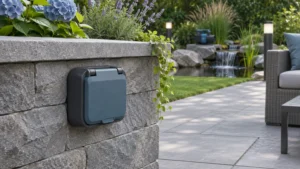
| Outdoor splice | Suitable complete environmental assembly | Sealing, cable compatibility and electrical enclosure requirements |
| Special cable joint | Purpose-designed joint system | Approval for cable, voltage, location and wiring method |
| SELV connection | Assess the specific system and location | Actual SELV classification, insulation and manufacturer conditions |
Do not classify an installation as SELV merely because its nominal voltage is small. SELV is a protective system concept with requirements beyond a number printed on a power supply. Your designer or electrician must establish the classification and applicable conditions.
Distinguish Product Tests From Installation Permission
A connector's approval or current rating is evidence about that product within a defined scope. It does not independently authorize every way the product might be installed. A moisture rating does not settle enclosure, mechanical-protection or accessibility questions either.
For US workplace installations, OSHA's wiring-method requirements address suitable covers for junction boxes. That establishes the importance of the complete wiring enclosure in that regulatory context. OSHA's workplace standard is not the residential code for every home or the installation standard for another country.
For a US project, have the electrician verify the locally adopted electrical code, amendments and approval of any alternative wiring system. For a UK project, assess the applicable wiring regulations and accessory instructions. Do not transfer a product claim between markets without checking its scope.

Check Whether an Existing Enclosure Already Does the Job
You do not necessarily need an extra standalone box beside every device. Equipment may have a designated compartment suitable for its field connections. The question is whether that compartment is intended for the conductors, connector arrangement and installation conditions involved.
Check the manufacturer's instructions for entry method, space, temperature, routing and any separation between circuits. A nearby hollow cavity or decorative cover is not automatically an electrical wiring compartment. Do not force a connection into equipment simply because its lid can close.
The wire splice selection guide helps establish connector compatibility. Select the enclosure alongside that choice so both fit together physically and electrically.
Waterproof Does Not Automatically Mean Box-Free
WAGO's GB Gelbox guidance distinguishes its defined SELV applications from low-voltage applications such as 230 V, where an outer junction box is needed. This shows why the electrical application matters even when a connection has moisture protection.
Do not generalize this example to every gel case, connector series or country. Establish the accepted combination and instructions for the actual system. A larger outer enclosure also cannot make an incompatible electrical connector suitable for its conductor.

The same caution applies underground. Moisture protection does not establish suitability for direct soil contact, mechanical loading or a different cable arrangement. See the outdoor splice selection article for the separate environmental checks.
Access and Maintenance Are Separate Decisions
A connector described as maintenance-free does not automatically authorize hiding it behind plaster or beneath inaccessible flooring. The complete accessory, cable restraint, conductor combinations, installation method and local rules still need assessment.
IDEAL publishes separate instructions for its In-Sure Box's maintenance-free accessory arrangement, identifying particular connectors and additional conditions. Assess that documented assembly rather than assuming every connector inside any plastic box qualifies.
If you cannot establish that an inaccessible arrangement is permitted, keep an appropriate access provision or redesign the cable route with the electrician. Reusable, maintenance-free, re-accessible and permitted to be concealed are different claims; record them separately.
Size and Complete the Box Properly
Choosing an enclosure involves more than its outside dimensions. Allow for conductors, connectors, bending space, entries and servicing. Apply the capacity rules relevant to the location and wiring system; there is no universal number of connectors per box.
- Use entries and closures intended for the enclosure and cable.
- Keep cable loads away from splice contacts.
- Protect wires from sharp edges and trapped covers.
- Maintain required separation between circuit types.
- Complete earthing or bonding where required.
- Retain appropriate access and identification.

Consider a hypothetical luminaire replacement joining a fixed supply cable to a flexible lead. A compatible connector is only the first selection. If the luminaire has no suitable field-wiring compartment, provide another appropriate enclosure or documented connection system. Hiding the same connector above the fitting does not resolve the missing protection.
Before accepting work, ask the electrician to identify the connector, enclosure, cable-entry arrangement, access decision and relevant verification. This creates a reviewable specification instead of relying on the fact that the connector is insulated.
Frequently Asked Questions
Can I leave lever connectors outside a junction box?
Not simply because they have an insulating housing. Establish the complete arrangement and applicable rules. Plan ordinary mains splices inside a suitable enclosure unless a documented permitted alternative applies.
Does a waterproof splice connector still need a box?
It may. Moisture protection does not settle insulation, restraint or installation requirements. Check the product system and electrical application rather than treating waterproof as a blanket exemption.
Can I hide a maintenance-free connector inside a wall?
The label alone is insufficient. A permitted inaccessible connection depends on the complete accessory system, its instructions and installation rules. Have the arrangement assessed before covering it.
Can an equipment wiring compartment replace a separate box?
It can provide the enclosure where designed and permitted for that field wiring. Confirm the equipment instructions, space, entries and environment; an arbitrary cavity is not equivalent.
Technical sources checked 18 November 2026. This explains installation planning, not compliance for a particular property.