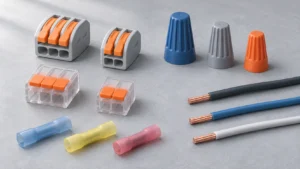
Yes, you can connect solid and stranded wire when the selected connector is expressly suitable for both conductors and the complete combination. Match the conductor material, size, strand construction, circuit requirements and installation environment. Twisting the ends together and covering them with tape is not a substitute for an appropriate connection system.
For fixed wiring, have a qualified electrician assess and perform the work under local requirements. The advice below helps you specify and evaluate a connection; it does not authorize work on energized equipment. Power must be safely isolated and absence of voltage verified by the responsible qualified person before conductors are handled.
Start With the Conductors, Not the Connector Color

Solid wire has a single conductor; stranded wire contains multiple strands. Within the stranded category, a relatively rigid conductor and a highly flexible fine-stranded lead may require different terminal permissions. Describing a wire simply as stranded can leave out information that determines whether a connector is suitable.
Identify each conductor from its cable or equipment documentation. Record its material and cross-sectional size as well as construction. If the material is uncertain, stop and identify it. A copper-to-copper connector is not automatically suitable for aluminum or copper-clad conductors.
Wire colors generally identify functions within a particular installation system; they do not establish conductor construction or connector compatibility. Likewise, a connector's body color is not a universal size chart. The part number and its documentation are the dependable starting point.
Which Connector Types Can Join Them?
You have several possible connection methods, but each needs model-level verification. The wire splice connector comparison explains how their operating mechanisms differ.
| Connector family | What to establish before joining solid and stranded wire | Common incorrect assumption |
|---|---|---|
| Lever-operated splice | Both constructions and sizes are permitted at the relevant ports | Every lever product accepts every flexible cable |
| Push-in splice | The exact stranded construction is accepted, alongside the solid conductor | All push-in products are either universally suitable or universally unsuitable |
| Twist-on | The combination chart covers the specific bundle and preparation method | Any bundle within the overall gauge range is acceptable |
| Crimp splice | The splice, wire combination and matched tooling support the application | One crimp barrel accepts any two wires that physically fit |
WAGO's 221 instructions cover solid, stranded and fine-stranded conductors within the product family's documented scope. That makes suitable lever models candidates for a mixed-construction splice. Check the exact part rather than transferring an entire family's largest size capability to its smaller variants.
Some push-in products also accept stranded wire. WAGO's 2773 handling instructions explicitly discuss solid and stranded conductors. This does not mean a fine-stranded equipment lead is automatically accepted. Where the available documentation does not clearly identify your conductor construction, obtain confirmation or choose a documented alternative.
Use Separate Ports Where the Design Requires Them

A multi-port splicing connector often provides a designated clamping point for each conductor. Do not place a solid wire and a stranded wire together in one entry unless that exact arrangement is permitted. Physical room in an opening does not establish a rated two-conductor termination.
Also check which ports are electrically common. Several holes in a housing do not necessarily represent isolated circuits, and a commoned multi-port connector must not join unrelated circuit conductors. The device's connection diagram or product documentation establishes its electrical arrangement.
The same principle applies when you add another branch later. An unused port is useful only if the intended connection, conductor and circuit arrangement remain permitted. It is not a reason to exceed circuit limits or mix functions. For the overall specification process, use how to choose a wire splice connector.
Prepare the Stranded End Without Changing Its Identity
The correct preparation depends on the terminal. Use its specified stripping length and method, preserving the complete conductor cross-section. Cut or missing strands can undermine the intended connection even when the remaining bundle enters the connector easily.
Do not solder-tin an end or add a ferrule merely because a bare flexible conductor will not enter a particular push-in product. Either modification changes the termination interface. Use it only where the connector documentation permits that preparation, with any required dimensions and tooling.
For a twist-on method, follow its instructions on bundle arrangement and pre-twisting. The lead position of a stranded end and the required stripped lengths are not universal. An instruction for one product should not be copied to another connector simply because the outer shell has a similar shape.
Check the Connection Before It Is Enclosed

The responsible installer should check that the conductors are fully seated, insulation is correctly positioned and no stray strand can contact a neighbouring connection. Apply the manufacturer's retention inspection and operating instructions. A transparent housing assists inspection but does not replace the required electrical verification.
Keep mechanical loads away from the splice. A connector that grips the conductor is not automatically a cable clamp. Provide the enclosure entry arrangement and cable restraint required for the installation, allowing space for the accessory and its conductors without forcing them into position.
Stop if an existing connection shows heat damage, corrosion, a cracked body or damaged conductor insulation. Simply fitting a new connector can leave the cause unresolved. Have the circuit and affected equipment assessed before returning them to service.
Example: A Flexible Luminaire Lead and Fixed Wiring
Suppose your indoor luminaire has a fine-stranded copper lead and the supply uses solid copper. First confirm each conductor's actual cross-section and the equipment connection instructions. A lever splice with explicit permissions for both may be a suitable candidate; a solid-wire-only push-in part is not.
Next, check the permitted connection arrangement, ratings and physical space inside the intended enclosure. Different conductor sizes do not make the smaller lead suitable for every supply circuit. The equipment instructions and circuit protection still govern the installation. This is a planning example, not approval of an unspecified luminaire or connector.
For the practical installation sequence, see how to use wire splice connectors correctly. For the housing decision, read whether wire splice connectors need a junction box.
Outdoor Connections Need a Separate Environmental Check

The ability to join solid and stranded copper does not establish moisture protection. An outdoor connection also needs a documented environmental system appropriate to its exposure, cable and installation. Tape alone does not transform a dry-location connector into a wet-location accessory.
Check the complete assembly rather than combining unrelated protection claims. A sealed box, connector insert, cable gland and cable must be compatible with the intended arrangement. Use the waterproof splice selection guide when rain, condensation or wet conditions are relevant.
Before approving the splice, keep a short record:
- Both conductor materials, sizes and constructions.
- Connector part number and permitted combination.
- Required end preparation and inspection method.
- Circuit and equipment compatibility.
- Enclosure, restraint and environmental provisions.
Frequently Asked Questions
Can you put stranded wire into a push-in connector?
Only if that exact product accepts the conductor construction and size. Some push-in splice products accept stranded wire; others have narrower permissions. A wire entering the opening is not proof of compatibility.
Are lever connectors suitable for solid and stranded wire?
Suitable models are. WAGO's 221 guidance includes both constructions and fine-stranded conductors. Confirm the selected part's limits and installation conditions rather than applying a universal lever-connector rule.
Do stranded wires need ferrules in a splice connector?
Not universally. Check the terminal's approved conductor preparation. Some connectors accept bare flexible conductors directly. A ferrule should not be used as an improvised way to bypass a conductor restriction.
Can solid and stranded wires of different sizes be connected?
Potentially, when the connector permits the combination and the circuit and equipment design support it. A connector's acceptance range does not increase the allowable load of the smaller conductor or waive protection requirements.
Technical sources checked 18 November 2026.