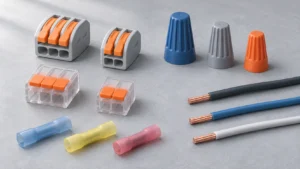
Choose a lever, push-in or twist-on wire connector by checking the conductors and the approved wire combination first. Then compare how you need to install, inspect and maintain the connection. A lever can make changes easier; a push-in design can simplify repetitive work; a twist-on connector can suit an approved group of wires. None is automatically the best choice for every splice.
This comparison covers installation splicing connectors, rather than the push-fit terminals built into some switches and receptacles. Work on fixed electrical wiring belongs with a qualified person operating within local requirements. Connector appearance alone does not establish suitability or safety.
What Changes Between the Three Designs?
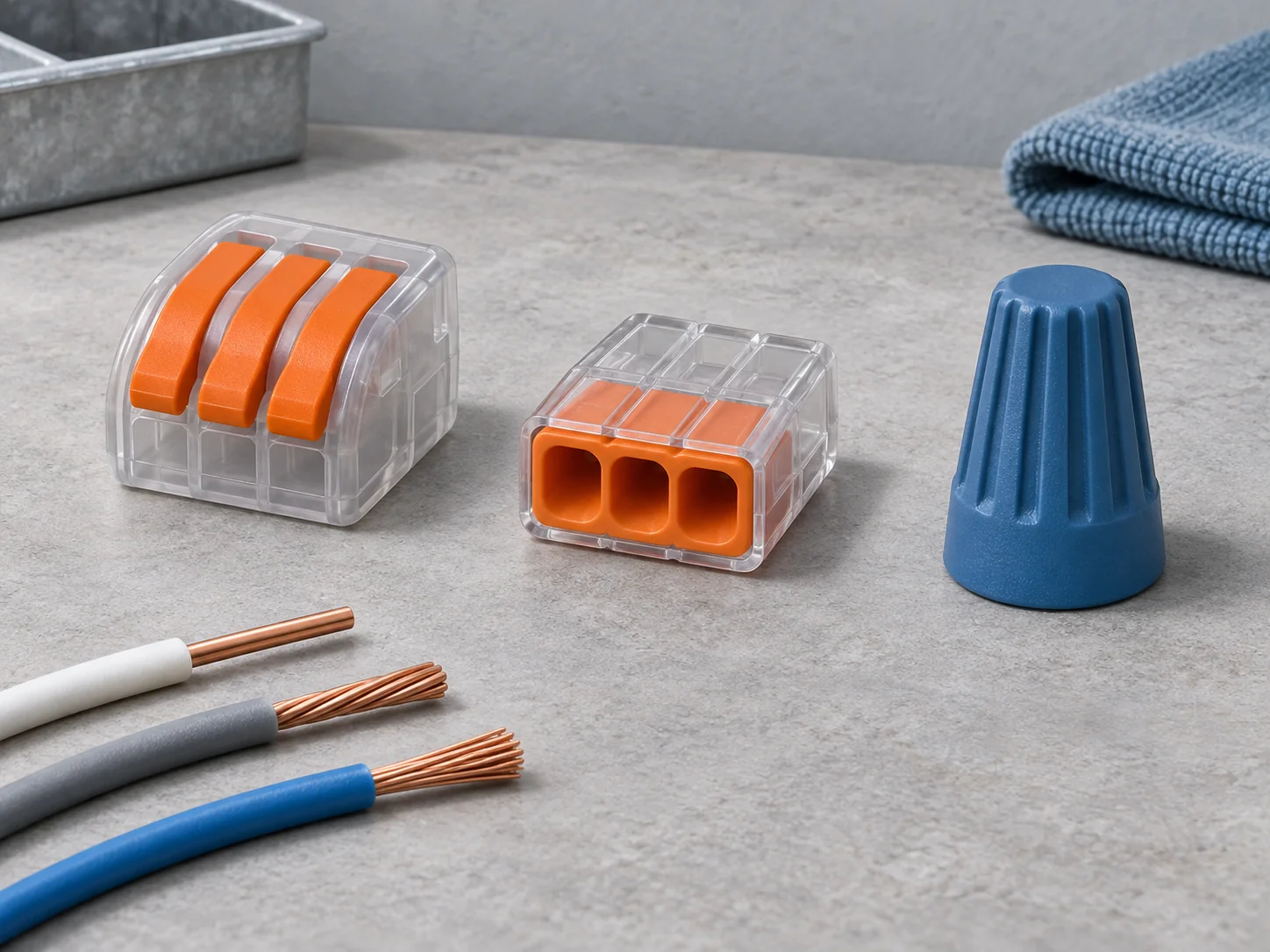
A lever connector opens its clamping mechanism with an operating lever. The conductor is inserted and the mechanism is closed. A push-in splice connector accepts a permitted conductor directly into a spring contact, without a separate lever-opening step. A twist-on connector secures a permitted conductor combination as its body is rotated according to the product instructions.
These are families, not interchangeable specifications. Even products that look alike can have different conductor restrictions. For a broader overview of other joining methods, see the types of wire splice connectors.
| Decision | Lever connector | Push-in splice connector | Twist-on connector |
|---|---|---|---|
| Conductor compatibility | Check solid, stranded and fine-stranded permissions | Check particularly carefully; permitted types vary | Verify the listed combination, sizes and conductor types |
| Installation action | Open, insert and close as instructed | Insert an approved prepared conductor | Prepare the approved bundle and rotate as instructed |
| Future alterations | Lever-operated release can be convenient | Removal and reuse depend on the exact product | Removal and reuse depend on the exact product |
| Inspection | Transparent models can help check insertion | Transparent models can help check insertion | Follow the product's inspection and retention instructions |
| Wet use | Requires a suitable documented system | Requires a suitable documented system | Requires a suitable documented system |
The table compares working characteristics, not failure rates. There is no controlled, like-for-like reliability test behind a claim that one whole family is universally safer.
Match the Conductor Before Comparing Convenience
Your shortlist should identify the conductor material, cross-section, construction and number of wires. Solid copper, rigid stranded copper and flexible fine-stranded copper should not be treated as identical inputs. A connector described as suitable for stranded wire still needs its precise limits checked.
For example, WAGO's 221 handling guidance describes solid, stranded and fine-stranded applications. Its separate 2773 guidance describes solid and stranded conductors. That is enough to reject the blanket statement that every push-in splice connector is solid-wire-only. It does not establish that every stranded cable fits every 2773 part.
If your project joins a flexible equipment lead to fixed wiring, start with solid-to-stranded compatibility. Do not add a ferrule or solder the end simply to make an unsuitable conductor fit. Conductor preparation must be permitted for the selected terminal.
When a Lever Connector Makes Sense

A lever design is worth considering when the installation includes different permitted conductor constructions or when planned changes make releasable individual ports useful. Opening one clamping point can allow a conductor to be removed without rebuilding the whole connection, subject to the model's handling instructions.
Think beyond the connector's external dimensions. You need room to operate the levers, route the conductors and close the enclosure without forcing the wiring. An easily operated connector on a bench can become awkward after an accessory is mounted against it.
A transparent housing can assist visual inspection, but it does not prove the circuit has been correctly designed or tested. Check insertion, insulation position and closure using the manufacturer's acceptance criteria. Have the completed installation verified by the responsible electrical professional.
When a Push-In Connector Makes Sense
A push-in design can suit repeated connections where the same approved conductor type and preparation are used consistently. The attraction is a short installation sequence and, for some models, a compact body. Confirm that the actual part meets your enclosure layout before assuming it uses less space.
The term push-in causes confusion because it is applied to different terminal technologies. A dedicated spring-contact splice connector is not automatically equivalent to a device's push-fit termination. Compare actual product documentation, rather than transferring a reputation from one mechanism to another.
For flexible conductors, insertion behaviour matters. If strands splay or the wire will not enter as instructed, stop and reassess compatibility and preparation. Forcing it, trimming away strands or improvising a stiffened end does not create an approved connection.
When a Twist-On Connector Makes Sense

A twist-on connector is a candidate when its documented combination covers every conductor in the splice and the installation team can follow the specified preparation and tightening method. Read the combination chart; a connector's overall gauge range is not permission for every possible bundle within that range.
Pre-twisting is a product-instruction question. Do not turn one manufacturer's allowance or requirement into a universal rule. The same applies to stripped length, alignment of solid and stranded ends, reuse and the final inspection method. The appropriate reference is the exact connector's instructions supplied for your market.
Color is not a substitute for identification. Different brands can use similar colors for different combinations. Keep the part number and instructions available, especially where materials from several suppliers are used on the same project.
Compare Two Realistic Selection Situations
Consider a dry indoor lighting enclosure with a fixed copper conductor and a fine-stranded copper equipment lead. A lever connector documented for both is a practical candidate. A push-in connector may also be considered only if the exact conductor construction is permitted. A twist-on alternative must list the combination. These are selection examples, not approval of an unnamed product.
Now consider repetitive solid-copper connections in a confined enclosure. A compatible push-in connector may simplify the work, while a lever connector may make later alterations easier. Compare enclosure fit, handling access and approved wire arrangements before comparing unit cost. Neither choice removes the enclosure requirements explained in Do Wire Splice Connectors Need a Junction Box?.
What All Three Still Need

Before approving any design, record:
- The precise manufacturer and part number.
- Permitted conductor materials, constructions, sizes and combinations.
- Applicable electrical and temperature ratings for the market.
- Required preparation, inspection and reuse instructions.
- Enclosure, cable restraint and environmental suitability.
Ordinary dry-location connectors do not become wet-location products because they are wrapped in tape. If moisture is expected, use the outdoor splice selection guide and assess the complete assembly. For the overall procurement sequence, see how to choose a wire splice connector.
Frequently Asked Questions
Are lever connectors better than wire nuts?
They can be more convenient for releasable individual connections, but suitability depends on the conductors, product instructions and installation. Compare documented capabilities rather than choosing a universal winner.
Can push-in connectors be used with stranded wire?
Some can. WAGO's 2773 guidance expressly includes solid and stranded conductors. Check the exact part and permitted strand construction; this permission cannot be transferred to every push-in product.
Do you need to twist wires before using a connector?
Follow the selected product's instructions. Lever and push-in splice connectors use prepared conductors at their designated clamping points; twist-on preparation varies. Do not apply one procedure to all three families.
Can you reuse these connectors?
Only where the manufacturer permits reuse and the connector and conductor remain acceptable. A release mechanism does not establish unlimited reuse. Replace parts affected by damage, overheating, contamination or uncertain history.
Technical sources checked 18 November 2026.